
Smart AI Blog Summary
Get a quick blog summary from any of the below LLM's
What You'll Learn
Ongoing coaching for a field sales team tends to be strongest right after onboarding and weakest a year in, once the initial certification push is behind everyone. Reps who were coached closely in their first ninety days often go quiet on structured development after that, even though the market, the product line, and the competitive landscape keep moving.
Managers are not the reason this happens. A manager covering fifteen to twenty reps across a large territory simply cannot sit in on enough calls or run enough live roleplay sessions to keep every rep sharp on every skill, indefinitely.
This piece looks at how AI coaching and role-based learning paths work together to keep development active well past the onboarding window, without requiring managers to personally coach every rep on every skill.
Why Does Ongoing Coaching Get Deprioritized After Initial Onboarding?
Ongoing coaching gets deprioritized because manager time is finite and gets pulled toward whatever is most urgent that week, which is rarely a tenured rep's skill development. New hires get structured attention because there is a fixed onboarding program driving it. Tenured reps rely on ad hoc coaching that competes with everything else on a manager's plate.
Over time, this creates a gap between what a rep was certified on at hire and what they actually need to know a year later, after label updates, new competitors, and shifting objections have changed the conversation.
What Is the Difference Between AI Coaching and a Role-Based Learning Path?
AI coaching is scored, simulated practice on specific conversations, while a role-based learning path is the structured sequence of content and assessments a rep moves through based on their role, tenure, and skill gaps. The learning path decides what a rep needs next. AI coaching gives them a way to practice it and get scored feedback without waiting for a manager to be available.
Used separately, each has a gap. A learning path without practice tells a rep what they should know but never tests whether they can apply it in a live conversation. AI coaching without a learning path gives isolated practice sessions with no connection to what a rep should be working on next.
How Do the Two Work Together Across a Rep's Development Timeline?
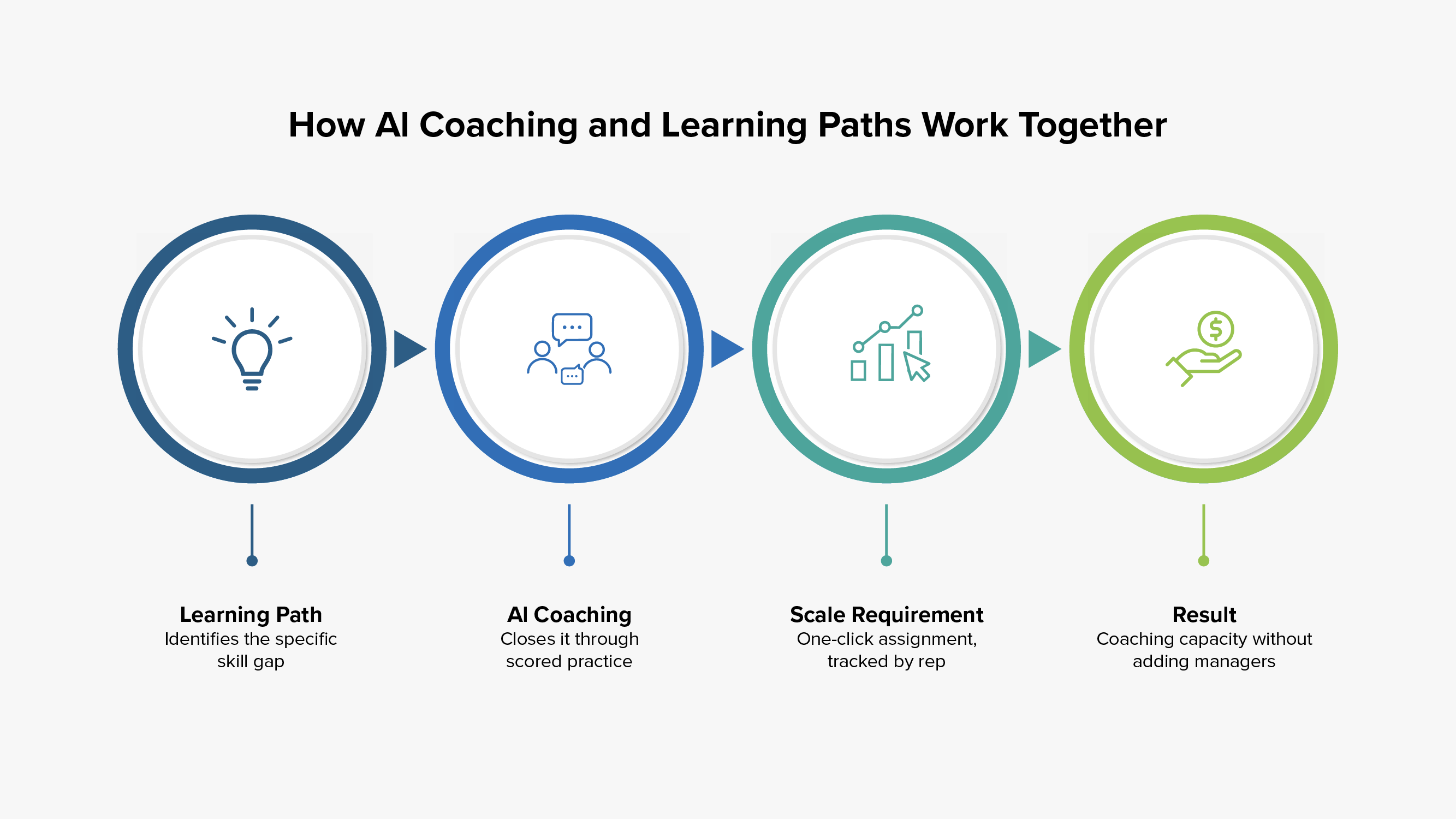
Together, the learning path identifies the skill gap and the AI coaching session closes it, creating a loop instead of two disconnected tools. A knowledge check or manager observation surfaces a specific gap, the learning path assigns the relevant content, and an AI roleplay scenario gives the rep a chance to practice that exact skill until the score holds up.
SmartWinnr customers report a 74 percent increase in rep confidence for complex conversations when this kind of scored practice is built into ongoing development. Confidence gains like this tend to come from repetition on a specific, identified gap, not from generic refresher content.
Consider a regional manager who notices during a joint visit that a tenured rep has started fumbling a competitive objection that used to be a strength. Rather than scheduling a formal retraining session weeks out, the manager assigns a short roleplay scenario on that exact objection directly from the coaching note. The rep completes it twice that week between calls.
What this reveals: closing a skill gap works best when the practice happens immediately after it is identified, not on the next scheduled training cycle.
What Should Managers Look for When Scaling This Across a Large Field Force?
Scaling this loop across a large team depends on whether the platform can assign targeted practice automatically based on identified gaps, rather than requiring a manager to manually build a scenario every time. Three things matter most at scale.
One-click assignment from a coaching note or knowledge check directly into a relevant roleplay scenario or micro-lesson
Individual-level readiness tracking, so gaps are visible by rep and by skill, not just as a team-wide average
Coaching capacity that does not depend on manager headcount, since AI-scored practice can run without a manager present for every session
SmartWinnr customers report 25 times more coaching capacity without adding managers when AI-scored practice supplements live coaching. That capacity gain is what makes ongoing development possible across a large team without proportionally growing the management layer.
How Do You Measure Whether Ongoing Development Is Actually Working?
Ongoing development is working when skill scores trend upward over time at the individual rep level, not just when completion rates stay high. Completion measures participation. Skill scores measure whether the practice actually changed anything.
SmartWinnr customers report a 92 percent reduction in reporting time when readiness and coaching data roll up automatically instead of being compiled manually across a large field team. That time savings tends to get reinvested directly into coaching, which is the piece of this loop that scales worst without support.
This progression from individual coaching toward broader capability building is really about what role-based learning paths make possible at scale: managers directing development strategically instead of personally running every practice session.
Ready to Close the Ongoing Development Gap?
See how AI coaching and role-based learning paths work together to keep development active well past onboarding. Request a demo.
Frequently Asked Questions
Does AI coaching replace manager involvement in ongoing development?
No. AI coaching handles the repetition and scoring that a manager cannot personally provide for every rep on every skill. Managers still direct what gets practiced and review the results, focusing their limited time on the highest-value coaching conversations.
How often should tenured reps go through structured learning paths?
There is no universal cadence, but most organizations trigger a new path segment whenever a product update, competitive shift, or identified skill gap warrants it, rather than only at fixed annual intervals.
What is the risk of relying only on completion rates to measure development?
Completion rates show participation, not competence. A rep can complete every assigned module and still perform inconsistently in the field if the content was never tested through scored practice.
Can this approach work for a field force without dedicated regional managers?
Yes. Because AI-scored practice does not require a manager to be present for every session, it reduces the dependency on manager availability that ongoing coaching typically requires.
How is a skill gap identified before assigning a learning path or coaching session?
Skill gaps are typically identified through knowledge check scores, roleplay performance, or direct manager observation during field visits, then addressed by assigning targeted content or practice tied to that specific gap.
Disclaimer: This content reflects industry practices and does not constitute medical, legal, or regulatory advice.
Last Updated: