
Smart AI Blog Summary
Get a quick blog summary from any of the below LLM's
What You'll Learn
Most pharma commercial launches do not struggle because the product is weak. They struggle because the field team was prepared for the training environment, not the field environment. Representatives who performed well in boot camp find themselves hesitating when a specialist cardiologist challenges a trial endpoint in a way the training scenarios never quite captured.
A regional manager discovers two weeks post-launch that half their team is defaulting to the same three talking points because those are the ones they practiced, and the others never felt solid enough to use under pressure.
This is not a knowledge problem. It is a practice problem. And simulation-based training is the mechanism that addresses it, not by adding more content, but by changing what representatives do with the content they already have.
This article explores how simulation-based training platforms support biotech launch readiness, what effective scenario design looks like in this context, and how organizations can structure their certification and ongoing readiness programs to sustain what they build before launch day.
The Real Reason Launch Readiness Breaks Down in the Field
Ask any seasoned pharma sales leader what the first sixty days after a launch actually look like and most will tell you the same thing. The representatives who attended every training session and scored well on assessments are not necessarily the ones performing consistently in the field.
Meanwhile, representatives who struggled during boot camp occasionally surprise everyone once they have had enough real conversations to build confidence.
The gap between training performance and field performance is not random. It is structural. Traditional launch preparation front-loads information and under-invests in practice. A representative who has attended four days of product training and completed the required modules has been exposed to the content.
They have not yet developed the fluency to deliver it under the conditions of an actual specialist interaction, where the physician is distracted, skeptical, or asking a question that does not map neatly onto any of the scenarios covered in training.
The research on this is consistent. Knowledge acquired through passive exposure decays rapidly without application. Within two weeks of a training event, representatives who have not actively practiced applying what they learned retain a fraction of what they were exposed to.
In a regulated commercial environment where precise, compliant messaging is a legal requirement, that decay has consequences that go beyond performance.
What Pharma and Biotech Launches Demand
A first commercial launch in pharma or life sciences is a categorically different training challenge from a line extension or an established product relaunch. Consider what a rep faces in week one of a novel biologic launch targeting academic oncology centers.
The oncologist across the table may have reviewed the pivotal trial data in a journal club before the representative arrived. They have questions about the patient selection criteria that go deeper than the approved indication language covers. They want to understand how the mechanism compares to an emerging competitive approach they read about in a conference abstract.
And they are evaluating not just the product but whether this representative is worth their time in future interactions.
Standard training programs prepare representatives for the product. They rarely prepare them for that conversation at that level of depth and under that kind of pressure. The representative needs to have navigated a version of that interaction before they walk into it.
Not once in a training room with a manager playing the role of a distracted specialist, but multiple times, with feedback, in scenarios that reflect the real clinical and access landscape of their specific territory.
That is what simulation-based training at the right depth delivers. Not a rehearsal of approved talking points, but genuine practice in the conditions that matter.
The Scenarios That Actually Matter, and Why Most Programs Miss Them
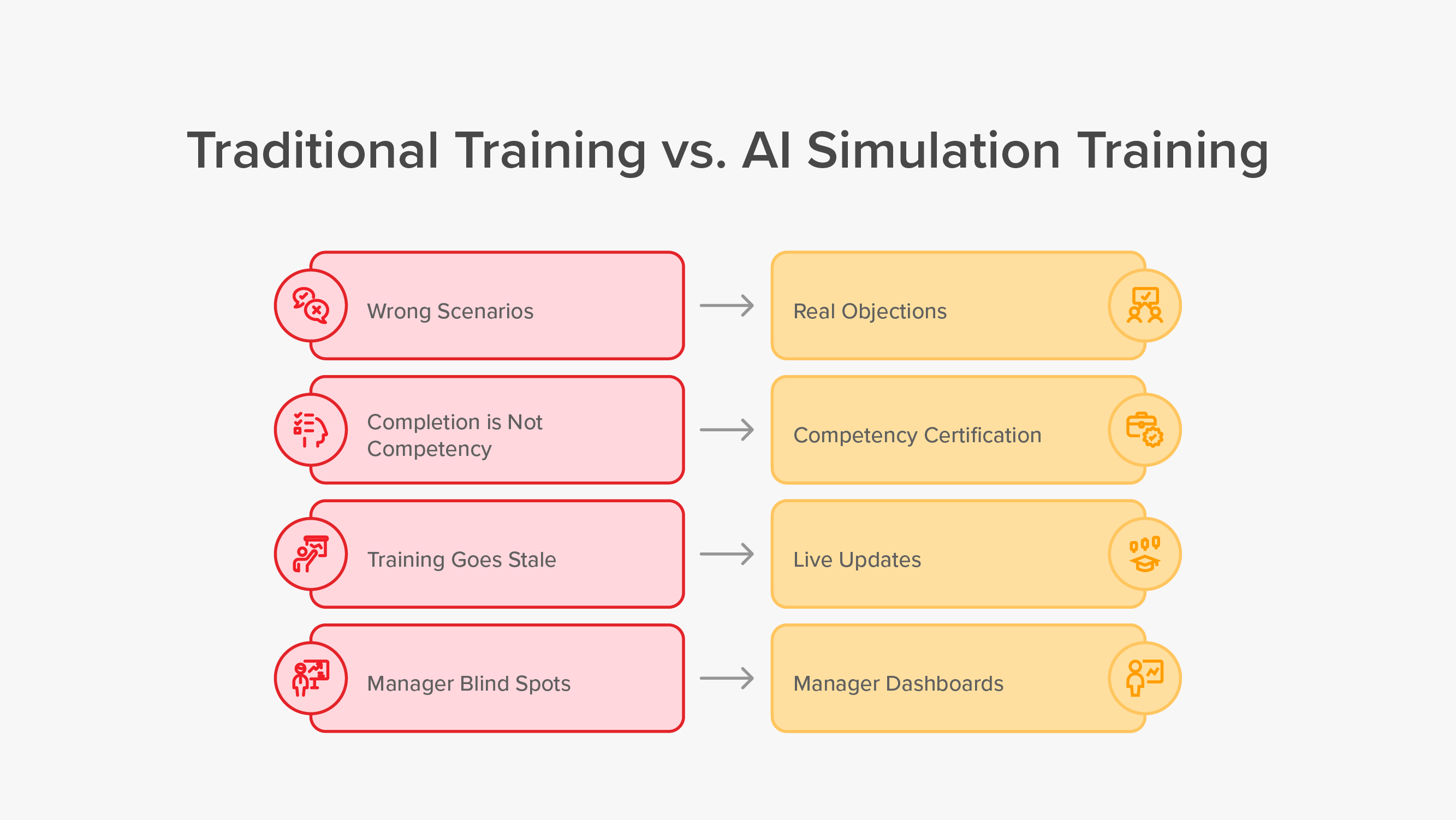
The scenarios that most commonly determine launch success are not the ones that make it into standard training programs. They are the ones that feel too specific, too edge-case, or too difficult to design well in the time available before a launch deadline.
The result is that training programs cover the expected conversations and under-prepare representatives for the ones that create the most field pressure.
In practice, the scenarios that matter most in a pharma or life sciences launch tend to cluster around a few high-stakes interaction types. The KOL engagement in an academic center where the physician has read the data more carefully than most representatives have.
The formulary discussion with a P&T committee member who wants to understand how the product fits into an already crowded formulary.
The access conversation with a practice manager who has heard from three other representatives this month and is skeptical about support claims. The second or third call with a physician who was interested at first contact but has since heard something from a colleague that changed their perception.
Each of these scenarios requires a different communication skill set and draws on different areas of knowledge. A representative who has only practiced the introductory product conversation is not prepared for any of them.
Building scenario libraries that cover this full range, developed with input from medical affairs, market access, and experienced field leaders who know what the actual objection landscape looks like, is the difference between a simulation program that produces field-ready representatives and one that produces representatives who are confident in training and uncertain in the field.
What Happens When Certification Measures Completion Instead of Competency
This is a pain point that most pharma training leaders recognize immediately. A representative completes every required module, passes every assessment at the threshold score, receives their certification, and is cleared to launch.
Three weeks later, their manager is on a joint field visit watching them freeze when a specialist asks why the overall survival data from the Phase 3 trial was not statistically significant.
The representative knew the answer. It was in the training. But knowing something and being able to retrieve it accurately and communicate it clearly under the pressure of a live interaction with a skeptical specialist are different competencies, and completion-based certification measures only the first.
Certification that incorporates AI-powered roleplay simulations, evaluated against weighted rubrics that reflect both knowledge accuracy and compliance alignment, measures something closer to actual field readiness.
A representative who can navigate a challenging specialist objection in a simulation that adapts to their responses in real time has demonstrated a meaningfully different level of preparation than one who completed a module and answered multiple choice questions about the same content.
The practical implication for launch preparation is that certification timelines should build in sufficient practice and re-assessment time for representatives who do not meet the rubric threshold on their first attempt.
Deploying representatives who have completed training but not demonstrated communication readiness is a predictable source of the first-sixty-day performance variability that most launch teams experience.
Sustaining Readiness When the Market Moves After Launch
Here is the scenario that plays out in almost every pharma launch. The organization invests heavily in pre-launch preparation. Representatives arrive at launch week with strong knowledge scores and reasonable simulation performance.
Then six weeks into the commercial period, a competitor publishes a head-to-head study that gets attention at a major congress. Formulary decisions start coming in from regional P&T committees, some favorable, some not, and each one changes the access conversation representatives need to have. A new safety signal gets added to the label.
The field team is now operating in a market that looks materially different from the one they trained for, and the training program has not been updated.
This is where static pre-launch training programs fail most visibly. They treat launch readiness as a fixed state rather than an ongoing requirement.
Sustaining readiness through the commercial period means building the infrastructure to deploy updated simulation scenarios quickly when messaging guidance changes, run targeted knowledge reinforcement campaigns aligned with new clinical data, and give managers continuous visibility into team readiness trends so they can intervene before individual gaps compound into regional performance issues.
The organizations that manage this well treat the training platform as a live operational tool throughout the commercial lifecycle, not a pre-launch preparation infrastructure that gets mothballed after day one.
The Manager Visibility Problem Nobody Talks About
Regional managers in pharma launches are expected to coach their teams through the highest-pressure period of the commercial cycle while simultaneously managing their own territory relationships, reporting obligations, and launch activity calendars. The expectation that they will have current, accurate visibility into the readiness of each representative on their team through field observation alone is not realistic.
A manager who does not have data about where their team's simulation performance gaps are will default to coaching the representatives they spend the most time with, or the ones whose gaps are most visible in field ride-alongs. This is not bad management. It is the predictable consequence of trying to allocate coaching attention without the information needed to allocate it well.
When managers have access to AI roleplay performance data showing which scenarios are generating consistent difficulty across their team, which representatives are meeting certification thresholds and which are not, and how individual performance trends are moving over time, their coaching becomes fundamentally more targeted. They stop distributing coaching time uniformly and start directing it where the data indicates it will have the most impact. In a launch preparation period where every week matters, that efficiency is not incremental. It is significant.
How SmartWinnr Supports Pharma and Life Sciences Launch Training
SmartWinnr Platform is built for the regulated commercial environment that pharma and life sciences launches operate in, bringing together AI roleplay simulations, knowledge reinforcement, and readiness analytics in one platform.
Two-Way AI Roleplay for Launch Practice
Scenarios are built from the organization's own approved clinical content, talk tracks, and messaging frameworks, configured to reflect the specific therapy area, indication, and objection bank of the launch.
Every session is scored automatically against weighted rubrics, with representatives seeing their score, a full transcript, and missed-statement flags immediately after each session.
Practice volume accumulates before launch day, giving representatives genuine conversational experience with the customer profiles and objection types they will encounter in the field.
Knowledge Reinforcement Between Training Events
Targeted, bite-sized content on clinical data, competitive intelligence, and product knowledge is delivered through a mobile-first interface that fits into the representative's field schedule.
When a label update is issued or new clinical data changes the conversation, updated content can be pushed to the entire field team rapidly without rebuilding the training program.
AI-driven quizzes reinforce retention of clinical and compliance knowledge between formal training events, keeping knowledge current through the full launch preparation period.
Manager Visibility Throughout the Pre-Launch Period
Real-time dashboards surface performance trends, readiness scores, and coaching impact across individuals, teams, and regions.
Regional managers see exactly where to direct coaching time rather than distributing it uniformly across a team with very different preparation profiles.
Early identification of knowledge gaps and simulation performance patterns allows managers to intervene before readiness issues carry into the field.
Accessible Across Every Device
Runs seamlessly on mobile, tablet, and web with full feature availability across all device types with truly allowing reps to practice: Anywhere, Any time.
Sales reps can engage with simulations and reinforcement between formal training events, during travel, and across the full preparation period leading into launch day
The mobile experience is designed for field conditions, not just office use, supporting consistent engagement regardless of connectivity or location
Explore SmartWinnr: Request a demo to explore how SmartWinnr supports pharma and life sciences commercial launch readiness through simulation-based training, structured certification, and ongoing field reinforcement.
Disclaimer: This content reflects industry practices and does not constitute medical, legal, or regulatory advice.
Last Updated: