
Smart AI Blog Summary
Get a quick blog summary from any of the below LLM's
What You'll Learn
At some point, every medical device sales leader asks a version of the same question. The reps know the device. The training programs are well designed. The managers are experienced. And yet field performance is inconsistent, new hire ramp time is longer than it should be, and coaching quality varies too much from one territory to the next.
The answer, often, is not more training content. It is better practice infrastructure.
Interactive sales coaching and roleplay solutions have become one of the most significant investments in medical device commercial enablement over the past several years. The category has matured quickly and the best platforms available today are genuinely different in capability and sophistication from what was available even three years ago.
But not all solutions are built for the specific demands of medical device selling. The clinical complexity, multi-stakeholder buying environment, IFU compliance requirements, and hospital credentialing landscape create a very specific set of needs that generic sales training tools were not designed to address.
This guide covers what leading solutions look like for medical device teams, what capabilities matter most in this environment, and how to evaluate a solution before committing.
Why Interactive Coaching and Roleplay Have Become a Commercial Priority in MedTech
The case for interactive coaching and roleplay in medical device is not complicated. A rep who has practiced navigating a value analysis committee preparation ten times before doing it for real is better prepared than one who encounters it for the first time in a live account. A rep who has rehearsed a competitive clinical evidence challenge with a skeptical surgeon persona is more confident in the OR than one who has only read about how to handle it.
What has changed in recent years is the scale at which that practice can now happen. A field force of three hundred reps used to rely entirely on manager-led roleplay, which meant practice quality varied by territory, by manager coaching skill, and by how much bandwidth a manager had in a given week. That variability produced uneven field performance that was difficult to diagnose and harder to fix consistently.
According to McKinsey's research on medtech commercial capabilities, companies with the most advanced commercial capabilities achieved CAGR 1.4 times higher than those with average commercial capabilities, directly linking the quality of frontline commercial execution to growth performance at a sector level.
That commercial capability gap does not close through product knowledge programs alone. It closes through field teams that can perform consistently in the complex, multi-stakeholder, compliance-sensitive conversations that define medical device selling. Interactive coaching and roleplay solutions are what give those conversations a practice environment that scales.
What Separates a Leading Solution from a Generic Tool in Medical Device
The market for sales coaching and roleplay platforms has grown significantly. There are now dozens of tools offering some version of AI-powered practice, simulated conversations, and coaching dashboards. The challenge for medical device commercial leaders is that most were built for general B2B sales environments, and the differences matter considerably in this industry.
A leading solution for medical device is not defined by the number of features it offers. It is defined by how well it handles the specific demands of the environment it will be deployed in.
Three things stand apart immediately when evaluating solutions for this industry.
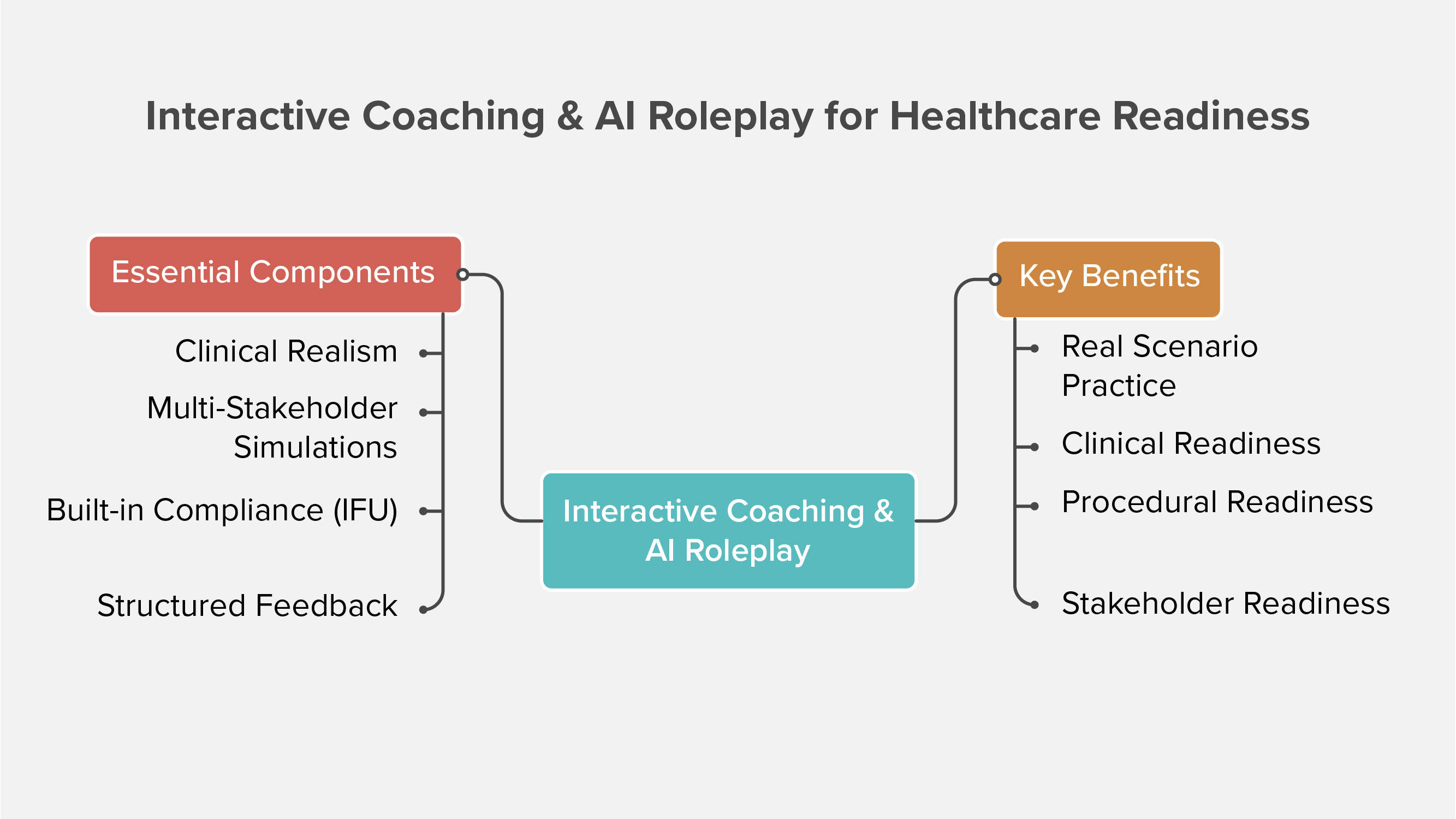
IFU and compliance integration built into practice, not bolted on. Generic roleplay tools can simulate a sales conversation. What they cannot do is enforce IFU language compliance within the simulation itself. A leading solution for medical device flags off-label language in real time during practice, enforces approved messaging within the scenario, and generates auditable records of every practice session. These are not optional features in a regulated environment.
Clinical and procedural realism in the simulated persona. A simulated buyer in a generic sales tool asks about pricing, features, and timing. A medical device-specific simulation asks about procedural outcomes, IFU indications, complication management, and clinical evidence hierarchy. The closer the simulation is to a real clinical conversation, the more the practice transfers into genuine field readiness.
Multi-stakeholder scenario capability. Medical device deals involve multiple stakeholders with different priorities who do not always communicate with each other. Leading solutions can expose reps to the reality of navigating a surgeon, a procurement director, and a clinical champion in the same account, building the institutional selling intelligence that single-stakeholder simulations cannot develop.
The Capabilities That Matter Most for Medical Device Sales Teams
When commercial excellence leaders in medical device evaluate interactive coaching and roleplay solutions, the conversation often starts with features and pricing. The right conversation starts with outcomes and then works backward to the capabilities required to deliver them.
For medical device teams specifically, five capabilities consistently determine whether a solution delivers real commercial impact or sits underused after the initial rollout.
Clinically grounded AI roleplay with dynamic responses. The simulation needs to feel real enough that the rep is genuinely practicing, not performing. An AI persona that challenges a vague clinical claim, escalates if a rep makes an off-label statement, and mirrors the time pressure of a real OR or procurement conversation produces practice that transfers to the field. A scripted simulation does not.
Structured feedback tied to specific observable behaviors. Feedback that says "needs improvement on clinical objection handling" does not develop skills. Feedback that says "you acknowledged the surgeon's evidence question but moved to a feature benefit before referencing the clinical outcomes data" gives the rep something specific to work on immediately.
IFU compliance scoring built into the rubric. Every medical device company has required disclosures, approved language, and prohibited claims that must be maintained in every field interaction. A leading roleplay solution builds those criteria into the scoring rubric and flags deviations in real time, making every practice session a compliance reinforcement exercise as well as a skill development one.
Manager visibility into territory-level readiness patterns. AI simulations generate intelligence that manager observation alone cannot produce. Which reps are progressing on clinical depth conversations. Where competitive objection handling is consistently weak across a region. Which new hires are approaching independence, and which need more structured practice. That intelligence makes coaching conversations targeted rather than generic.
On-demand mobile access for field teams. Medical device reps spend their days in hospitals, surgical suites, and clinical offices. A solution that requires desktop access or scheduled training sessions does not fit how they work. Leading solutions are accessible on any device, on demand, in the rep's workflow rather than separate from it.
How to Evaluate a Solution Before You Commit
The evaluation process for interactive coaching and roleplay solutions is where many medical device organizations make avoidable mistakes. They focus on demos, pricing tiers, and feature checklists without asking the questions that would reveal whether the solution will actually work in their specific commercial environment.
Three questions matter most before committing to any solution in this space.
Does the simulation reflect our actual device category and clinical stakeholder?
Ask the vendor to build a scenario using your specific device, your specific indication, and a clinical persona that reflects the stakeholders your reps actually engage with. Then run it. If the simulation feels generic, if the AI persona does not know how to engage with the specific procedural context of your device category, or if the objections raised are transactional rather than clinical, the practice value will be limited regardless of how polished the platform interface looks.
Can IFU compliance requirements be built into the scoring, not just reviewed after the fact?
This is a question that generic platforms consistently struggle to answer satisfactorily. Ask specifically how approved messaging language is enforced within the simulation, how off-label language is flagged, and what the audit trail looks like for each session. If the answer involves manual transcript review after the fact, that is a significant operational gap for a regulated medical device organization.
How does this solution make our managers better coaches, not just our reps better practitioners?
The platforms that deliver the most durable commercial impact are the ones that change how managers coach, not just how individual reps practice. Ask to see the manager dashboard. Ask how it surfaces coaching priorities by rep and by territory. Ask how it connects simulation data to field observation and coaching conversations. If the answer is primarily rep-centric with no clear path to structured manager action, the solution may improve individual practice but will not transform team performance.
For medical device organizations serious about choosing a solution that will genuinely move field readiness and commercial capability, these three questions will tell more than any feature comparison ever will.
How SmartWinnr Leads in Interactive Sales Coaching and Roleplay for Medical Device
SmartWinnr platform combines AI roleplay, microlearning, gamification, and field coaching in a single platform designed for large, distributed field forces operating across multiple device categories, therapeutic areas, and geographies.
Reps practice real conversations with simulated surgeons, procurement directors, OR coordinators, and value analysis committee contacts. IFU compliance guardrails are built into every simulation. Approved messaging is enforced within the practice environment itself. Every session generates an auditable record that compliance and training teams can access when needed.
Managers get clear visibility into readiness across their teams, from individual rep progress to territory-level patterns to regional trends that inform coaching priorities. Simulation data connects directly to coaching conversations, making those conversations sharper, faster, and more grounded in evidence than observation alone ever could produce.
Learn how top organizations in the medical device industry are using SmartWinnr to turn interactive coaching and roleplay into a consistent driver of field readiness and commercial performance.
Or you can Request a demo to see SmartWinnr in action for your medical device sales team:
Disclaimer: This content reflects industry practices and does not constitute medical, legal, or regulatory advice.
Last Updated: