
Smart AI Blog Summary
Get a quick blog summary from any of the below LLM's
What You'll Learn
The classroom has been the centerpiece of pharma sales training for decades and for good reason. NSMs, POA events, and launch boot camps do things that no digital tool can fully replicate they align entire field organizations around a brand narrative, deliver MLR-reviewed content to hundreds of reps at once, and create the shared experiences that build team culture and motivation.
But the classroom has a structural limitation that has always existed and is now more commercially consequential than ever. It happens a few times a year, and HCP conversations happen every day.
The knowledge and conversational fluency that training events build begins to erode almost immediately after the event ends. In 2026, leading pharma commercial and L&D leaders are building an always-on enablement model that extends NSM and launch training into the daily rhythm of field work without replacing what the classroom delivers best. Read on to see how.
What Classroom Training Does Exceptionally Well in Pharma
Before describing how the enablement model is evolving, it is important to be clear about what classroom training does that no other format can match. The evolution happening in 2026 is additive, not replacement. The most effective pharma organizations are using AI-powered continuous enablement to extend and sustain what classroom training builds not to substitute for it.
The irreplaceable functions of classroom training in pharma include:
Delivering MLR-reviewed content at scale. The entire field organization receives accurate, authorized information from the same source at the same time. There is no faster or more reliable way to align a large field team on a compliant brand narrative.
Building brand culture and team alignment. The social and experiential elements of NSMs and POAs create the motivation, shared identity, and team cohesion that drive field performance over the long term. These cannot be replicated in a module.
Providing compliance certification and regulatory documentation. The non-negotiable baseline every pharma field team member must have before field deployment. Classroom-based certification remains the standard for regulatory documentation in most markets.
Delivering foundational scientific and clinical education. The depth of product knowledge that launches require and that everything else in the field readiness journey builds on. Complex clinical science needs facilitated instruction, not just self-paced content.
Creating facilitated role play and group coaching experiences. Early conversation practice in a collaborative, manager-led environment that builds initial confidence and team-level messaging alignment before rep's head into the field.
Where Continuous AI-Powered Enablement Extends the Classroom
The limitations of classroom training are not failures of design. They are inherent to the format. A classroom event is a moment in time. Field performance is continuous.
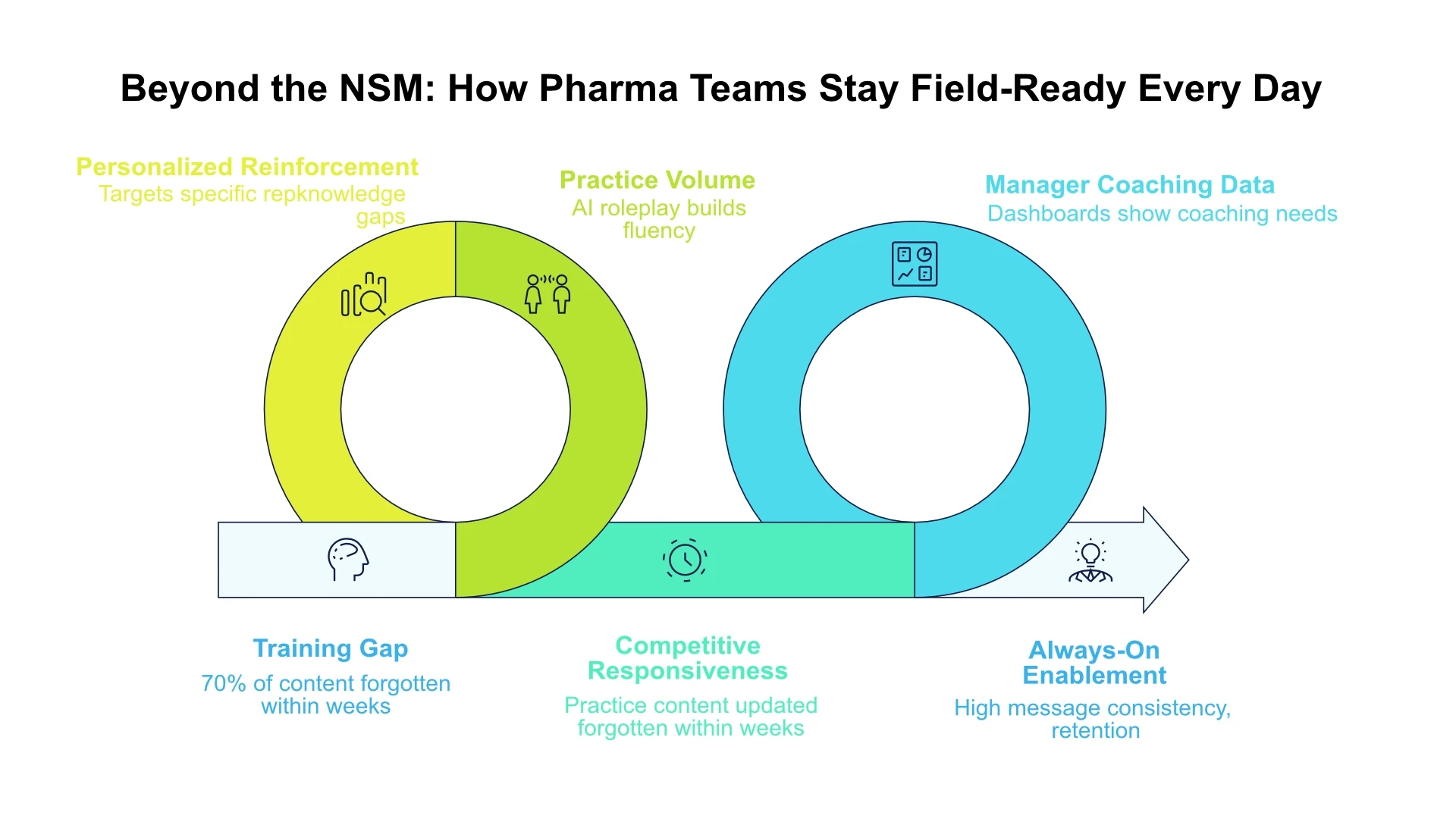
Research consistently shows that without structured reinforcement, up to 70% of training content is forgotten within weeks of the initial event. That gap between what reps learned at the last NSM and what they need to recall in front of an HCP today is exactly what continuous AI-powered enablement is built to close.
The most effective pharma enablement models in 2026 have built an always-on practice and reinforcement layer that extends what the classroom builds into the daily rhythm of field work.
Practice volume between events. AI roleplay provides the conversation repetitions that classroom time simply cannot accommodate. Every rep gets the practice they need to build genuine fluency not just event-day familiarity. Teams using structured AI roleplay programs between training events report 30% faster product launch readiness compared to classroom-only preparation.
Personalized reinforcement. Scenario libraries can be tailored to individual rep development areas based on manager coaching observations and AI practice performance data. Reinforcement becomes targeted rather than generic each rep works on the specific gaps that are slowing them down in the field.
Competitive and formulary responsiveness. Practice content can be updated within days of a market development, keeping reps practiced on the conversations they are actually having in their territories not the conversations they rehearsed six weeks ago at the last training event.
Manager coaching data. Readiness dashboards surface which reps are engaging with practice content and how their performance is developing between events. Managers get the information they need to allocate coaching time where it will have the most impact before a problem becomes visible in the field.
How Pharma Enablement Models Are Evolving in 2026
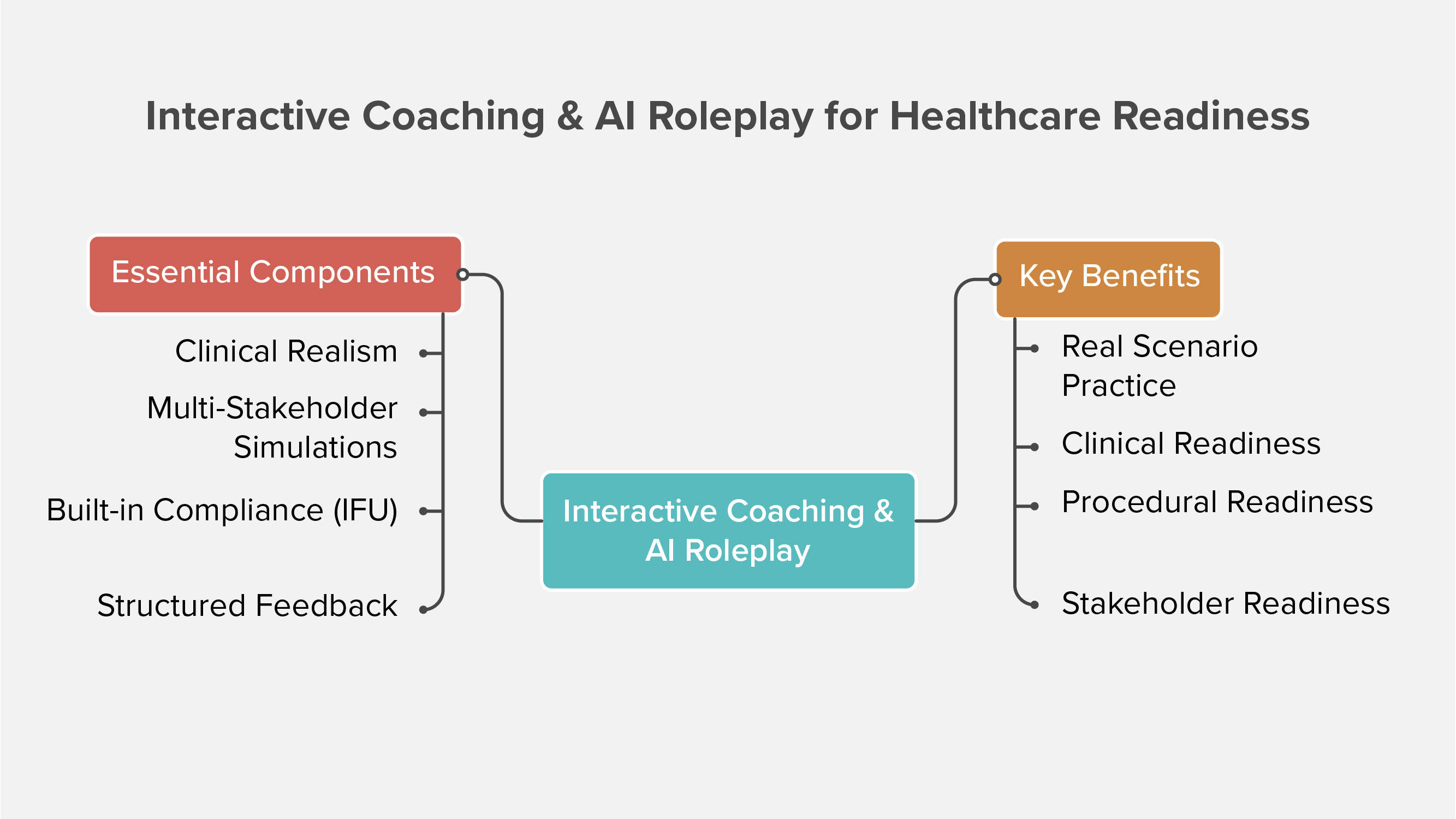
The most sophisticated pharma enablement models in 2026 are built around three integrated components that work together to create a continuous, connected readiness ecosystem rather than a series of disconnected training events separated by long periods of unsupported field activity.
Hybrid Training Event Formats
The large-format training event remains central, but its role is evolving. The most effective organizations are using NSMs and POAs more strategically as the anchors of a continuous enablement program rather than standalone delivery mechanisms.
NSM and POA events should focus on the experiences that work best in live, facilitated environments: culture-building, brand alignment, compliance certification, and foundational clinical education. These are the moments that only happen in the room.
AI roleplay scenario packs deployed immediately after these events help convert newly acquired knowledge into practiced conversational fluency. Teams using structured post-event AI practice report 30% faster launch readiness and 90% message consistency during critical rollouts two outcomes that classroom training alone rarely sustains beyond the first few weeks.
Pre-event preparation modules allow reps to arrive at NSMs with foundational product knowledge already established, freeing live event time for the high-value collaborative experiences that instructor-led sessions deliver best.
Continuous Microlearning Integration
Between training events, the most effective pharma enablement programs maintain knowledge currency and conversational skill through structured microlearning formats designed for field use.
Daily or weekly practice bursts lasting just a few minutes keep reps aligned to changing territory priorities, evolving competitive dynamics, and the conversation scenarios they are most likely to face on their next HCP call. Short enough to fit between calls. Specific enough to matter.
Spaced reinforcement keeps critical clinical details, approved messaging, and objection-handling approaches fresh over time. Teams using spaced reinforcement between training events report up to 70% improvement in knowledge retention compared to single-event training formats the difference between content that sticks and content that fades by the next quarter.
Personalized microlearning assigned by managers allows reinforcement to focus on the specific coaching gaps observed during field interactions. Development becomes immediately relevant rather than calendar-driven.
AI-Augmented Manager Coaching
One of the most important shifts in pharma enablement in 2026 is the growing use of AI practice insights within manager coaching. Instead of relying primarily on intuition or occasional field observation, managers can now coach using structured readiness data tied to real practice behavior.
Manager dashboards provide visibility into individual readiness patterns from AI roleplay practice. Managers can identify preparation gaps with greater consistency and objectivity before those gaps show up in a field visit or a lost prescription.
Coaching conversations become more focused because scenario performance data highlights the specific communication behaviors, objection-handling patterns, and clinical discussion areas where each rep needs support. Less time diagnosing. More time developing.
Assigned AI practice scenarios extend coaching beyond verbal feedback, giving reps structured opportunities to apply coaching guidance through repeated practice between manager visits.
Teams running AI-augmented coaching programs report up to 25x more coaching capacity without adding headcount freeing managers to focus on the conversations that only a human can lead.
How SmartWinnr Supports Evolving Pharma Enablement Models
SmartWinnr is built to complement and extend the impact of classroom training programs in pharma. The platform provides the practice infrastructure that keeps NSM and launch training content alive in the field through structured AI roleplay scenarios, microlearning, and manager coaching tools that work between training events, not just during them.
For pharma commercial and L&D leaders building next-generation enablement models, the outcomes are measurable: 90% message consistency during critical launches, 70% improvement in clinical knowledge retention, and 500+ trainer hours saved per month through automated AI assessments.
Scenario libraries are aligned to NSM content, launch phases, and competitive landscape developments ensuring AI roleplay practice reinforces the content built in formal training rather than working against it. Microlearning modules are designed for the daily rhythm of pharma field teams, accessible on mobile between HCP calls. Compliance-aware AI feedback ensures every practice session reinforces approved messaging, not accidental habits built between training events.
For pharma organizations looking to build continuous, compliance-aware field readiness at scale, SmartWinnr is helping shape the next generation of enablement.
Request a demo to see how AI roleplay, structured coaching, and compliant skill reinforcement work together to keep your field teams confident and prepared every day not just after the NSM.
Frequently Asked Questions
What is pharma sales enablement and how has it changed in 2026?
Pharma sales enablement is the practice of preparing field teams to have compliant, confident conversations with HCPs at every stage of the product lifecycle. In 2026 it has moved beyond classroom-only models. Leading organizations now combine NSM and POA training with AI roleplay, microlearning, and manager coaching tools that sustain rep readiness every day between events not just in the weeks following a training session.
Why can't classroom training alone keep pharma reps field-ready?
Classroom training builds the foundation every pharma field team needs. The limitation is time NSMs and POAs happen a few times a year while HCP conversations happen every day. Without structured reinforcement, up to 70% of training content is forgotten within weeks. AI-powered practice and microlearning close the gap between training events and daily field activity, keeping reps sharp between sessions.
How does AI roleplay support pharma sales enablement between NSMs?
AI roleplay lets reps practice approved HCP conversations, objection handling, and clinical messaging between training events without needing a trainer or manager present every time. Reps get instant scored feedback on tone, empathy, and compliance accuracy after every session. Teams using structured AI roleplay programs report up to 30% faster product launch readiness and 90% message consistency during critical rollouts.
How do pharma managers use AI practice data to coach their teams?
Instead of relying on occasional field observation, managers get readiness dashboards that show which reps are practicing, how their scores are trending, and which specific communication behaviors need attention. That data focuses coaching conversations on real gaps rather than general impressions. Organizations using this model report up to 25x more coaching capacity without adding headcount.
What is spaced reinforcement and why does it matter in pharma sales training?
Spaced reinforcement delivers short knowledge reviews at timed intervals after the initial training event. It works with how memory is built repeated low-stakes exposure over time improves retention far more effectively than a single high-intensity training session. For pharma teams managing complex clinical data and approved messaging, spaced reinforcement through microlearning improves long-term knowledge retention by up to 70%.
Disclaimer: This content reflects industry practices and does not constitute medical, legal, or regulatory advice.
Last Updated: