
Smart AI Blog Summary
Get a quick blog summary from any of the below LLM's
What You'll Learn
Enterprise sales organizations invest heavily in enablement. Product certifications are completed. Playbooks are distributed. Learning platforms reflect strong participation and coverage. From a reporting perspective, readiness appears well established.
However, field execution can still vary.
Conversations may differ in structure across regions. Messaging may be interpreted with slight variations. Complex discussions - such as pricing or objections - may be handled with differing levels of clarity.
In many cases, the gap is not knowledge. It is confidence.
In complex sales environments, confidence is not a personality trait. It is an execution capability.
What Is Sales Conversation Confidence
Sales conversation confidence refers to a rep’s ability to apply knowledge clearly, calmly, and consistently during live interactions. It is not about persuasion or personality. It is about executing structured, relevant, and compliant conversations under real-world conditions.
Confidence ensures that knowledge is not only understood, but usable especially when conversations become dynamic and time-constrained.
Strengthening Field Execution Through Confidence
Traditional training programs remain essential. Workshops and structured learning help sales teams understand product positioning, compliance expectations, competitive differentiation, and process frameworks. These programs create alignment at scale.
However, understanding content does not automatically translate into confident execution.
When conversations become unpredictable, the ability to recall information, structure responses, and communicate clearly in real time becomes critical. Confidence enables this transition from knowledge to execution.
How Confidence Is Built at Scale
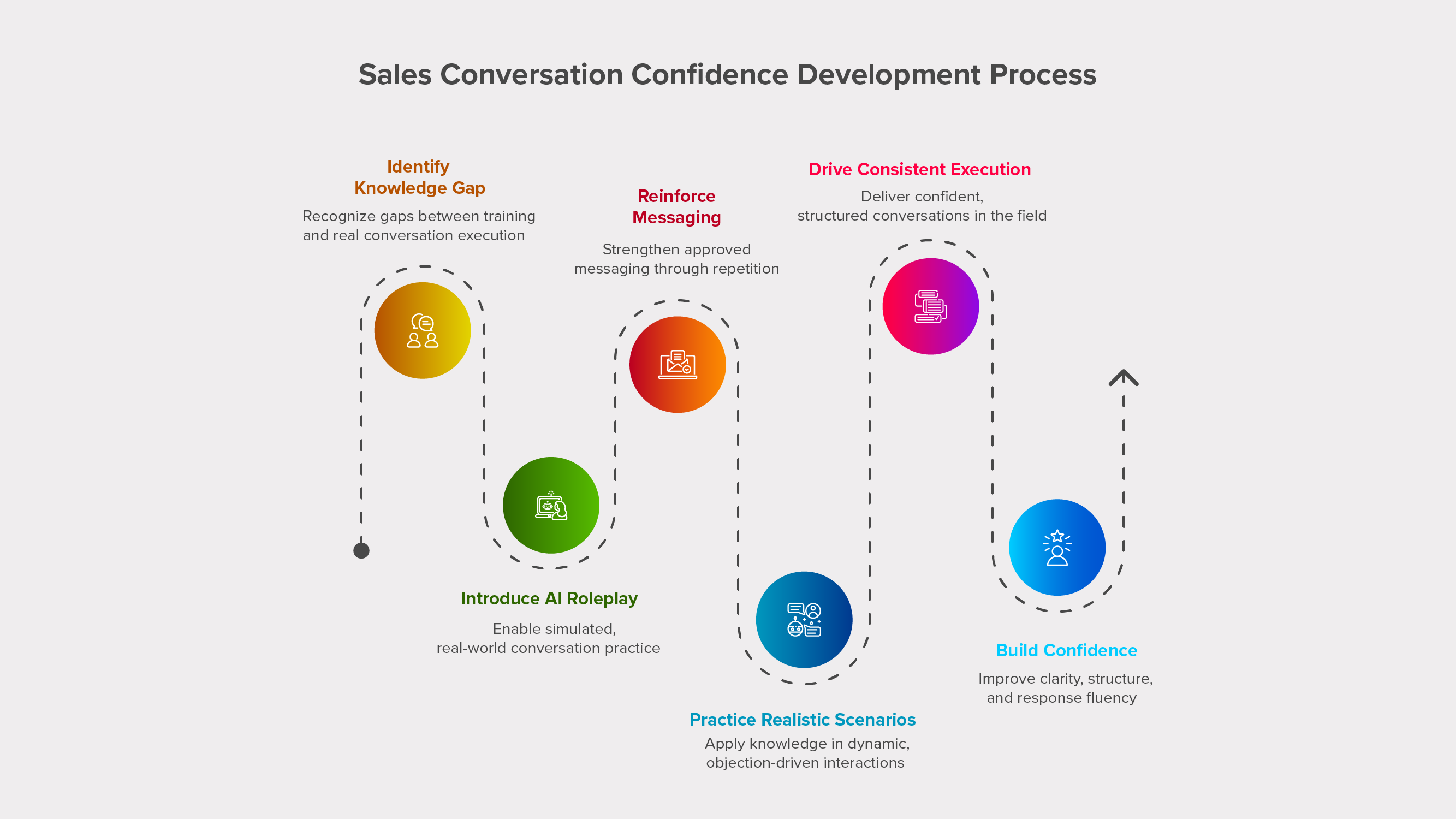
Confidence develops through structured application over time. Leading organizations focus on three key elements:
Exposure: Practicing realistic conversation scenarios
Repetition: Reinforcing responses across multiple situations
Feedback: Providing consistent, objective guidance
Together, these elements create familiarity and fluency. Over time, this fluency supports confident and consistent execution across teams.
Research from Gartner highlights that high-performing sales organizations prioritize reinforcing seller behaviors that directly influence customer interactions. Structured practice and coaching play a key role in improving how knowledge is applied in live conversations.
In complex sales environments, consistent execution depends less on information volume and more on how effectively that information is delivered.
The Impact of Confidence Across Complex Sales Environments
In regulated industries such as life sciences, conversations must remain precise and aligned with approved messaging. Confidence supports clarity and consistency in these interactions.
In financial services and similarly structured environments, product discussions require accuracy and composure. Confidence enables clear articulation without deviation.
In industries where pricing structures and product configurations evolve, confidence supports timely and structured responses.
Across sectors, consistent confidence contributes to:
Alignment in messaging across teams and regions
Structured and timely responses during conversations
Greater consistency in field execution
Why Confidence Determines Field Readiness
Field readiness is defined not by how much a rep has studied, but by how effectively that rep performs in a live, unscripted interaction.
When a customer raises a complex question, there is no pause in the conversation. The rep must retrieve information, structure it clearly, and communicate it with confidence.
Confidence ensures that knowledge is accessible and actionable in the moment.
Organizations that strengthen conversational confidence often see improvements in execution quality, consistency across teams, and overall engagement in customer interactions.
How AI Roleplay Supports Confidence Development
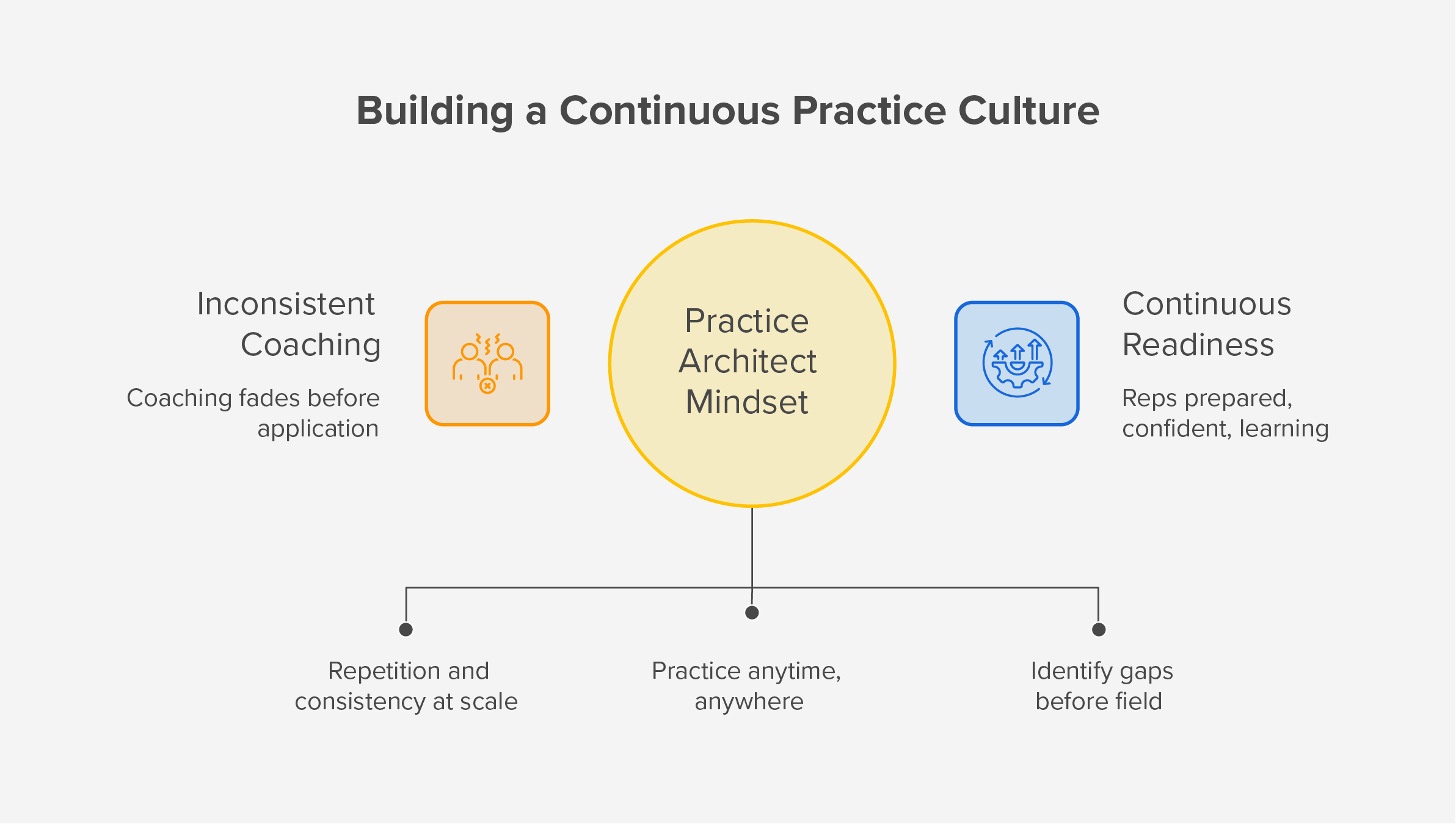
AI roleplay introduces structured, repeatable practice into sales enablement. Reps engage in realistic simulated conversations where they apply knowledge in dynamic scenarios.
This allows teams to:
Practice handling objections in controlled environments
Reinforce approved messaging through repetition
Build familiarity with complex interaction patterns
Practice becomes continuous rather than event-based. Feedback becomes consistent.
Repeated application builds fluency. Fluency builds confidence. Confidence supports consistent execution.
From Practice to Observable Confidence
At scale, structured practice leads to measurable improvements in how reps engage in conversations. Organizations implementing roleplay-driven enablement programs often observe increased confidence during complex interactions.
These improvements are reflected in:
More structured objection handling
Clearer articulation of value
Greater consistency in messaging across teams
Confidence becomes visible through behavior. Reps approach conversations with clarity and structure, enabling more consistent execution in the field.
Why Confidence Matters in Sales Conversations
Confidence ensures that knowledge is applied clearly and consistently in real-time interactions. It enables reps to respond to questions, articulate value effectively, and maintain structured conversations supporting consistent field execution across teams.
How This Fits into Your Sales Readiness Program
Sales conversation confidence is a core component of sales readiness. While training provides knowledge, confidence ensures that knowledge is applied consistently in live interactions.
By combining structured practice, reinforcement, and feedback, organizations can move from content distribution to performance preparation.
Platforms like SmartWinnr support this transition by integrating roleplay, learning, coaching, and performance visibility helping teams build confidence at scale.
Request a demo to explore how structured roleplay can strengthen confidence and consistency across your sales teams.
Disclaimer: This content reflects industry practices and does not constitute medical, legal, or regulatory advice.
Last Updated: