

Smart AI Blog Summary
Get a quick blog summary from any of the below LLM's
What You'll Learn
Walk the exhibit hall at LTEN 2026 in Kissimmee this June and you will hear the same word at nearly every booth. Readiness. Everyone is selling it. But spend ten minutes in conversation and a quieter question surface, the one that matters most to anyone who has built a field team. Readiness for what, exactly?
Because finishing a training module is not the same as being ready.
Passing a quiz is not the same as walking into a formulary meeting and holding your ground when a physician challenges your data.
That gap is where most enablement programs quietly fall apart, and it is exactly the gap the life sciences community has come to LTEN to close.
This year, the teams arriving with the most momentum are not looking for one more tool.
They are rethinking field enablement from the ground up.
The Knowing-Doing Gap Is Still Wide Open
Picture this; a rep at a mid-size biotech, three weeks into a launch. She has completed twelve hours of training and passed every assessment. Her dashboard is a perfect row of green checkmarks.
Then she sits across from a skeptical oncologist who pushes back on her clinical data, and she freezes. Everything she learned was technically in her head. None of it came out of her mouth when it counted.
That is the knowing-doing gap, and it has been hiding in plain sight for years. For a long time, we measured the wrong things. Hours logged, modules completed, quiz scores recorded.
All of it neat and reportable, and none of it telling us whether a rep could advance a real conversation with a real clinician.
LTEN itself has named the shift.
The 2026 theme, Excellence Elevated, carries a simple idea underneath it. Excellence is not about doing more.
It is about doing it better. The community is moving from activity metrics toward impact metrics, from whether people reacted well to training toward whether their behavior in the field changed. Which raises an uncomfortable question.
If behavior in the field is what matters, why is so much of our technology built around everything except the field?
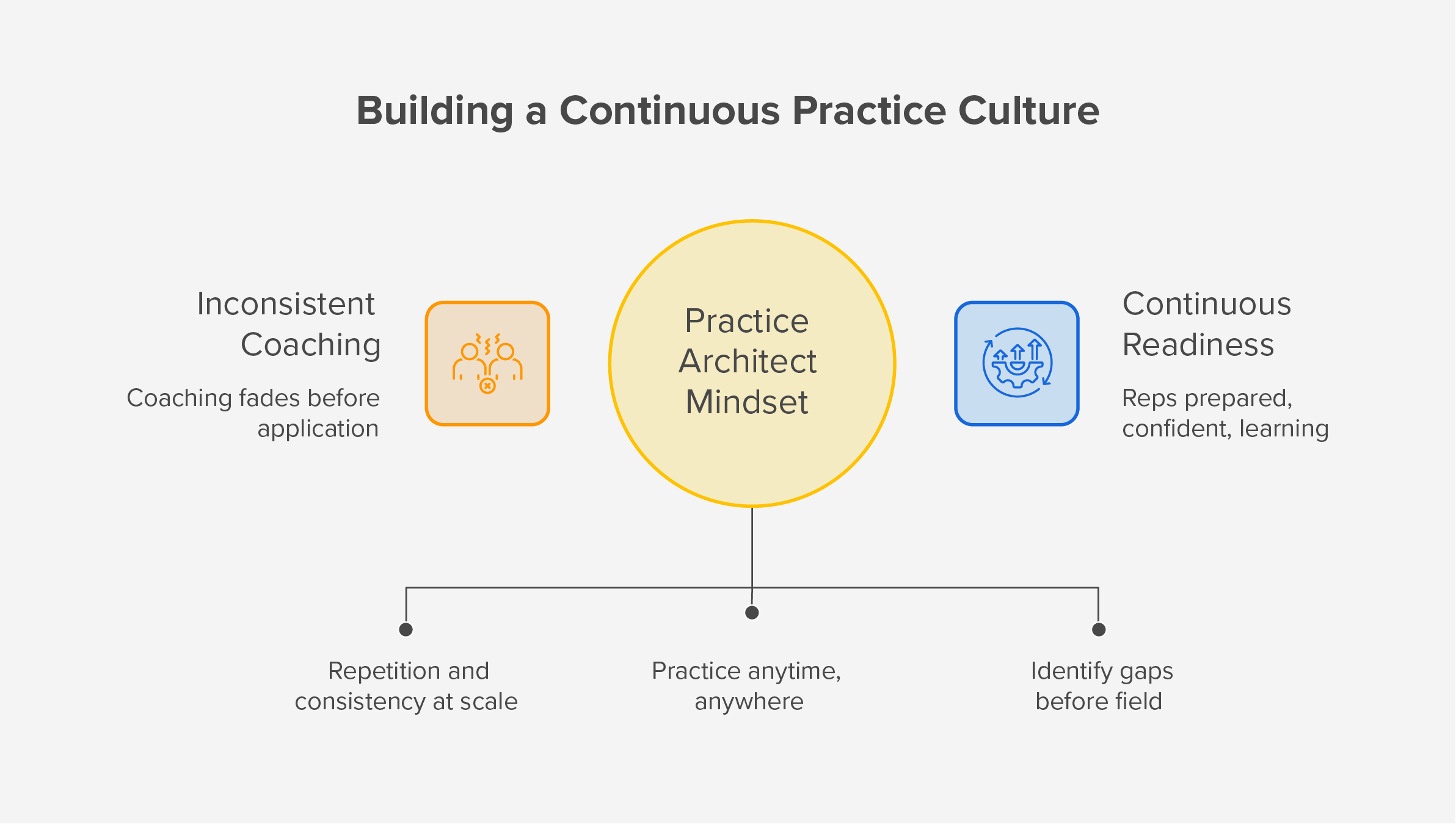
One Tool for Learning. Another for Practice. A Spreadsheet for Coaching.
The answer has less to do with strategy and more to do with how the stack got built over time.
Consider a Sales Training Manager at a medical device company running capability for a few hundred reps. She is juggling three systems that do not talk to each other. A learning platform that holds the content and certifications.
A separate AI roleplay tool someone bought when AI practice became the thing everyone had to have. And coaching, which lives in a spreadsheet she updates by hand.
The learning platform does not know what the rep practiced. The practice tool does not know what the manager observed.
So, she spends more of her week stitching tools together than enabling reps.
This is how the market got here. Companies bought a learning system first, bolted on AI roleplay when it arrived, then added a third thing to fix inconsistent coaching. Each purchase solved a narrow problem well.
Together they created a new one. The rep experiences four disconnected programs, the manager has no single view of who is ready, and the field team still freezes in the moments that matter.
If that feels familiar, you are not alone.
The better question is no longer which tool to add, but how the whole thing should fit together.
Four Pillars, One Continuous Journey
Strip field enablement back to what a rep needs to perform, and it comes down to four things working together rather than sitting in separate corners.
The first is learning. Not a one-time content dump before a launch, but structured pathways that adapt to a rep's role, territory and product mix.
A brand-new MedTech rep preparing for a cardiology launch needs a very different journey than a veteran who just needs a sharp refresher on an updated label.
Learning by itself is only potential. It becomes real the moment a rep must use it, which is why the second pillar is practice.
This is where AI-powered roleplay earns its keep, but only if the practice is real. There is a world of difference between rehearsing a generic objection and rehearsing the actual one a rep will hear, the formulary restriction, the head-to-head comparison, the tough question from a tumor board.
Practice that mirrors the field turns knowledge into fluency that holds up under pressure.
The third pillar is engagement, the one most program forget. Reps do not live inside training events. They live in the weeks between them, out in their territories, often alone.
A field trainer who spots a brilliant approach from a top performer should be able to share it across the region in a day, not save it for the next quarterly meeting. Timely nudges and peer sharing keep readiness warm instead of letting it decay.
The fourth pillar is coaching, where everything either comes together or quietly falls apart. Most coaching still runs on instinct.
A manager rides along, forms an impression, offers advice.
But instinct cannot see what a rep practiced last week, or which conversation skill keeps slipping. A manager who walks into a one-on-one already knowing where a rep is struggling can spend the whole conversation fixing it.
Put the four pillars together and they stop being four programs.
They become one journey, where what a rep learns feeds what they practice, what they practice informs how they are coached, and engagement keeps it alive in between.
Most Tools Do One Thing Well. The Best Do All Four.
Here is the part the exhibit hall does not always make obvious. Almost every platform you will see at LTEN is genuinely good at one of these pillars.
The roleplay specialists build impressive practice but treat coaching as an afterthought. The learning platforms manage content beautifully but have no real engagement layer.
The coaching tools sit in isolation from the data that would make them useful.
That is why field enablement gets rethought from the ground up rather than patched. When all four pillars live on one connected platform, a manager coaching a rep can see exactly what that rep learned, how they performed in practice, where the gap is, and what to assign next, all in the same workflow.
That connection is the whole point, and it is rare. Very few platforms deliver all four, which is precisely where SmartWinnr was built to live, bringing learning, practice, engagement and coaching into a single readiness journey.
The Questions Worth Asking in Kissimmee
Before you walk the floor at LTEN 2026, arrive with a few questions that cut to the heart of it. Ask every vendor whether their platform connects learning, practice and coaching in one workflow, or whether those are separate products you would integrate yourself.
Ask whether a manager can see a rep's readiness alongside their practice history.
Ask what engagement looks like in the weeks between training.
And ask how they measure whether any of it changed behavior in the field, not just whether reps finished the content.
The ones worth a second conversation are those who can describe all four pillars working together.
The teams that leave LTEN 2026 with real momentum will not be the ones who collected the most brochures.
They will be the ones who arrived with a clear picture of what 360 readiness means for their organization, and who left with a partner ready to help them build it. That is the shift worth making this June.
Not more training. Better readiness. The kind that holds up in the room where it counts.
SmartWinnr will be at LTEN 2026. Come see what 360 field readiness looks like when learning, practice, engagement and coaching finally work as one.
Join us across our sponsored workshops with Abbvie & Gilead along with our Tech Demo & Learning Lab.
Attending LTEN this year? Come find us at Booth #513.
Learn more here
Disclaimer: This content reflects industry practices and does not constitute medical, legal, or regulatory advice.
Last Updated: