

Smart AI Blog Summary
Get a quick blog summary from any of the below LLM's
What You'll Learn
Onboarding a medical device clinical specialist is one of the most operationally complex talent challenges you will face in commercial life sciences. Unlike most professional selling roles, your new specialists must simultaneously build clinical credibility, procedural familiarity, regulatory knowledge, multi-stakeholder conversation readiness, and in-service delivery capability, often against a tight launch window where every week of ramp time affects commercial performance.
Getting this sequence right protects something harder to rebuild than a launch timeline the surgeon relationship your specialist carries for the rest of their tenure. A specialist who cannot navigate a value analysis committee conversation from their first significant hospital interaction misses a window that can shape the device's commercial trajectory, and uncertainty about the regulatory and compliance framework governing field interactions creates organizational risk with every account visit.
If you invest in structured, practice-rich onboarding, you put your team in a stronger position to shorten that ramp, since launch performance depends heavily on how quickly new specialists reach independent field readiness. This checklist lays out what a complete, structured onboarding program looks like from day one to OR readiness, across four sequential phases: compliance foundation, clinical knowledge, stakeholder conversation readiness, and field activation.
What Is Medical Device Sales Rep Onboarding?
Medical device sales rep onboarding is the structured process of preparing a new clinical specialist to operate credibly and compliantly across procedural environments, hospital stakeholder groups, and regulatory boundaries before they begin independent field activity in your territories. Unlike onboarding in most commercial roles, it combines product training with procedural fluency, in-service certification, and compliance certification into a single readiness bar your specialists must clear before entering the OR unsupervised.
Quick answer: Medical device sales rep onboarding is the structured process that builds clinical credibility, procedural fluency, and compliance certification before a specialist works independently in the field. It differs from other commercial onboarding because your specialists' success depends on hands-on procedural and stakeholder readiness, not product knowledge alone.
What Makes Medical Device Onboarding So Complex?
The complexity of medical device onboarding is not just a matter of volume. It is a matter of type. The skills and knowledge your new specialists must develop span a range broader than almost any other commercial role, and several of those skills, particularly procedural credibility and clinical conversation fluency, cannot be built through knowledge transfer alone. They require practice.
Picture this: one of your new specialists completes two weeks of product training and has excellent assessment scores. On day fifteen, their manager arranges a first field ride with an experienced colleague. They walk into a hospital together, and the experienced specialist casually navigates a check-in process, greets the charge nurse by name, suits up appropriately for the OR environment, and manages a quick interaction with a scrub tech in the scrub sink area.
The new specialist, despite having strong product knowledge, quickly realizes that success in the OR depends on far more than clinical information alone. They have not yet been exposed to the subtle behavioral protocols of the operating room environment. They are still learning how communication flows within the sterile field, how interactions differ across clinical stakeholders, and how experienced specialists adapt naturally to the rhythm of the procedure room.
What this reveals: procedural credibility is built through rehearsal, not product training alone. No module prepared them for this because no module can replace structured behavioral preparation and practice in conditions that simulate the real environment, an idea that connects directly to how you can approach AI roleplay for procedural readiness today.
The specific complexity factors that define medical device onboarding in 2026 include:
Your specialists must be credible in procedural environments before they can add commercial value, and that credibility requires procedural knowledge that goes well beyond product feature familiarity.
OR, Cath lab, and procedural suite environments have strict protocols that require behavioral preparation before entry. A specialist who does not know how to conduct themselves in a sterile field creates immediate safety and relationship risks.
Multi-stakeholder account structures require your specialists to be conversation-ready across surgeon, nursing, biomedical, and procurement roles from their first significant account interactions.
Device-specific in-service training requirements add a certification and delivery capability layer that most commercial roles do not have. Your specialists must be prepared to educate as well as represent.
Compliance and regulatory requirements span company-specific policies, the AdvaMed Code of Ethics, anti-kickback regulations, and Sunshine Act reporting, all of which your specialists must certify before any field activity.
What Does a Complete Medical Device Onboarding Checklist Look Like in 2026?
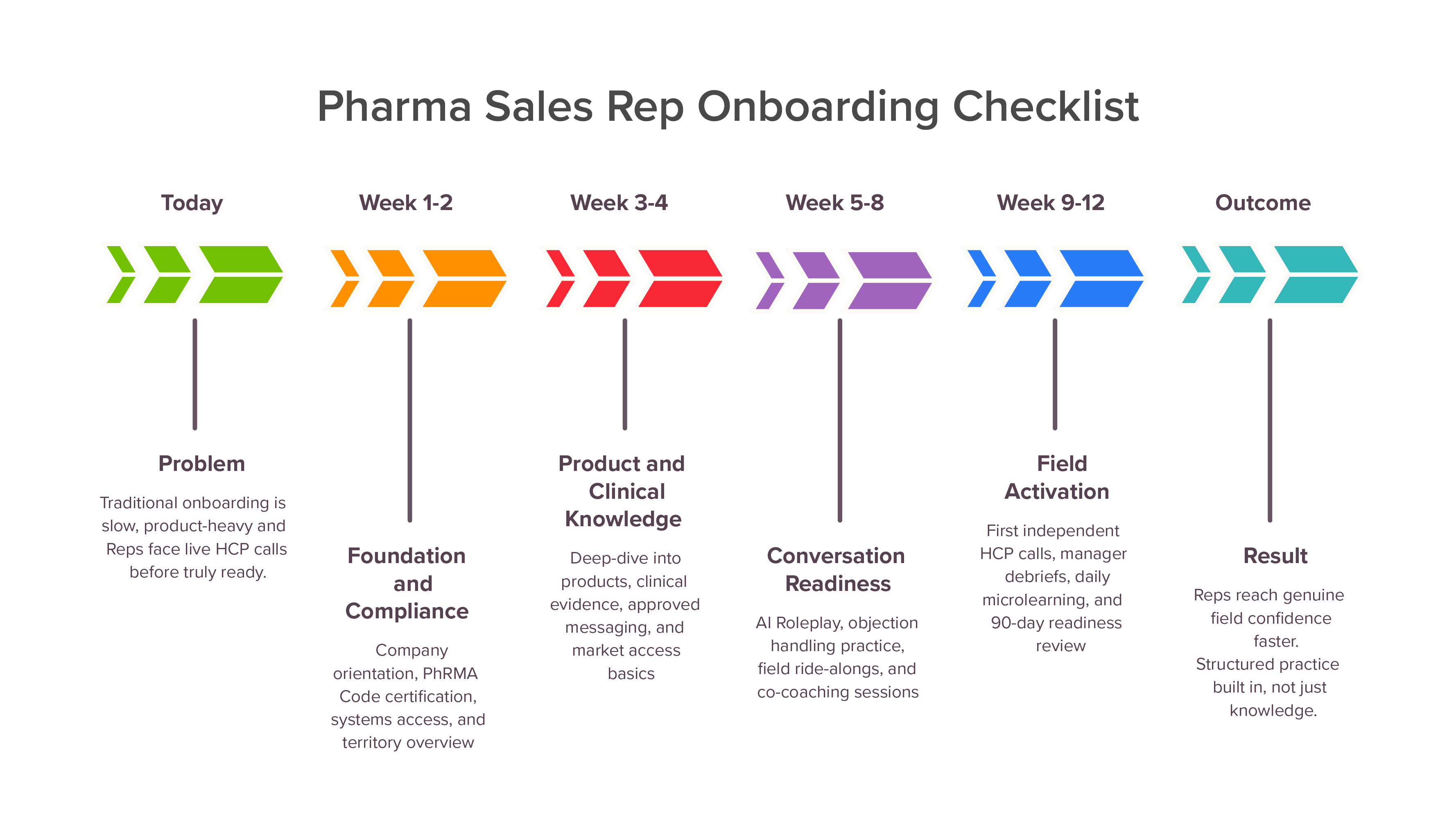
The most effective medical device onboarding programs in 2026 are structured around four phases that build the clinical, compliance, conversational, and field activation capabilities your specialists need, sequentially, with structured practice integrated throughout.
Weeks 1 & 2: Company, Compliance & Systems Foundation
This phase must be completed before any product or clinical training begins. It establishes the compliance mindset that will govern every field interaction throughout your specialist's career.
Company Orientation covers mission, commercial strategy, and organizational structure, including how the individual territory and device category fit within your broader commercial organization.
AdvaMed Code of Ethics Training and formal certification to anchor every future field interaction within ethical and legal boundaries.
Healthcare Compliance Training includes anti-kickback regulations, Sunshine Act reporting requirements, company-specific compliance policies, and the guidelines governing HCP entertainment, education, and consulting relationships.
Systems Access & Operational Setup covers CRM configuration, LMS enrollment, sample management, expense reporting, and initiation of facility credentialing for hospital access.
Territory Overview covers account prioritization, key existing contacts, current device relationships, and the competitive landscape specific to your territory and care settings.
Quick answer: Compliance foundation training, covering AdvaMed certification, anti-kickback and Sunshine Act requirements, and systems access, must be completed before any product or clinical training begins.
Weeks 3 & 4: Device & Clinical Knowledge Foundation
The depth of understanding built in this phase directly determines the quality of field performance in all subsequent phases. Every element here is a prerequisite to credible clinical conversations.
Product Portfolio Deep-Dive covers device mechanism, approved indications, contraindications, and how the device integrates procedurally into the surgical or clinical workflows of target care settings.
Regulatory Overview covers the 510(k) clearance basis, the most relevant clinical studies and their key findings, and the approved safety data summary.
In-Service Protocol Certification covers device setup, operation, troubleshooting, and cleaning and sterilization procedures, certified, not just reviewed.
Competitive Landscape & Positioning provides orientation to the competitive field and the approved positioning framework for differentiating the device.
Reimbursement & Coding Overview covers relevant CPT codes, DRG classifications, reimbursement pathway, and the financial case that procurement and administrative stakeholders will need to understand.
Quick answer: Clinical knowledge foundation covers product mechanism, 510(k) regulatory basis, in-service certification, and reimbursement coding, the prerequisite knowledge for every subsequent field conversation.
Week 5 to 8: Stakeholder Conversation and Procedural Readiness
This is the phase that builds genuine field fluency across the full range of stakeholder conversations and procedural environments your specialist will encounter. AI roleplay practice is central to this phase, providing the structured repetitions needed to convert clinical and product knowledge into confident, credible, compliant field conversations.
Structured AI Roleplay covers the full stakeholder range including surgeon, scrub nurse, biomedical engineer, procurement director, and hospital administrator conversation scenarios.
OR & Procedural Suite Preparation covers behavioral protocols for entering sterile environments, communicating appropriately during procedures, and managing device-related questions in a live case.
Clinical Specialist Shadowing involves observing an experienced colleague across multiple account types, including OR first-case support, in-service delivery, and account management conversations.
In-Service Delivery Practice involves simulated device setup, operation demonstration, and in-service training delivery with structured coaching feedback on clinical accuracy and communication quality.
Objection Handling Practice covers the full range of clinical, operational, and financial objection categories your specialist is likely to encounter in the field.
Quick answer: Stakeholder and procedural readiness is built through structured AI roleplay across surgeon, nursing, biomedical, and procurement conversations, paired with OR shadowing and in-service delivery practice.
Week 9 to 12: Field Activation and First-Case Preparation
The field activation phase transitions your specialist to independent field activity while maintaining the structured practice and coaching support that ensures continued development through the critical first 90 days.
First In-Service Delivery is conducted with manager observation and a structured post-delivery debrief measured against the approved in-service framework.
First Independent Account Conversations receive post-call coaching feedback delivered against the approved stakeholder conversation frameworks to reinforce correct habits early.
90-Day Readiness Review covers clinical confidence assessment, stakeholder relationship quality evaluation, and account progress measured against the territory plan.
Quick answer: Field activation moves the specialist into independent account activity with manager-observed first in-services, post-call coaching, and a formal 90-day readiness review.
Closing the Onboarding Gap with Structured Practice
Most onboarding programs prepare specialists to know the device. Far fewer prepare them to perform in the room, across the full range of clinical stakeholders, procedural environments, and compliance boundaries they will encounter from day one. Closing that gap before the first account interaction that counts requires a practice environment built around medical device specifics, not a generic sales training platform.
Your new specialists need to practice the full range of field conversations, including surgeon, scrub nurse, biomedical engineer, procurement director, and hospital administrator, in scenario environments configured to your specific device category and care settings. They should arrive at their first OR scrub-in, their first VAC conversation, and their first independent in-service having already built the repetitions that translate clinical knowledge into credible, confident field performance.
For medical device commercial and L&D leaders, the right practice platform provides:
Device-specific scenario libraries covering the full stakeholder range across OR, Cath lab, and procedural suite environments, reflecting the actual conversations your specialists will face, not generic selling situations.
Compliance-aware AI coaching aligned to AdvaMed standards and your organization's approved messaging frameworks, so practice builds compliant habits from the first repetition.
Manager dashboards giving you real visibility into individual specialist readiness across all four onboarding phases, so you can target coaching before field exposure reveals the gaps.
Field-friendly microlearning formats giving your new specialists structured practice between onboarding events and shadowing sessions, without requiring manager facilitation or scheduling windows that rarely exist in active territories.
Onboarding progress tracking and certification reporting, giving you a clear record of who has completed each phase and which certifications are outstanding before field activation is approved.
Quick answer: Closing the field-readiness gap requires a practice platform built around medical device specifics: stakeholder scenario libraries, compliance-aware coaching, manager visibility, and certification tracking, rather than a generic sales enablement tool.
Accelerating your launch ramp performance means building field readiness deliberately, at scale, rather than leaving it to live exposure alone.
SmartWinnr is built for exactly this kind of medical device field readiness. Request a demo to see how AI roleplay, structured coaching, and compliant skill reinforcement work together to get your specialists field-ready before the first account interaction that counts.
Disclaimer: This content reflects industry practices and does not constitute medical, legal, or regulatory advice.
Last Updated: