

Smart AI Blog Summary
Get a quick blog summary from any of the below LLM's
What You'll Learn
Onboarding field reps for a first commercial product launch carries a different weight than routine new hire training. There is no established sales history to lean on, no prior product messaging to reinforce, and a fixed launch date that will not move to accommodate a slow ramp.
For a biotech commercializing its first product, this moment sets the tone for how the field organization operates going forward. The training approach chosen for this first cohort of 50 or more reps becomes the template every future hire is measured against.
This piece looks at what to evaluate in an AI-powered enablement platform built for exactly this kind of launch: fast time to competency, consistent messaging across a brand-new team, and readiness data your leadership can trust before day one in the field.
What Makes First-Launch Onboarding Different From Standard New-Hire Training?
A first commercial launch onboarding program has to build product knowledge, clinical fluency, and compliant messaging simultaneously, with no tenured reps in the field to model behavior for new hires. Standard onboarding at an established company can lean on peer shadowing and existing playbooks. A first launch cannot.
This changes what the training program has to carry on its own. Every rep needs a consistent understanding of mechanism of action, competitive positioning, objection handling, and required disclosures before the first call, because there is no senior rep down the hall to correct a misstatement in the field.
It also changes the timeline pressure. A commercial launch date is set well in advance, and the onboarding program has to hit that date with a fully certified team, not a partially ready one.
What Is an AI-Powered Field Enablement Platform?
An AI-powered field enablement platform is software that combines structured learning content, simulated practice conversations, and readiness analytics to prepare sales and clinical field teams for real customer interactions. It typically includes role-based learning paths, scenario-based roleplay practice, and manager-facing dashboards that show who is ready and who still needs work.
For a first-launch cohort, the platform's job is narrower and higher stakes than general training software. It has to take reps with no prior pharma product experience and get every one of them to a consistent, certifiable standard of readiness by a fixed date.
What Should You Look for When Onboarding a Launch Cohort of 50 or More Reps?
At this scale, the platform needs to standardize training delivery while still surfacing individual readiness gaps, because a cohort-wide average score hides the reps who are not actually ready. Look for three capabilities specifically.
Structured, role-based learning paths that sequence content by what a rep needs to know before their first call, not a flat course library
Scenario-based practice that lets reps rehearse real conversations, including objections and compliance-sensitive moments, before they face a live customer
Individual readiness tracking, not just cohort completion rates, so your managers can identify which reps need more coaching before launch day
Consider a training lead preparing a 60-person launch cohort six weeks out. Weekly knowledge checks show the group averaging 82%, which looks strong on a dashboard. A closer look at individual scores shows eleven reps below 65% on objection handling specifically. Without that individual-level view, those eleven reps would have gone into the field looking ready when they were not.
What this reveals: cohort-level averages can mask exactly the readiness gaps a first launch cannot afford to miss.
How Do Role-Based Learning Paths Shorten Time to Field Readiness?
Role-based learning paths shorten ramp time by sequencing training around what each rep actually needs before their first call, rather than pushing every rep through the same generic content in the same order. A rep hired with prior therapeutic area experience does not need the same foundational modules as someone new to the disease state.
SmartWinnr customers report an 80% reduction in onboarding time when learning paths are targeted to specific skill gaps rather than delivered as one-size-fits-all courses. For a first-launch team, that difference often determines whether the full cohort is field-ready by launch day or trailing behind it.
Microlearning delivered through the ramp, rather than front-loaded entirely before launch, also helps reps retain product and clinical detail as label updates or competitive information shifts in the weeks leading up to go-live.
How Does AI Roleplay Practice Reduce Ramp Time Before Launch Day?
AI Roleplay lets reps rehearse full conversations with a simulated customer, get scored on tone, accuracy, and compliance, and repeat the scenario until the conversation holds up, without needing a manager or peer available to run the practice session. For a brand-new cohort, this matters because there is no bench of experienced reps to run live practice with fifty new hires at once.
SmartWinnr customers report a 30% faster path to product launch readiness when AI Roleplay-based practice is built into the onboarding sequence. Your reps can practice objection handling and required disclosures repeatedly before a live HCP or customer conversation, and managers get a scored transcript to review instead of relying on secondhand accounts of how a call went.
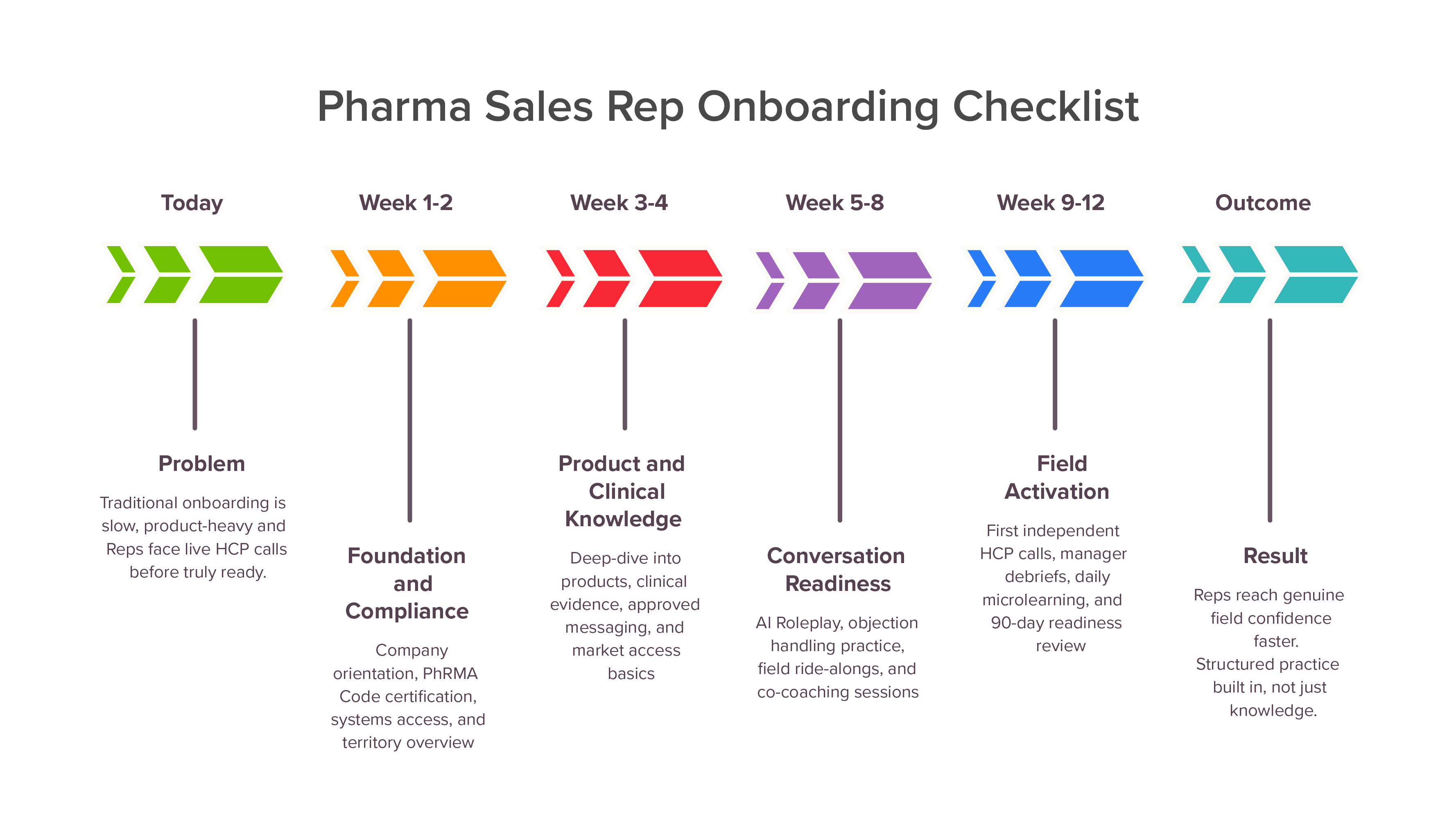
This kind of readiness assessment approach is described in more detail in this pharma sales onboarding checklist, which covers the broader checklist for getting a new commercial team field-ready.
Ready to Prepare Your Launch Cohort?
Request a demo to see how a role-based learning path and AI Roleplay practice can get your first commercial launch team field-ready on schedule.
Frequently Asked Questions
How long should onboarding take before a first commercial launch?
There is no fixed number, since it depends on product complexity and the cohort's prior experience. Most first-launch programs run six to twelve weeks, combining structured learning paths with roleplay practice and a certification checkpoint before go-live.
What is the biggest risk in onboarding a large first-launch cohort quickly?
The biggest risk is treating cohort-wide completion rates as a proxy for individual readiness. A team can show high average completion while several reps remain under-prepared on specific skills like objection handling or required disclosures.
Can new hires with no life sciences background be ready in time for a launch?
Yes, with role-based learning paths that start from foundational product and disease-state knowledge and build toward scenario practice. The key is sequencing content by prior experience rather than running every rep through an identical timeline.
How is readiness measured before launch day?
Readiness is typically measured through knowledge check scores, roleplay scoring on accuracy and compliance, and certification completion, tracked at the individual rep level rather than as a team average.
Does AI Roleplay replace manager coaching during onboarding?
No. AI Roleplay gives reps repeatable practice and a scored transcript, which your managers then use to focus coaching time on the specific gaps that practice surfaced, rather than replacing manager involvement altogether.
Disclaimer: This content reflects industry practices and does not constitute medical, legal, or regulatory advice.
Last Updated: