
Smart AI Blog Summary
Get a quick blog summary from any of the below LLM's
What You'll Learn
Structuring pharma sales rep onboarding around a clear, phase-by-phase checklist gets new reps to genuine field confidence faster than a generic ramp-up program ever could. Onboarding a new pharmaceutical sales representative has always been a complex, multi-stage process, but the operational and competitive demands on a new pharma rep from the moment they reach the field have intensified to a degree that makes the traditional model, heavy on product knowledge delivery, light on conversation practice, insufficient for the role they are actually being asked to perform.
A new pharma rep in 2026 is expected to hold clinically credible conversations with HCPs who are better informed than ever, navigate market access conversations involving prior authorization, specialty pharmacy, and hub services from the first independent call, and handle comparator questions about competitive products with accuracy and compliance, all while building account relationships on trust rather than scripted interactions. The standard six-to-eight-week onboarding program was not designed for this environment.
In pharma, where HCP relationship quality is the primary commercial asset, the cost of an extended productivity ramp is significant. Pharma rep onboarding has become a top priority among sales excellence and L&D teams in 2026, and the sections below outline what a fully structured, checklist-driven onboarding program actually includes.
What Is Pharma Sales Rep Onboarding?
Pharma sales rep onboarding is the structured process of preparing a newly hired sales representative for independent field activity, covering compliance certification, clinical knowledge, HCP conversation practice, and field activation milestones. In 2026, effective programs compress this into a phased, checklist-driven format that uses AI Roleplay to build conversation fluency before a rep's first live HCP call.
Why Is Pharma Rep Onboarding Under More Scrutiny in 2026?
The scrutiny that pharma commercial and enablement leaders are applying to onboarding programs in 2026 reflects several structural changes that have made the cost of a slow or inadequate onboarding more visible and more consequential.
The productivity gap between a fully ramped rep and a rep in their first six months of field deployment represents a meaningful commercial opportunity cost per territory per quarter, a cost that compounds across the full new-hire cohort of any given year. Getting reps to genuine field fluency faster is one of the highest-leverage investments a pharma commercial organization can make.
The specific factors making 2026 onboarding more challenging include:
Compressed launch timelines mean that new reps hired for a launch may be expected to be field-ready in a matter of weeks rather than the months a standard onboarding program provides.
Specialty and rare disease portfolios require a depth of clinical knowledge that takes longer to build but is expected from the first field interaction.
Compliance and regulatory requirements create a non-negotiable baseline of certification that must be completed before any field activity, leaving less time in the total onboarding window for conversation practice.
Manager coaching time is limited and must be allocated thoughtfully. Onboarding programs that rely heavily on manager involvement for every practice repetition are not scalable.
The quality of a rep's early HCP interactions sets the tone for account relationships that can take months or years to correct if they go poorly.
What Does a Complete Pharma Rep Onboarding Checklist Look Like for 2026?
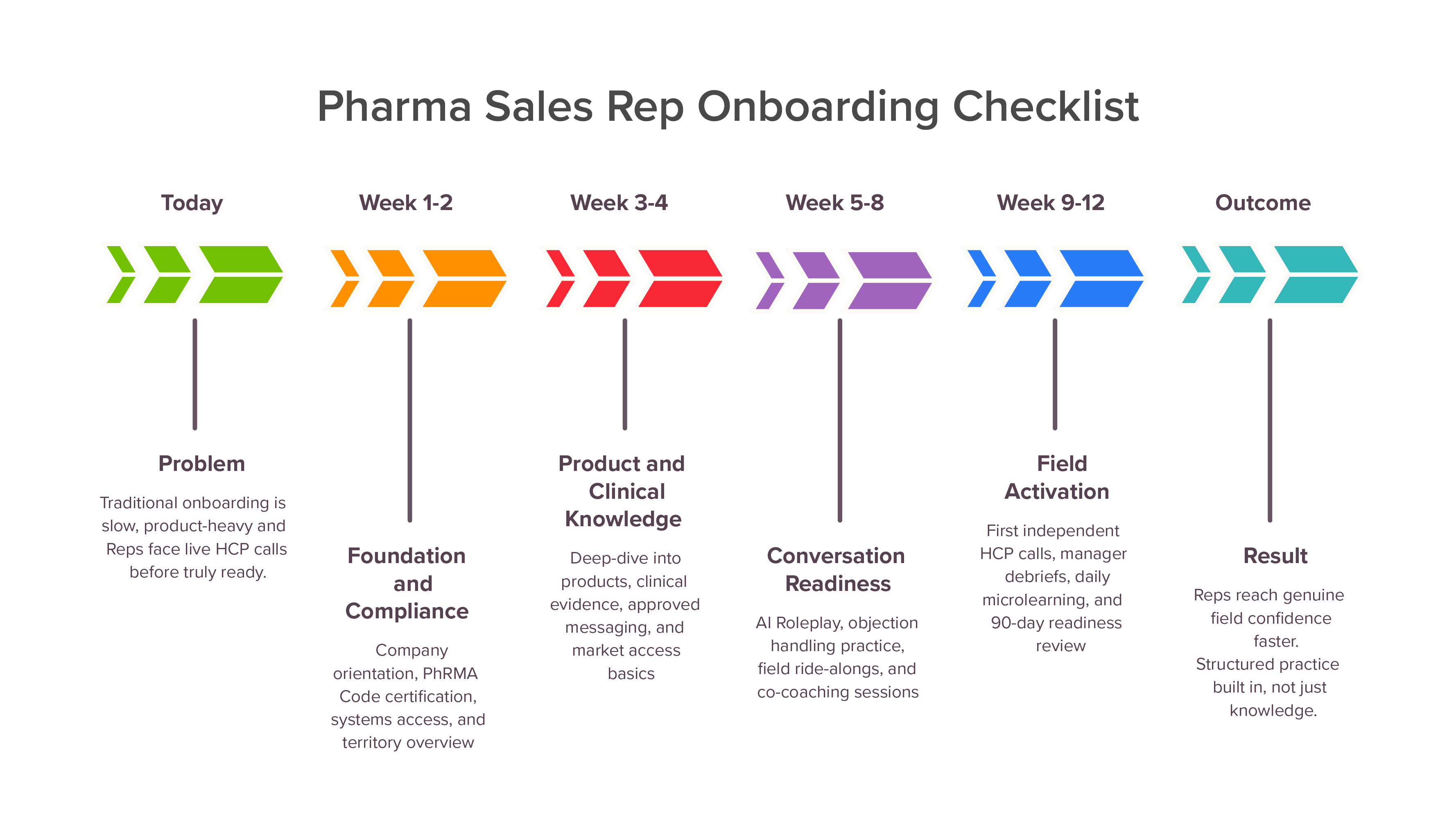
The most effective pharma onboarding programs in 2026 are structured around four sequential phases that move from compliance and systems foundation through clinical knowledge, conversation readiness, and field activation. Each phase builds on the previous one, and AI Roleplay practice is integrated throughout to ensure that knowledge converts to conversational fluency before the rep reaches the field.
Week 1 to 2: Foundation and Compliance
The first two weeks establish the organizational, systems, and compliance foundation that every subsequent element of onboarding builds on. This phase must be completed before any product or clinical training begins.
Company orientation: mission, values, organizational structure, commercial strategy, and how the individual territory fits within the broader commercial organization.
PhRMA Code of Conduct training and certification, ensuring every rep understands the industry standards governing their interactions before they encounter a single HCP.
Healthcare compliance training: the Anti-Kickback Statute and Sunshine Act reporting requirements, company-specific compliance policies, and speaker program and advisory board participation guidelines.
Systems access and operational setup: CRM configuration, LMS enrollment, expense reporting, sample management system, and any territory-specific digital tools.
Territory overview: geography, account prioritization framework, existing key contacts, and the competitive landscape specific to the territory.
Week 3 to 4: Product and Clinical Knowledge
This phase builds the clinical and commercial knowledge base that conversation practice will activate. The goal is deep understanding, not surface familiarity. Reps who understand the mechanism of action, the clinical evidence, and the approved messaging framework at a genuine level are far better prepared for the objection handling practice that follows.
Product portfolio deep-dive: mechanism of action, approved indications, contraindications, dosing and administration, and the clinical evidence base supporting each indication.
Clinical evidence reviews: key trial data, primary and secondary endpoints, patient population, and the approved language for referencing each data point in HCP conversations.
Approved messaging framework and brand certification, ensuring every rep can articulate the core value proposition, the clinical differentiation story, and the compliant response to the most common HCP questions.
Market access foundation: formulary status across key payer groups, the prior authorization process and support, the specialty pharmacy pathway, and hub service details.
Competitive landscape orientation and approved comparator language, preparing reps for the comparator questions they will encounter from the first field interaction.
Week 5 to 8: Conversation Readiness and Field Preparation
This is the phase that separates onboarding programs that build genuine field fluency from those that build product knowledge alone. The goal is to give new reps the structured practice volume they need to convert what they have learned into confident, compliant, credible HCP conversations before they encounter a live HCP.
Structured AI Roleplay covering territory-relevant HCP archetypes and the conversation scenarios most common in the specific therapeutic area and geography.
Objection handling practice across the objection categories most likely to arise in the territory: efficacy questions, safety concerns, formulary access barriers, and comparator challenges.
Field ride-along with an experienced territory rep or manager, observing real HCP interactions to calibrate the gap between practice scenarios and live field dynamics.
Co-coaching sessions with the manager using AI Roleplay feedback data to identify individual development areas and target additional practice accordingly.
Sample management certification and PDMA compliance confirmation before any independent sample interactions.
Week 9 to 12: Field Activation
The field activation phase transitions the new rep to independent field activity while maintaining the structured support and practice infrastructure that ensures continued development through the critical first 90 days.
First independent HCP calls with structured manager debriefing and coaching feedback against the approved conversation framework.
Daily microlearning reinforcement modules, 10-minute practice sessions that keep knowledge and conversation skills fresh through the initial weeks of field activity.
90-day readiness review: a structured assessment of conversation quality, message adherence, market access knowledge, and account progress against territory plan.
Continued access to AI Roleplay scenario libraries for ongoing practice and preparation ahead of high-priority account interactions.
The pharma organizations achieving the fastest and most consistent rep ramp times in 2026 are those that have integrated structured AI Roleplay throughout the onboarding journey, giving new reps the practice volume they need to build genuine field fluency without consuming the manager time that a fully facilitated practice program would require.
How Do AI Roleplay Platforms Support Pharma Onboarding?
A reinforcement platform built for pharma onboarding typically provides the structured, scalable practice environment that complements the clinical and compliance elements of an onboarding program. New reps practice HCP conversations, work through objection scenarios, and receive AI-powered feedback on message adherence and conversation quality, building the confidence that transfers to live field interactions before their first independent call. For pharma commercial and L&D leaders, this kind of platform generally provides:
Onboarding-phase scenario libraries configured to therapeutic area, HCP archetype, and brand messaging framework, reflecting the specific conversations new reps will encounter in their territories.
Compliance-aware AI coaching that reinforces approved messaging throughout the onboarding journey, ensuring that practice conversations build the right habits from the start.
Manager dashboards that surface individual new rep readiness levels across the four onboarding phases and identify where additional coaching is most needed.
Self-directed microlearning formats that give new reps structured practice opportunities between onboarding events without requiring manager facilitation for every repetition.
SmartWinnr is one platform built around this kind of onboarding architecture, combining AI Roleplay, targeted learning, and field coaching tools for pharma sales teams. Organizations evaluating onboarding platforms should weigh this kind of architecture against their own launch timelines, territory structure, and existing LMS and CRM stack, since fit varies by organization size and portfolio complexity.
Request a demo to explore how AI Roleplay, structured coaching, and compliant skill reinforcement can help your new pharma reps reach field confidence faster.
Frequently Asked Questions
How long should pharma sales rep onboarding take in 2026?
Many pharma organizations are compressing onboarding from the traditional six-to-eight-week model into a structured 12-week program that adds dedicated conversation practice and field activation phases. The exact timeline depends on portfolio complexity, with specialty and rare disease products typically requiring more clinical depth before field readiness. A phased, checklist-driven structure helps keep the program on schedule even as the timeline compresses.
What should be completed before a new pharma rep's first HCP interaction?
Compliance and regulatory certification, including PhRMA Code of Conduct training and Anti-Kickback Statute and Sunshine Act awareness, must be completed before any field activity. Product and clinical knowledge certification should follow, along with structured conversation practice covering the objection categories most likely to arise in the rep's therapeutic area. Sample management and PDMA compliance confirmation are also required before any independent sample interactions.
How does AI Roleplay fit into pharma onboarding compared to manager-led practice?
AI Roleplay gives new reps a scalable way to practice HCP conversations and objection handling without requiring a manager to facilitate every repetition. Manager-led activities, such as field ride-alongs and co-coaching sessions, remain essential for calibrating practice scenarios against real field dynamics. Together, the two approaches build both practice volume and contextual judgment.
What is the biggest risk of a compressed pharma onboarding timeline?
The main risk is prioritizing product knowledge delivery at the expense of conversation practice, leaving new reps clinically informed but underprepared for live HCP interactions. Early account relationships that start on shaky footing can take months or years to correct. Building structured practice into every phase of onboarding, rather than treating it as a final step, helps guard against this risk.
How do L&D leaders measure whether a pharma onboarding program is working?
Common measures include a 90-day readiness review covering conversation quality, message adherence, market access knowledge, and account progress against the territory plan. Manager dashboards that track certification completion and practice scores across the onboarding phases give an earlier view of where a rep may need additional support. Time-to-first-independent-call and time-to-full-productivity are also widely used benchmarks.
Disclaimer: This content reflects industry practices and does not constitute medical, legal, or regulatory advice.
Last Updated: