

Smart AI Blog Summary
Get a quick blog summary from any of the below LLM's
What You'll Learn
Evaluate a sales onboarding platform by running one new-hire class on it before you sign. First agree on the day a new hire is cleared to work alone, which this guide calls field release. Then measure the days each new hire takes to reach it, against a group on your current program held to the same certification standard.
A class also tests what a scripted demo can't stage. Certification attempts land on managers in the same week, approved content can change mid-class, and your approvers will ask for records afterward.
This guide is for commercial training leaders at US pharma companies and sales training leaders at US medtech companies who are choosing a platform for new-hire onboarding. For what to check in the demo itself, see how to evaluate medical rep field training platforms.
What Should the Pilot Class Prove?
The pilot should show that new hires on the platform reach field release in fewer days and still pass the certification you use today. Write down what field release means before the class starts, with the sales leaders who will manage the new hires.
Before field release | Pharma | Medtech |
|---|---|---|
Product knowledge | Disease state and product, checked with knowledge tests | Device knowledge, including handling and accessories |
Approved message | A certification roleplay on the approved visual aid, with fair balance | A certification roleplay on the cleared or approved claims |
Compliance | Training on the PhRMA Code and on referring off-label questions to Medical Information | Training on the AdvaMed Code and on where off-label questions go |
Access | The manager clears solo HCP calls after joint visits | Vendor credentials at the hospitals in the territory, and a sign-off before covering cases alone |
An example definition of field release. Your own list comes from your program and your compliance team.
In medtech, part of field release sits outside any training platform. Hospital credentials can set the release date however fast a new hire certifies.
Keep the final certification the same for both groups. If the pilot group certifies in the platform with AI Roleplay and the comparison group in a live roleplay with a trainer, give both groups one final live certification. In a split class, have trainers who don't know which group a new hire is in score it. When you compare with the class before, use the same rubric and, where you can, the same scorers.
How Do You Set Up the Pilot?
Run the pilot on one class for one brand or franchise, from the first day of training through 30 days in the field. Set it up in five steps.
Pick the class and the comparison group. Split the class if it's large enough and your trainers can run two programs at once. Otherwise compare it with the class before it, using that class's records and the same definition of field release.
Agree on the measures before day one. Set the targets with the regional sales leaders who will manage the new hires.
Build the class's path from your approved content. Time the build, and note who did the work, your trainers or the vendor's team.
Review results every week with the trainers and first-line managers on both sides of the pilot.
Decide at day 30 in the field on the measures you agreed, before you discuss price.

The pilot on one page, from the definition of field release to the decision.
Clear the pilot with your approvers before the class starts, because new hires record practice from their first week.
Privacy: where voice recordings are stored and who can open them
IT: single sign-on, the vendor's ISO/IEC 27001 certification and accounts created before day one
MLR or PRC: that the class's scenarios come from approved content
The LMS owner: completions in the system of record
Quality, in medtech: whether it needs to review how training records are kept
What Should You Measure?
Measure days to field release first, and read it next to the measures that show whether the bar held. Count from each new hire's start date, and report the median for each group along with each new hire's own record.
Measure | How to count it | What it tells you |
|---|---|---|
Days to field release | Start date to the day the new hire meets every check on your list | The headline result |
Days to certification | Start date to passing the final certification on the approved message | The part of field release the platform controls |
First-attempt pass rate | Share of new hires who pass the final certification on their first attempt | Whether practice before the attempt worked |
Review time | Hours from a submitted certification attempt to the reviewer's decision | Whether reviewers keep up at class volume |
Build time | Hours from approved content to a scenario ready for certification | Whether your trainers can keep up with content changes |
Day-30 field rating | The first-line manager's rating on the approved message after 30 days in the field | Whether the faster group holds up in real calls |
The onboarding pilot scorecard at the end of this guide lists these six measures, with columns for both groups. To see how SmartWinnr tracks readiness by person and team, request a demo.
What Breaks at Class Volume?
Class volume tests three things: the review queue at class start, a content change mid-class and the records your approvers need. Run all three during the pilot, with the whole class in the platform.
The Review Queue at Class Start
A class tends to reach certification together, and every attempt lands in a manager's or trainer's queue. Watch the queue on the busiest days. Check that reviewers can sort attempts by due date and pass them to another trainer, and that the queue shows how long each attempt has waited.

Illustrative review queue for the 20 new hires on the platform in the pharma example below, in demo data. Attempts pile up in week 2 until a second trainer takes reviews.
A Content Change Mid-Class
Approved content can change while a class is in training, after a label update or a new MLR or PRC approval. Ask the vendor to load a new version partway through the pilot. The platform should show which new hires certified on the old version, assign them the update and keep both versions in their records.

Illustrative version check for the same 20 new hires after a mid-class update, in demo data.
The Records Your Approvers Need
At the end of the pilot, ask each approver to pull what they need without help from the vendor. Compliance should find the transcript and score behind each certification, and the LMS owner should find completions in the system of record. In medtech, check how a new hire's training records would reach the credentialing systems that hospitals use.
What Does a Pilot Look Like in Pharma and Medtech?
In the hypothetical pharma example below, the pilot group reaches field release 8 days sooner, held to the same certification. In the hypothetical medtech example, hospital credentials and case sign-offs set the release date for 11 of the 20 new hires. Both use demo data.
Example: A Pharma Class After a Territory Expansion
Imagine a cardiovascular brand hiring a class of 40 reps after a territory expansion. Training splits the class. Twenty new hires follow the current program, and 20 use the platform's learning path with AI Roleplay practice before certification. Both groups take the same live certification, scored by trainers who don't know which group a new hire is in.
The pilot group reaches field release in a median of 38 days, against 46 for the current program, and 15 of its 20 new hires pass certification on the first attempt, against 11. The review queue peaks at 31 attempts in the second week, until the training team adds a second reviewer. At day 30 in the field, managers rate both groups about the same on the approved message, and the brand team moves its next two classes to the platform.

Illustrative days to field release for each new hire in the pharma example, in demo data.
Example: A Medtech Franchise Onboarding Reps and Clinical Specialists
Imagine a franchise onboarding 12 reps and 8 clinical specialists in one class. On the platform, the median new hire certifies on the approved claims by day 24, against day 31 for the class before it. Field release takes longer for 11 of the 20. Seven are waiting on hospital credentials and four on a case sign-off. The training team bases the platform decision on days to certification and raises the credentialing delays with the team that manages credentials.

Illustrative count of what set each new hire's field release date in the medtech example, in demo data.
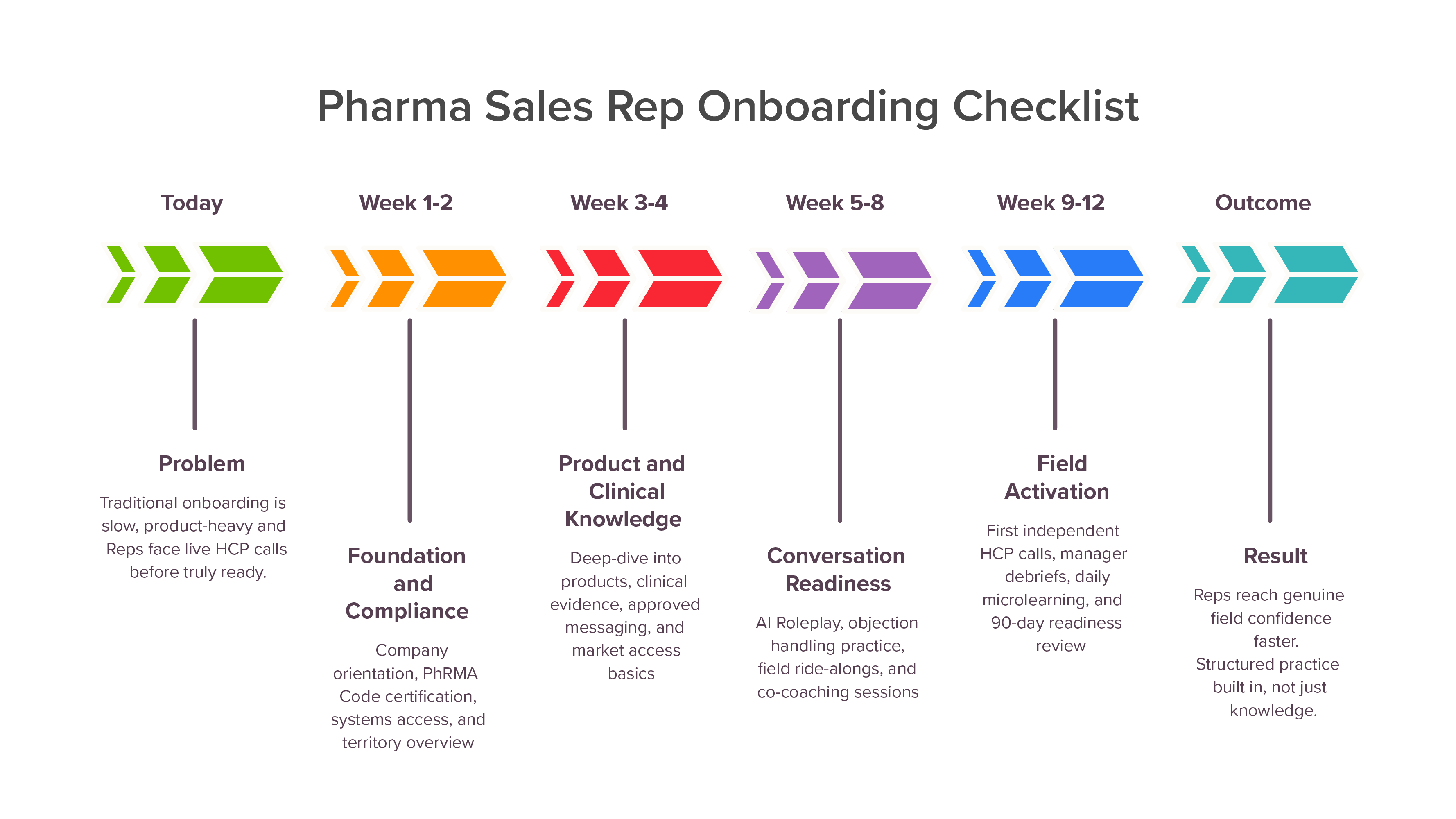
For the full programs behind these examples, see the pharma sales rep onboarding checklist and the medical device sales rep onboarding checklist.
Where Does SmartWinnr Fit?
SmartWinnr runs the new-hire path and the certification practice in one platform. The middle column below quotes SmartWinnr's product pages, and the last column lists what to confirm in your pilot.
Pilot need | In SmartWinnr | Confirm in the pilot |
|---|---|---|
The class's path | Targeted Learning: "Create role-based paths for new hires. Track progress and close gaps with quizzes and short refreshers." | One path per brand or franchise, built by your trainers |
Practice before certification | AI Roleplay: "Managers set required statements and pass gates, define weighted rubrics, and control what the avatar can say." | Your certification rubric, with fair balance as a required statement |
Reviewing attempts | AI Roleplay: "After each session, reps see an explainable score, a transcript, missed-statement flags, and an auditable trail that compliance teams can review." | A queue that trainers can sort and share at class start |
Progress toward certification | AI Roleplay: "Readiness analytics show time to first pass, skill-level scores, keyword coverage, and trends by team and region." | What time to first pass counts, and how it lines up with your final certification |
Day-30 field rating | Field Coaching: "Use shared forms with weighted rubrics." | The form your first-line managers rate new hires on |
Content versions | Digital Content Management: "Version control and content ownership" | Which version each new hire certified on |
[VISUAL: annotated SmartWinnr screenshot of a certification attempt from the demo environment · shows the required statements, the score and the transcript a reviewer sees · Product to supply and approve]
The AI Roleplay page also says "Most organizations launch with four to five scenarios in a few weeks, then expand by market, product, or role." For a pilot, build the class's certification scenarios first and add more after the class has run. For each industry's setup, see SmartWinnr for pharma and medical devices.
Plan Your Pilot
Download the onboarding pilot scorecard (PDF). It holds the definition of field release, the six measures, the three volume tests and the approvals on one page. To see a new-hire path and certification set up in SmartWinnr, request a demo.
Frequently Asked Questions
How Long Should an Onboarding Pilot Run?
Run it through field release and 30 days in the field, which is the length of your new-hire program plus a month. The extra month shows whether the faster group holds up in real calls.
Can You Run a Pilot With a Small Class?
Yes. With fewer than 20 new hires in a group, treat the medians as a direction and read each new hire's record. Run a second class before you roll the platform out to the whole field force.
What If Days to Field Release Come Out Even?
Compare review hours and build time per class. Those set the cost of running every future class.
Disclaimer: This content reflects industry practices and does not constitute medical, legal, or regulatory advice.
Last Updated: