
Smart AI Blog Summary
Get a quick blog summary from any of the below LLM's
What You'll Learn
Walk through any post-launch debrief in your organization and the same concern surfaces in different words. Some of your territories are performing confidently. Others, with comparable rep experience and identical training completion records, are not.
The product knowledge is there. The approved messaging is certified. But somewhere between the training room and the HCP's office, objection readiness is falling short, and it is not falling short evenly.
As HCP engagement models evolve, physicians increasingly expect interactions that are personalized, scientifically credible, and immediately relevant to their patient and practice realities. That expectation does not pause for a rep on your team who is still finding their footing in a difficult formulary conversation or a biosimilar objection encountered only once in a workshop.
For you as a commercial or enablement leader, this is not a knowledge problem. It is a readiness variability problem. Solving it at scale, across distributed teams, multiple therapy areas, and managers with different coaching styles, is one of the defining operational challenges of 2026.
This article examines why that variability persists, why traditional enablement approaches struggle to close it, and how leading pharma organizations, including yours, are redesigning readiness for the commercial environment they operate in.
The Real Enterprise Problem Is Readiness Variability, Not Objections
Picture this: inside a large pharma organization managing a specialty launch, two reps cover adjacent territories. They attended the same NSM. They completed the same certification program.
They carry the same approved messaging. Six weeks into the launch, one is navigating formulary objections and comparative evidence questions with confidence. The other is escalating frequently, relying on leave-behinds, and avoiding the deeper clinical discussions that HCPs in that specialty are specifically looking for.
What this reveals: Identical training and certification records do not guarantee identical field performance. Readiness variability, not knowledge gaps, is the real driver of inconsistent HCP conversations.
That gap is not unusual. It is the norm, and most commercial leaders know it.
The challenge is that traditional enablement systems standardize information delivery well, though conversational preparedness typically calls for a different kind of reinforcement to reach the same consistency. Knowing the approved message and navigating a live objection under pressure are genuinely different capabilities.
The first can be tested in a certification assessment. The second only reveals itself in practice, specifically in structured practice that mirrors the complexity of the actual conversation.
Modern HCP interactions in specialty care now regularly involve comparative evidence interpretation, patient selection logic, biomarker discussions, formulary and access complexity, and safety profile questions that go well beyond label information. In a competitive bio similar conversation or an oncology discussion with a KOL who has read the relevant preprints, a rep who has reviewed the approved message but never rehearsed a difficult live version of that conversation is not the same as one who has. The gap between those two reps shows up in access quality, engagement depth, and ultimately commercial performance.
For enterprise organizations like yours, the issue compounds quickly. Some of your managers coach rigorously and often. Others prioritize pipeline management and coach sporadically.
Some of your regions develop strong conversational habits through consistent practice. Others remain dependent on scripted responses that break down the moment an HCP pushes back with a specific question. The result is organizational variability at precisely the moment when launch consistency matters most.
Why Traditional Objection Training Needs Reinforcement at Enterprise Scale?
The historical pharma enablement model was built for a different commercial environment. For years, structured workshops and periodic certification events were often sufficient, reflecting a period when HCP access tended to be broader, conversations tended to move faster, and competitive dynamics carried less day-to-day pressure.
Representatives typically held more of the information advantage in that environment. That environment has changed.
The modern HCP, particularly in specialty and academic settings, often arrives at a conversation already familiar with conference presentations, evolving guideline updates, real-world evidence publications, and competitor positioning. Interactions increasingly need to function as peer-level evidence discussions rather than product presentations. That shift changes what field readiness requires of your reps.
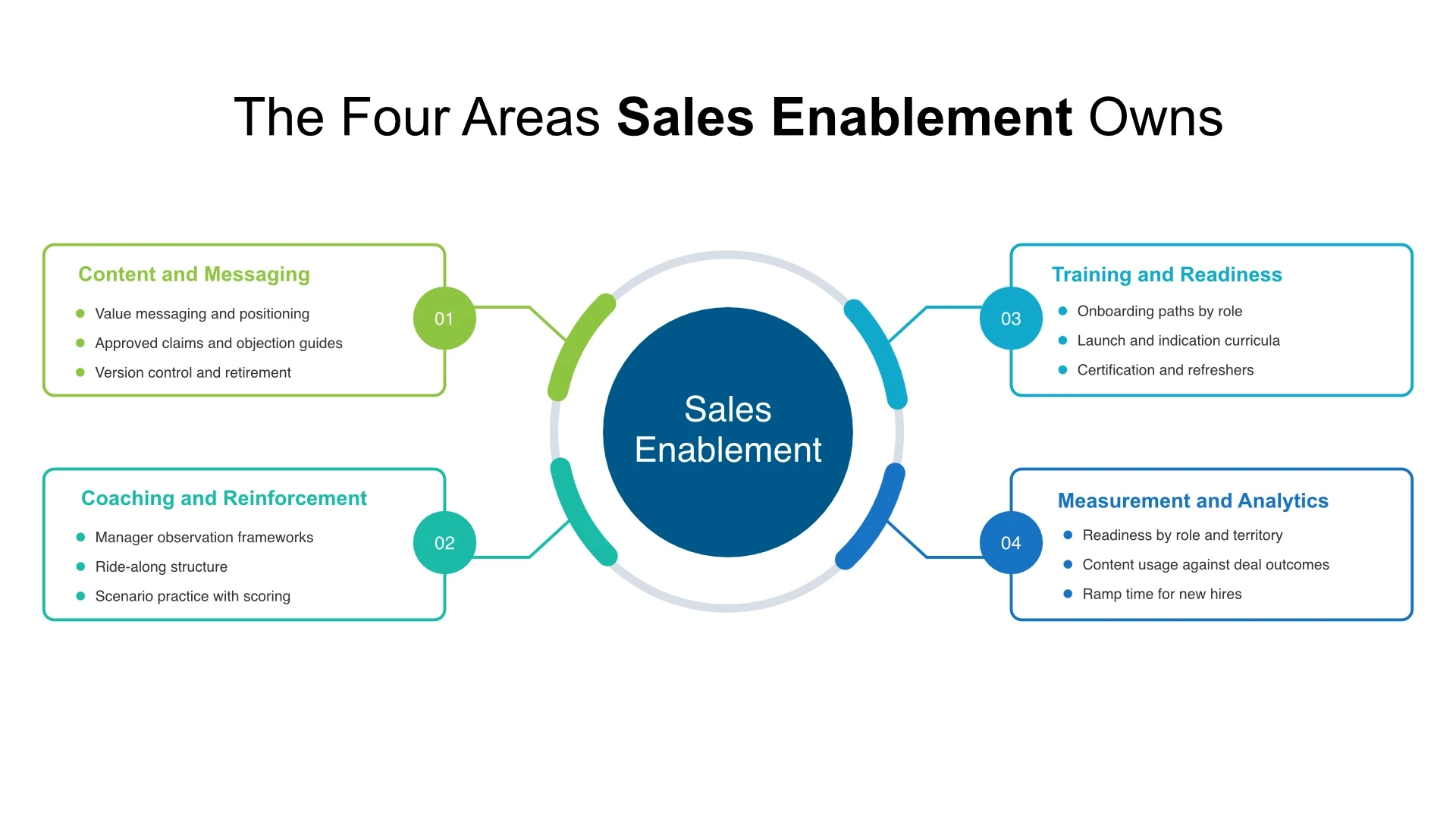
Yet most enterprise enablement systems still rely on episodic learning models: annual workshops, launch certification events, static LMS modules, and periodic manager-led roleplay that were not designed for the conversational complexity now expected in the field. Three specific limitations emerge at scale.
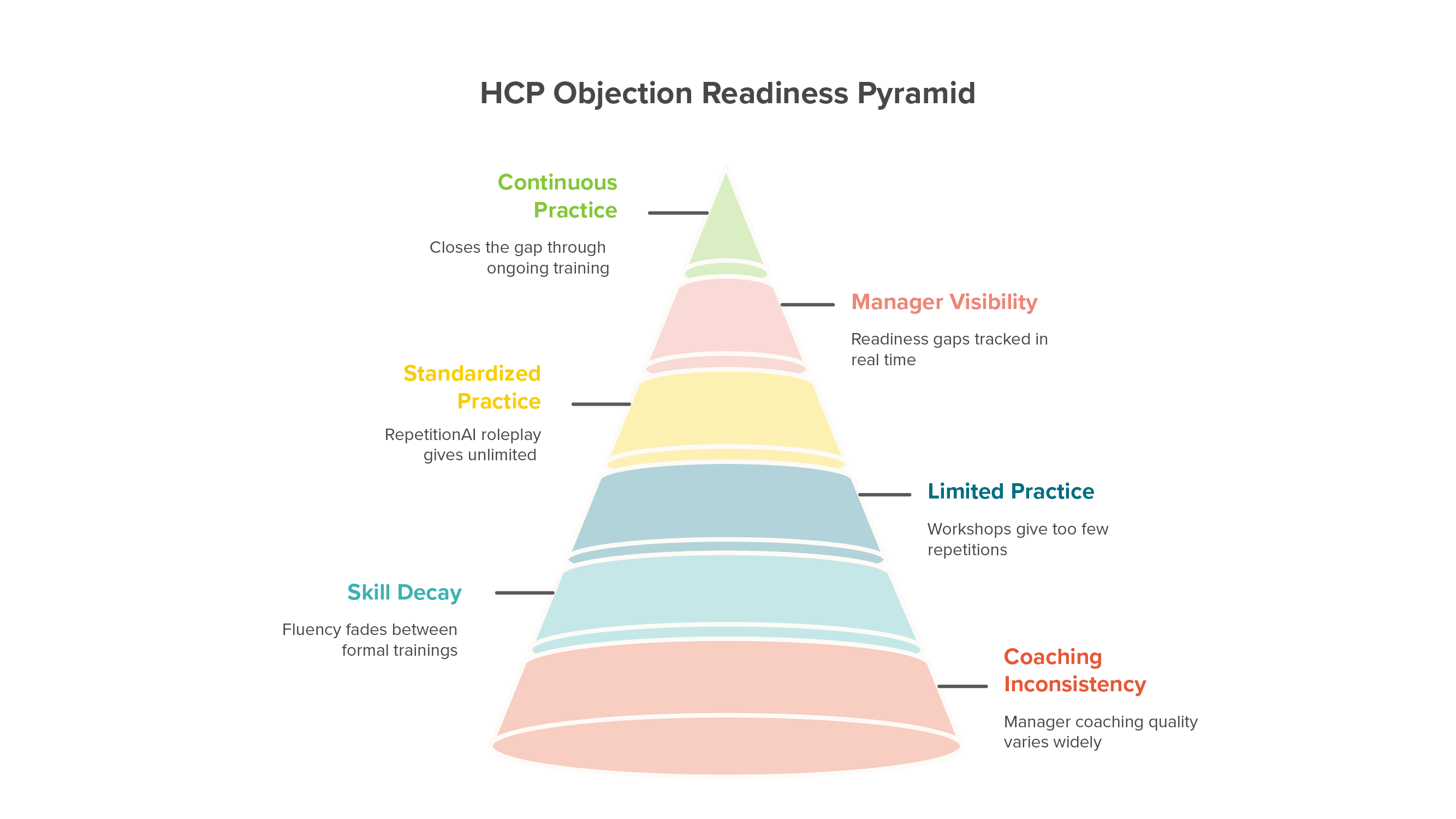
Coaching Quality Inconsistency
In any large commercial organization, manager coaching ranges from highly rigorous to barely present. One district manager may run detailed weekly scenario reviews. Another may focus almost entirely on pipeline and activity metrics.
In regulated environments where conversational variation can introduce compliance risk alongside performance risk, that inconsistency is not simply a coaching gap. It is a commercial execution challenge.
Post-Training Skill Decay
Conversational fluency is not retained the same way product knowledge is. A rep may perform well during a certification immediately after an NSM, then struggle several weeks later when facing a nuanced access objection or a pointed endpoint question in a live interaction.
The issue is not knowledge retention alone. It is conversational retention under pressure, and episodic training events do little to maintain it between formal touchpoints.
Practice Volume
A live workshop, however well-designed, realistically provides each rep with a small number of practice repetitions before returning to the field. For modern specialty conversations, that preparation level typically calls for additional reinforcement. Fluency in difficult objection handling requires far more repetition than any structured event can realistically deliver.
Why Leading Organizations Are Reframing What Readiness Means?
The most operationally forward-looking pharma organizations are shifting away from training completion as the primary readiness indicator and moving toward something more demanding: demonstrated conversational preparedness under realistic field conditions.
That distinction matters more than it might initially appear. Completion metrics tell you that a rep has been exposed to approved content.
Readiness metrics tell you whether that rep can execute a difficult HCP conversation with clinical accuracy, compliant messaging, and genuine confidence. Those are not the same thing, and the difference becomes highly visible during launches, competitive disruptions, or formulary changes, exactly the moments when consistent field performance matters most.
Leading organizations are responding by building readiness infrastructure that sits between formal training events rather than depending entirely on them. This means continuous simulation environments where your reps can rehearse against realistic scenarios independently. It means structured reinforcement that keeps conversational fluency sharp through weekly practice rather than quarterly events.
It means standardized evaluation frameworks so that objection handling quality is measured consistently across regions and managers rather than varying with each individual coach's judgment. And it means manager visibility tools that let you identify readiness gaps at the rep and territory level before those gaps show up in the field.
The conceptual shift is from readiness as a training output to readiness as an ongoing operational state: something that is continuously built, continuously measured, and continuously improved rather than certified once and assumed to hold.
What AI Roleplay Actually Solves for Pharma Commercial Teams?
AI Roleplay in pharma is sometimes discussed as though it simply digitizes existing practice formats. The more accurate description is that it solves four operational problems that traditional enablement has never been able to address consistently at enterprise scale.
Practice Volume at Scale
Fluency develops through repetition. A rep who has rehearsed a difficult formulary access conversation fifteen times before a key HCP interaction is genuinely better prepared than one who rehearsed it twice at an NSM workshop. AI Roleplay makes that volume of practice possible without requiring constant manager facilitation, which is the bottleneck that has always limited repetition in conventional coaching models.
Coaching Standardization
One of the most significant hidden costs of manager-dependent coaching is that different managers define good objection handling differently. A rep in one region receives one standard of feedback.
A rep in another receives something different. AI-driven evaluation creates a consistent benchmark across approved messaging adherence, conversation flow, evidence alignment, and compliance boundaries, a standard that does not vary from one coaching session to the next.
Adaptation Speed
Commercial environments shift. New competitor data becomes available. Formulary positioning changes.
Clinical guidance updates. In traditional training models, those changes often take weeks to translate into updated training content and field practice. AI-based readiness programs allow scenario libraries to be updated rapidly, so your reps can rehearse against current market realities rather than the competitive landscape from the last workshop.
Manager Visibility
Historically, field leaders assessed conversational readiness through subjective observation during ride-alongs and periodic check-ins. AI Roleplay platforms increasingly provide practice frequency data, competency scoring, and objection-specific performance patterns that let you identify which reps need targeted support, and on which specific conversation types, before those gaps manifest in a critical HCP interaction.
For pharma organizations managing specialty launches or navigating competitive disruption, these four capabilities together represent a meaningful shift in what structured readiness looks like operationally. Guidance from the FDA's Office of Prescription Drug Promotion continues to reinforce why compliant, evidence-based messaging must remain the foundation of any HCP conversation, regardless of how that conversation is practiced or scored. The PhRMA Code on Interactions with Healthcare Professionals sets a similar standard for how those interactions should be structured across the industry.
How AI Roleplay Supports Scalable HCP Objection Readiness?
Building consistent conversational readiness across a large, geographically distributed pharma field team is not a problem that periodic training events or individual manager effort can solve reliably at scale. The operational gap that persists in most organizations, the gap between what reps know and how they perform under real HCP pressure, requires infrastructure that sits between formal touchpoints and reinforces readiness continuously.
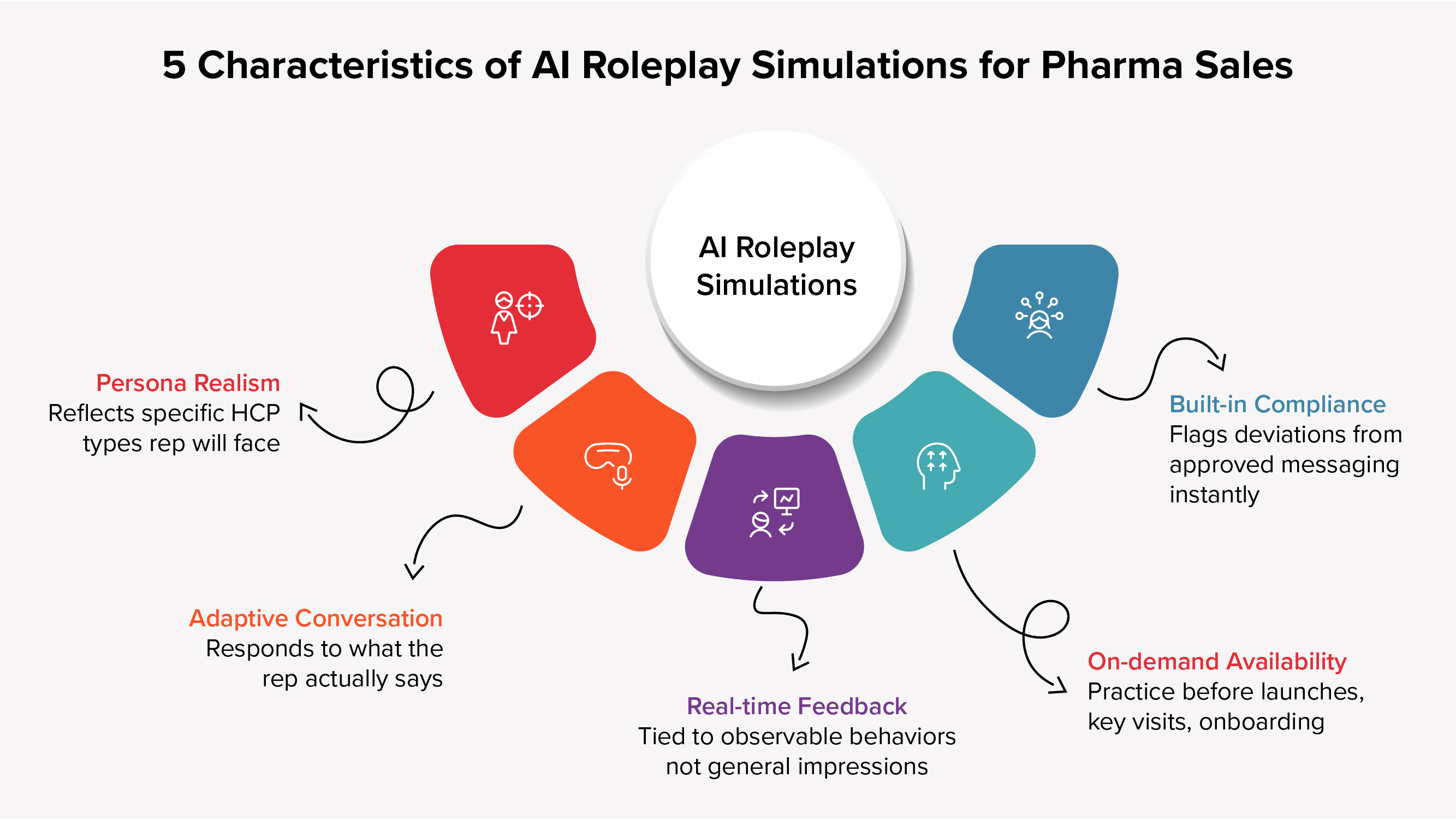
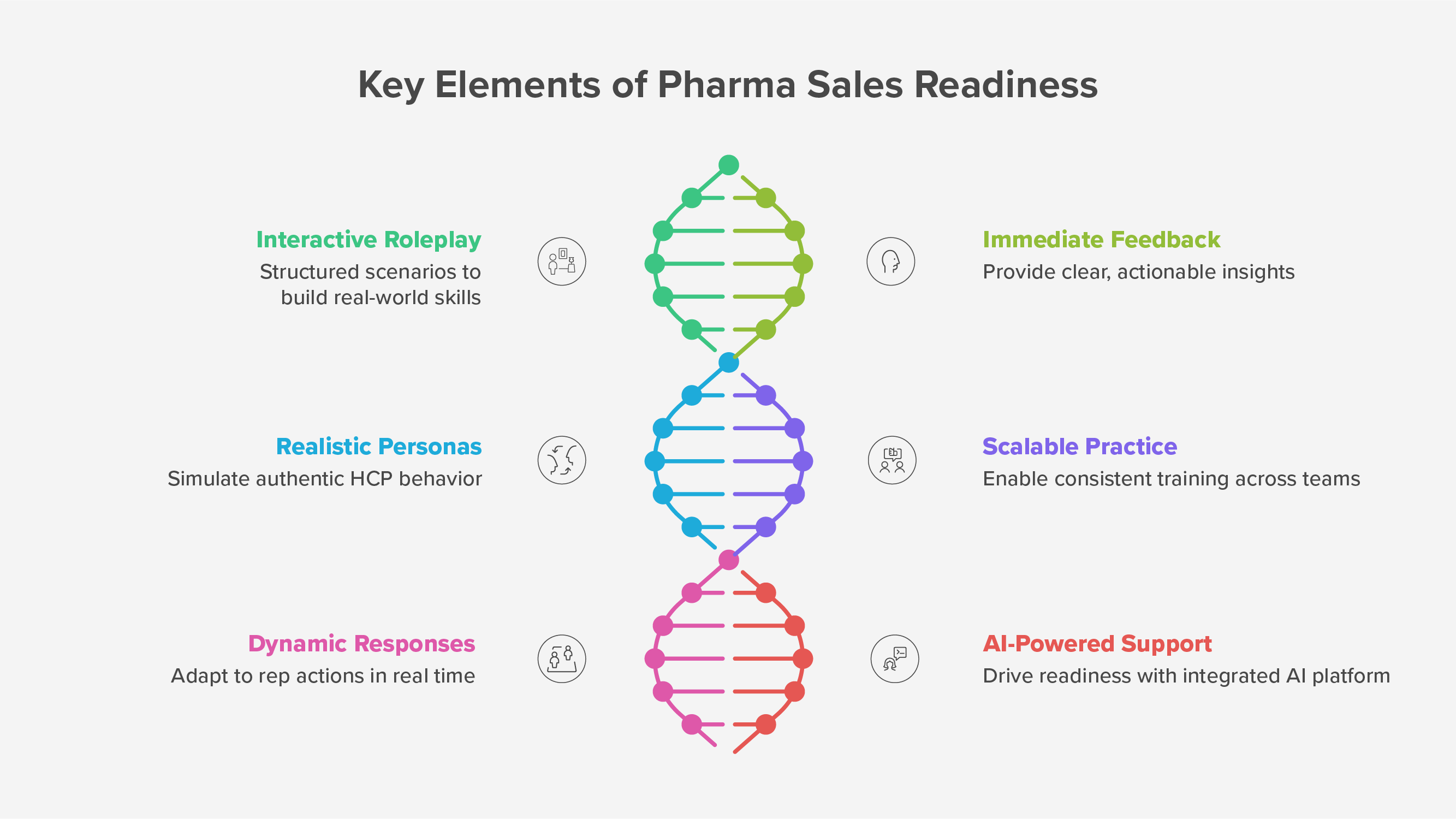
An AI Roleplay platform built for pharma commercial teams helps close that gap. Your teams can design therapy-specific simulation environments aligned to your actual clinical messaging priorities, market access landscape, competitive dynamics, and regional compliance requirements.
Reps practice against AI-driven HCP personas that reflect genuine conversation complexity, receiving immediate feedback on message adherence, evidence accuracy, and compliant response quality. Managers gain visibility into readiness patterns across individual reps, teams, and territories, allowing coaching to be targeted rather than reactive.
For commercial and enablement leaders, this kind of infrastructure supports scalable objection readiness practice, compliance-aware conversational reinforcement, rapid scenario deployment during market shifts, and continuous reinforcement beyond formal training events. As HCP conversations continue to become more evidence-driven and less tolerant of superficial engagement, the organizations that outperform will not simply train more. They will operationalize readiness more effectively.
An AI Roleplay platform built specifically for this kind of continuous, compliance-aware practice infrastructure gives your commercial team a way to close the readiness gap described above without adding headcount to your coaching function.
Request a Demo to see how structured AI Roleplay practice, standardized coaching, and compliance-aware reinforcement work together in the field.
Frequently Asked Questions
What is HCP objection readiness in pharma sales?
HCP objection readiness refers to a rep's ability to navigate live, unscripted physician objections on formulary access, comparative evidence, or safety profile questions, with clinical accuracy and compliant messaging. It goes beyond product knowledge or certification completion, since it is tested only in the pressure of a real conversation rather than a training assessment.
Why do reps with identical certification records perform differently in the field?
Certification confirms exposure to approved content, not conversational fluency under pressure. Coaching frequency, practice volume, and manager style vary widely across regions, which creates readiness gaps between reps who otherwise hold the same training record.
How does AI Roleplay improve HCP objection handling?
AI Roleplay gives reps a way to rehearse difficult HCP conversations repeatedly, receiving structured feedback on message adherence, evidence accuracy, and compliance boundaries after each session. This increases practice volume beyond what manager-led coaching alone can provide and standardizes how objection handling is evaluated across teams.
How often should pharma reps practice objection handling scenarios?
Conversational fluency decays faster than product knowledge, so reps benefit from ongoing weekly practice rather than relying on quarterly workshops or annual certification events. Leading organizations build reinforcement into the weeks between formal training touchpoints to keep skills sharp for live HCP interactions.
How can commercial leaders measure objection readiness across a distributed field team?
Readiness is measured through standardized evaluation criteria, practice frequency, and competency scoring rather than training completion alone. Platforms that provide manager visibility into these metrics at the rep and territory level allow leaders to identify and close gaps before they surface in the field.
Disclaimer: This content reflects industry practices and does not constitute medical, legal, or regulatory advice.
Last Updated: