
Smart AI Blog Summary
Get a quick blog summary from any of the below LLM's
What You'll Learn
There is a difference between a sales manager and a sales coach in medical device. Most organizations have plenty of the first. The second is considerably rarer and far more valuable.
A manager in medical device tracks territory metrics, reviews call plans, runs quarterly business reviews, and monitors capital equipment pipelines. A coach changes how a rep thinks when a surgeon pushes back on clinical evidence, when a procurement director dismisses the conversation before it starts, or when a value analysis committee meeting is coming up and the rep's clinical champion is not quite ready.
That kind of development does not happen in a performance review. It happens through consistent, structured, observation-based coaching that builds capability over time.
The good news is that coaching is a learnable skill. The principles behind it are consistent, the habits are buildable, and the impact on field performance in medical device sales is measurable.
This article covers what those principles look like in practice for medical device sales leaders.
Where Does Coaching Fit Into Medical Device Training Investment?
Ask most medical device sales organizations where their training budget goes and the answer is consistent. Product certification, anatomy and procedural training, compliance programs, and onboarding curricula. These are necessary investments and well justified in a regulated, technically complex industry.
Coaching rarely receives the same deliberate investment. Not because leaders do not value it, but because it is harder to measure, harder to scale, and frequently assumed to happen organically once a manager reaches their role.
Being a strong device rep does not automatically produce an effective coach. The skills are entirely different. Selling requires technical confidence, relationship instincts, and the ability to navigate complex hospital dynamics. Coaching requires observation, the discipline to ask rather than tell, the ability to identify patterns across multiple field interactions, and the patience to let a rep develop their own capability rather than simply handing them the answer.
Gartner research on critical sales leadership trends found that maximizing the impact of sales managers requires organizations to hire and develop managers based on specific mindsets and competencies rather than simply promoting top sellers, and to invest in enablement programs and technology that allow managers to provide personalized coaching at scale.
In medical device, this gap is particularly visible. Many field managers were promoted because they were exceptional reps with strong surgeon relationships, deep procedural knowledge, and a track record of navigating complex hospital accounts.
But coaching a team of fifteen reps across a large multi-device territory is a fundamentally different skill set, one that is rarely developed deliberately, and one that has an outsized impact on team performance when it is.
What Effective Coaching Actually Looks Like in MedTech?
Before building a coaching culture, it helps to be precise about what coaching actually is in a medical device context.
Coaching is not debriefing a joint OR visit. It is not reviewing call reports. It is not telling a rep what they did wrong after a procurement meeting and how to fix it.
Effective coaching is a structured, ongoing conversation between a manager and a rep that is grounded in specific field observations, focused on behavioral development, and designed to build the rep's own capability rather than just improving the next individual interaction.
In medical device sales, it has three qualities that separate it from routine management.
It is clinically and commercially specific. Good coaching in this environment does not say "You need to be more confident with surgeons." It says "When the surgeon asked about the comparative outcomes data in that pre-op conversation, you acknowledged the question but moved on without referencing our clinical evidence. Let us talk about what you could have said in that moment and practice it."
That level of specificity makes feedback actionable rather than abstract. It addresses the full stakeholder landscape. Coaching in medical device cannot focus only on clinical conversations.
A rep who handles surgeon interactions confidently but struggles to navigate a hospital procurement relationship, a value analysis committee preparation, or a multi-department account review needs coaching across the full stakeholder map.
Managers who only coach the clinical dimension leave significant development gaps unaddressed.
It is consistent, not event driven. A coaching conversation that only happens after something goes wrong does not build capability. It manages incidents.
The managers who develop the strongest medical device sales teams create a regular coaching rhythm, brief weekly conversations grounded in recent field observation, that compounds over time into genuine skill development and field confidence.
5 Habits of Managers Who Build Successful Medical Device Sales Teams
The best sales coaches in medical device are not necessarily the most experienced device veterans who got promoted. They are the managers who have built consistent habits around how they observe, listen, give feedback, and develop their people.
They observe before they advise. They watch how a rep opens a clinical conversation before deciding what needs developing. They listen to how a rep responds to a procurement objection before offering an alternative approach. Observation comes first and judgment comes second.
They ask more than they tell. Instead of saying "here is what you should have done," they ask "what do you think you could have approached differently in that procurement conversation?" Reps who arrive at their own answers retain them far longer than reps who are told what to do.
They coach to patterns, not incidents. A rep who misses a clinical evidence reference in one OR conversation is having a bad day. A rep who consistently avoids clinical evidence discussions is showing a skills gap. Great coaches track patterns across multiple observations and address them with structured practice rather than one-off feedback.
They make practice part of the routine. They do not wait for a formal training program to run a roleplay. A ten-minute scenario rehearsal before a big account visit, a quick debrief after a joint hospital call, a structured pre-call planning conversation before a value analysis committee prep session. These short, frequent practice moments build more durable readiness than a quarterly workshop.
They celebrate progress, not just outcomes. A rep who navigated a procurement objection more confidently this week than last week deserves recognition, even if the account has not moved forward yet. Progress builds confidence and confidence builds the kind of field performance that compounds over time.
Individual coaching habits matter. But a medical device organization with two hundred or five hundred field reps cannot rely on individual manager quality alone. Consistency across the field force requires structure.
How to Scale Coaching Consistently Across a Distributed Field Force?
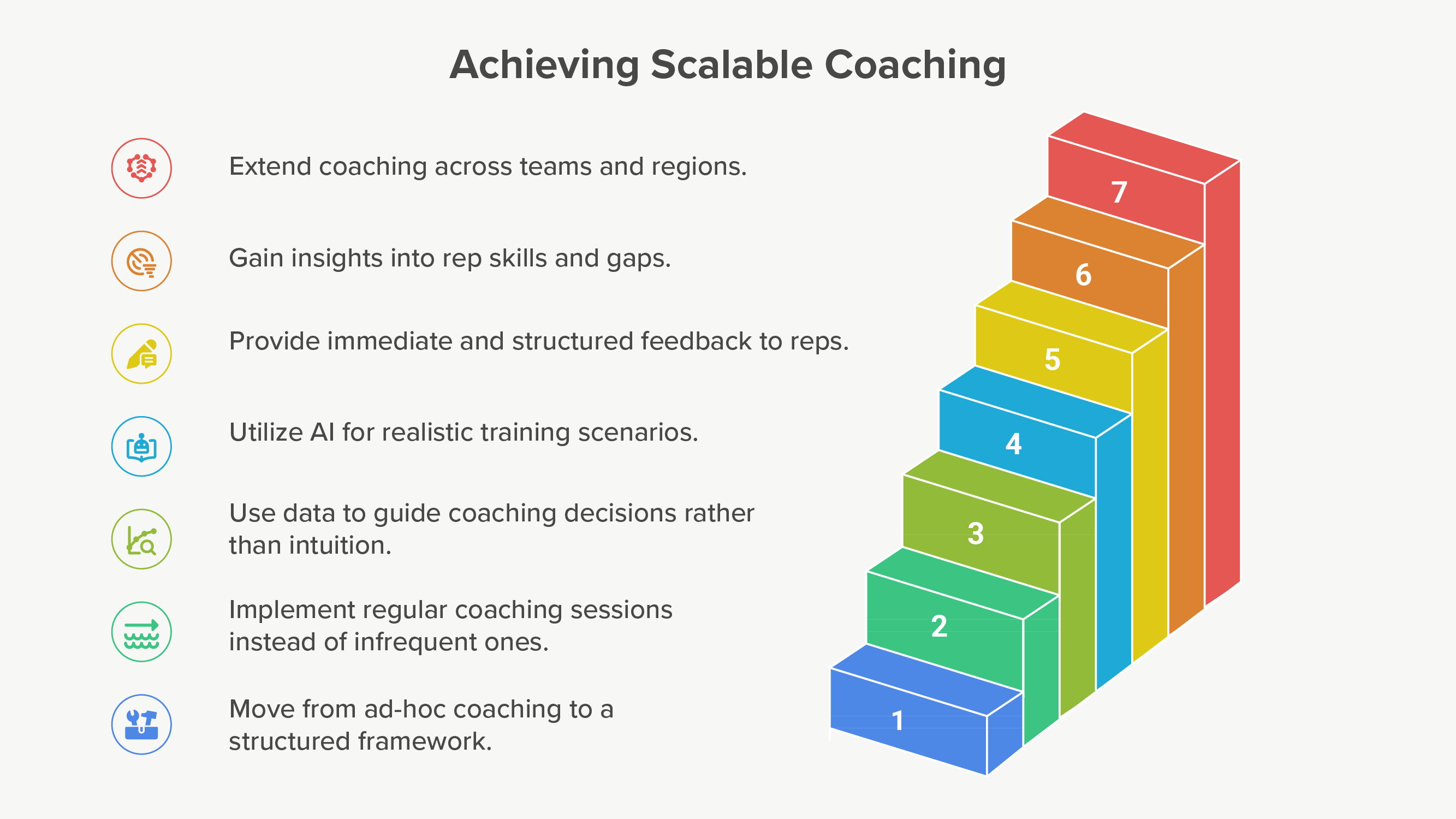
A shared coaching framework. Every manager should be working from the same definition of what a strong clinical conversation looks like, what effective multi-stakeholder navigation sounds like, and where IFU compliance requirements show up in day-to-day rep interactions. Without a shared framework, coaching quality varies by region, manager personality, and how recently someone attended a training event.
Regular cadence, not event-based coaching. Coaching that only happens at national sales meetings or when a rep is underperforming does not develop field capability. A weekly fifteen-minute coaching conversation grounded in recent field observation is more impactful than a half-day workshop once a quarter.
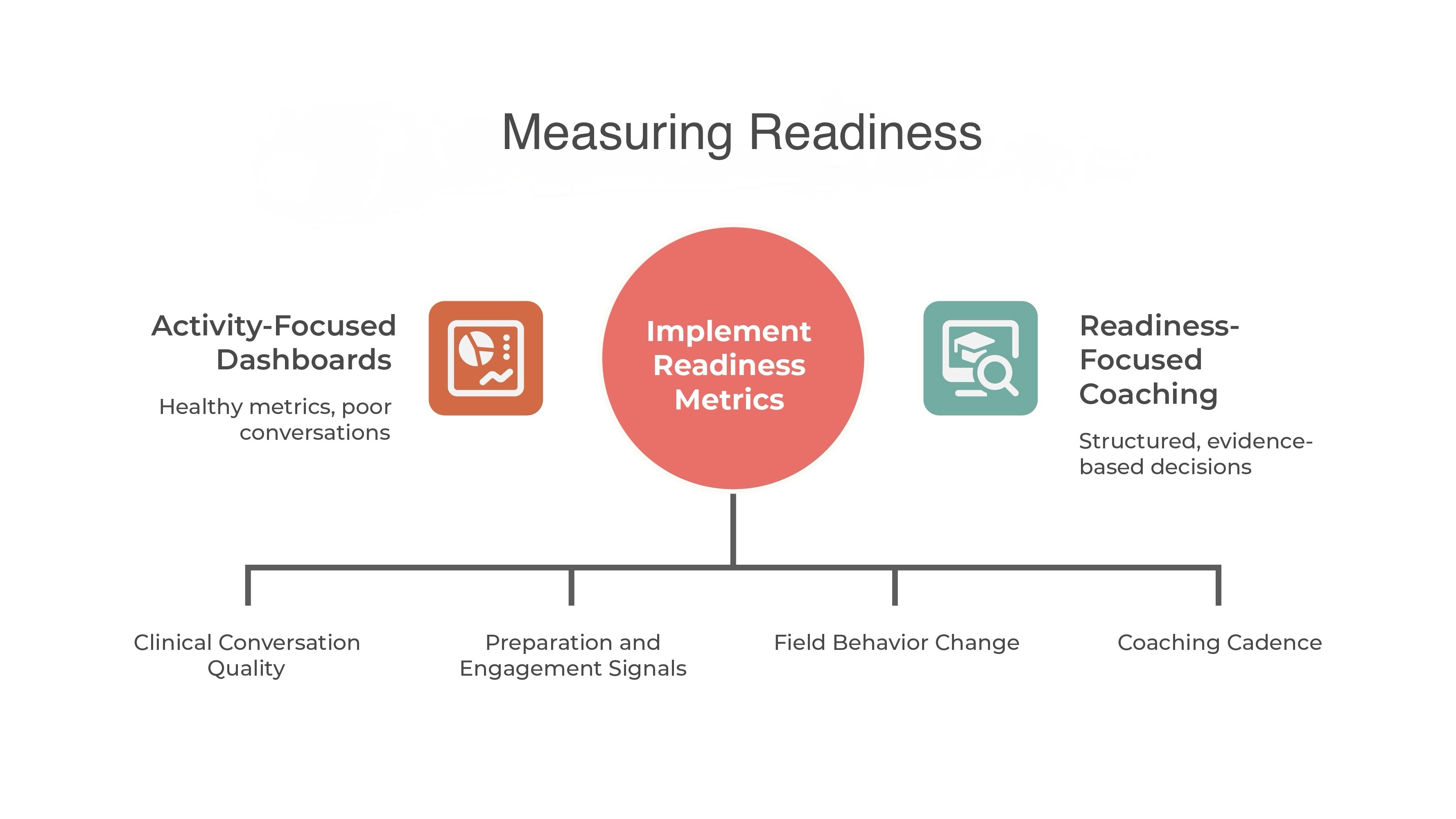
Data that informs the conversation. Managers who walk into a coaching conversation knowing which scenarios a rep has practiced, where their performance scores show consistent gaps, and what clinical objections they handle well versus poorly, have sharper and faster coaching conversations than those who rely on memory and impression.
For medical device organizations serious about building this kind of coaching structure consistently across their field force, the challenge is not intent. It is execution at scale.
That is where SmartWinnr comes in.
How SmartWinnr Supports a Coaching Culture in Medical Device Sales?
Medical device sales organizations trust SmartWinnr platform to build the coaching infrastructure that individual manager effort alone cannot sustain at scale.
Managers get visibility into how each rep is developing across specific clinical and institutional skills, so coaching conversations are grounded in data rather than impression. Reps practice realistic OR, procurement, and multi-stakeholder conversations through AI simulations, receive immediate structured feedback, and build the field confidence that only comes from deliberate, repeated practice.
From new device launches to onboarding new field cohorts, SmartWinnr is purpose built for the complexity, compliance demands, and multi-stakeholder reality of medical device selling.
Learn how top organizations in the medical device industry are using SmartWinnr to turn coaching into a repeatable driver of sales success.
Or you can Request a demo to see SmartWinnr in action for your medical device sales team.
Disclaimer: This content reflects industry practices and does not constitute medical, legal, or regulatory advice.
Last Updated: