
Smart AI Blog Summary
Get a quick blog summary from any of the below LLM's
What You'll Learn
In most medical device commercial organizations, coaching effectiveness is measured through a combination of activity tracking and manager judgment.
Call logs confirm field presence. Completion certificates confirm attendance. Manager ride-along reports confirm that observations happened.
And when asked to rate individual specialist readiness for a first-case scrub-in with a skeptical surgeon or a VAC presentation at a major health system, most managers rely on intuition accumulated through field observation rather than structured, comparable measurement.
The problem is not that manager intuition is worthless. Experienced field managers often have genuinely accurate assessments of individual specialist capability.
The problem is that intuition-based coaching effectiveness measurement does not scale, does not enable meaningful comparison across teams and regions, does not allow early identification of readiness gaps before they manifest as field performance problems, and does not provide the structured data that L&D leaders need to make evidence-based investment decisions.
In short, it works for the manager who has it and fails everyone else who needs the same insight at scale.
This article covers the shift from activity metrics to behavioral readiness signals, and what that shift makes possible for medical device commercial and L&D leaders.
A Smarter Approach to Measuring Device Team Readiness
The limitations of activity-based coaching effectiveness measurement are particularly pronounced in medical device sales, where the complexity of what specialists are being asked to do makes behavioral quality far more commercially relevant than behavioral quantity.
Call volume data confirms that a specialist visited accounts. It says nothing about whether they were clinically credible, commercially effective, or compliant in the conversations they had during those visits.
In-service completion tracking confirms that an in-service was delivered. It does not measure whether the clinical education provided was accurate, clear, and effective in building clinical staff confidence in the device.
Training attendance and module completion confirm that a specialist was exposed to content. They do not confirm that the specialist can apply that content in the complex, multi-stakeholder conversations that drive device adoption, conversations that fall within the training and competence expectations outlined in ISO 13485 quality management requirements for medical device organizations. And manager observation frequency confirms that observations happened, but without a structured behavioral assessment framework, the quality and comparability of those observations vary significantly across managers and regions.
Picture this: a regional commercial leader reviews her team's monthly metrics.
Call volume is strong. LMS completion rates are at 98%. Manager ride-along frequency is on target. Everything looks healthy on the dashboard. Then she attends a VAC presentation with a specialist from her top-performing territory.
The specialist knows the product. But when the hospital's value analysis coordinator asks a detailed question about post-procedure reimbursement coding, the specialist's response is vague and hedged. The meeting ends without a commitment.
The dashboard did not predict this, because it was measuring what specialists were doing, not how well they were doing it.
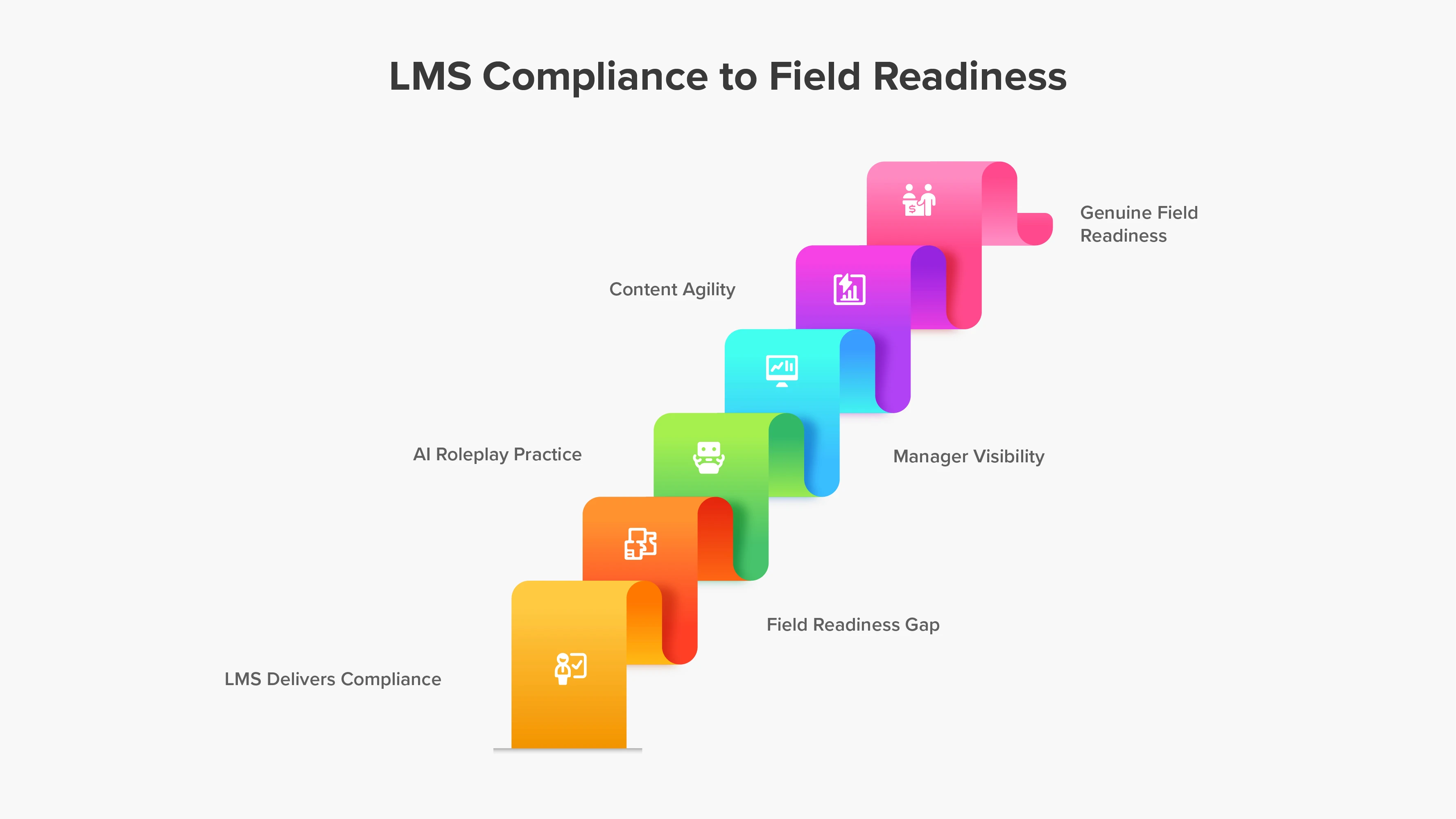
When the dashboard shows green and the field outcome is yellow, the measurement system is not measuring the right things. That gap is what the shift to behavioral readiness signals is designed to close.
Readiness Signals That Reflect Coaching Effectiveness
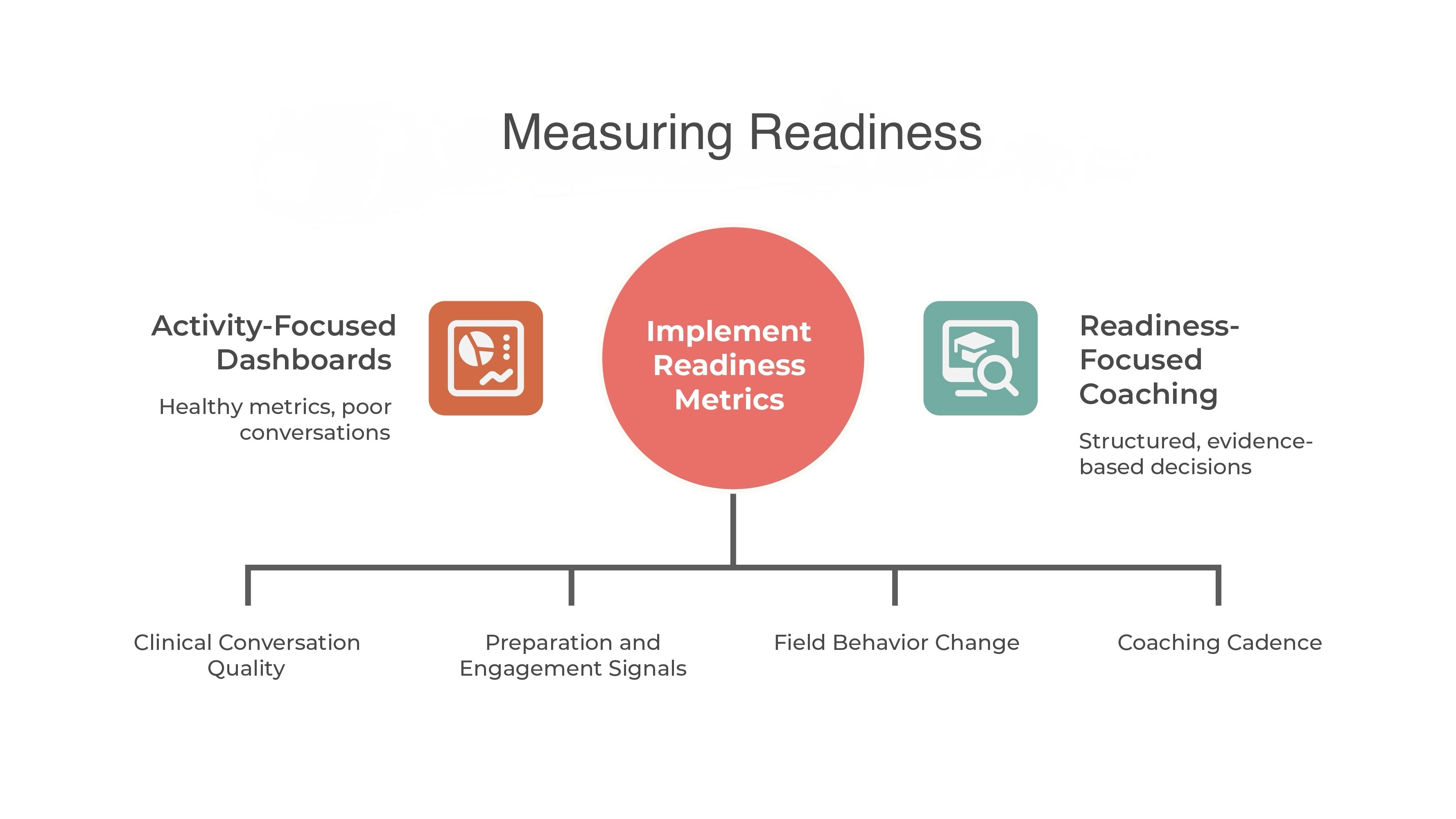
Building a meaningful coaching effectiveness measurement framework for medical device teams requires identifying the behavioral indicators most directly connected to field performance outcomes. These fall into three categories that together provide a comprehensive picture of coaching impact.
Clinical Conversation Quality Indicators
These measure the behavioral quality of practice and observed interactions, the most direct indicators of coaching effectiveness connected to field performance:
Scenario performance on structured AI Roleplay across the full stakeholder conversation range, including surgeon, nurse, biomedical, procurement, and administrator scenarios, assessing accuracy, tone, and clinical appropriateness across each interaction type.
Objection response quality across stakeholder types, providing structured evaluation of the accuracy, clinical appropriateness, and compliance of responses to the specific objection patterns most common in each stakeholder category.
In-service delivery readiness, assessing setup explanation quality, troubleshooting response accuracy, and protocol communication clarity, the specific quality dimensions that determine whether an in-service builds or erodes clinical staff confidence.
Clinical evidence fluency, measuring the precision and confidence with which specialists reference study data, outcomes evidence, and approved clinical claims in both practice scenarios and observed field conversations.
Knowledge retention over time, tracking performance on spaced repetition modules through targeted learning paths across clinical, procedural, and commercial content to identify specialists maintaining strong retention versus those showing decay patterns that require targeted reinforcement before field performance is affected.
Preparation and Engagement Signals
These measure the preparation behaviors that precede and predict field performance, providing leading indicators of readiness that enable coaching interventions before gaps become field problems:
AI roleplay practice frequency ahead of high-stakes account interactions, a behavioral signal of preparation investment directly connected to conversation quality in subsequent field interactions.
Scenario improvement trajectory, whether specialist performance on structured practice scenarios is improving over time across all stakeholder conversation types, indicating whether coaching is producing genuine skill development.
Manager-assigned scenario completion rate, an indicator of both coaching execution effectiveness and specialist engagement with the preparation process.
A pre-case preparation index, a composite measure of practice activity, clinical knowledge review, and scenario completion in the days immediately before high-stakes case support and account interactions.
Cross-scenario adaptability score, a measure of how effectively specialists transfer skills learned in one conversation type to unfamiliar or hybrid stakeholder scenarios, reflecting the depth and durability of coaching impact beyond rehearsed situations.
Picture this: a manager is reviewing her team's preparation ahead of a high-stakes first case with a major academic medical center.
She checks the platform dashboard and sees that the specialist covering that account has not completed any AI roleplay practice in two weeks. That signal, visible before the interaction happens, gives her time to intervene.
She assigns a targeted practice session and schedules a pre-call coaching conversation. The specialist walks into the academic medical center prepared. Without that visibility, she would only have found out there was a gap after the interaction, when the damage was already done.
Field Behavior Change Indicators
These connect coaching input to observable field behavior change, the ultimate validation that coaching is producing the capability improvements it is designed to build:
Manager-observed conversation quality versus baseline using structured behavioral observation frameworks that enable meaningful comparison across managers and regions.
Post-launch retention through structured knowledge and skill assessments at 30, 60, and 90 days post-certification, measuring whether coaching and reinforcement programs are sustaining the capabilities built during training.
Stakeholder feedback signals where accessible, providing qualitative indicators from surgeons and clinical staff about specialist credibility, clinical accuracy, and the quality of in-service and case support interactions.
How the Measurement Shift Changes Coaching Behavior
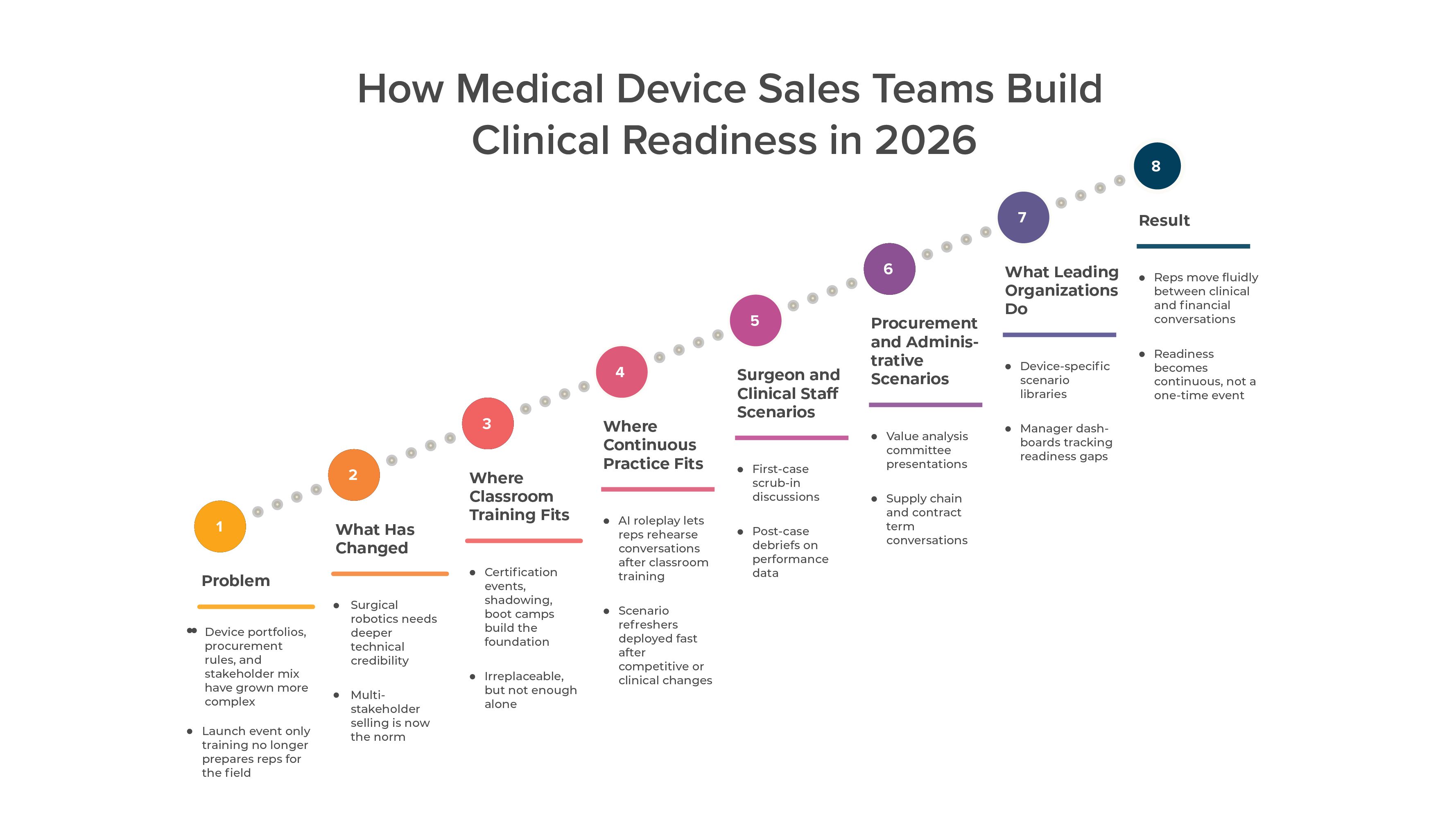
The shift from activity metrics to behavioral readiness signals does something beyond providing better data. It changes what managers pay attention to, and therefore what they coach.
When a manager's effectiveness is measured by call volume and completion rates, they focus on call volume and completion rates. When it is measured by scenario performance across stakeholder conversation types and pre-case practice frequency, they focus on behavioral readiness.
Because coaching attention shapes specialist behavior, the measurement framework determines, to a significant degree, what kind of readiness the team develops.
Organizations that have made this shift are not just measuring better, a distinction consistent with the Association for Talent Development's research on sales coaching effectiveness. They are coaching differently. Their managers are having more specific coaching conversations, grounded in behavioral data rather than general impressions. Their specialists are receiving more targeted practice assignments that address real gaps rather than generic reinforcement. And their commercial leaders have the visibility to allocate coaching resources based on where readiness gaps are most commercially consequential, before those gaps show up in field performance data.
This is not a small operational shift. It is a structural change in how coaching is designed, delivered, and evaluated. And for medical device commercial organizations where each specialist interaction carries significant commercial weight, the downstream impact of that structural change is measurable in field performance outcomes, not just coaching satisfaction scores.
Building a Coaching Cadence That Sustains Readiness
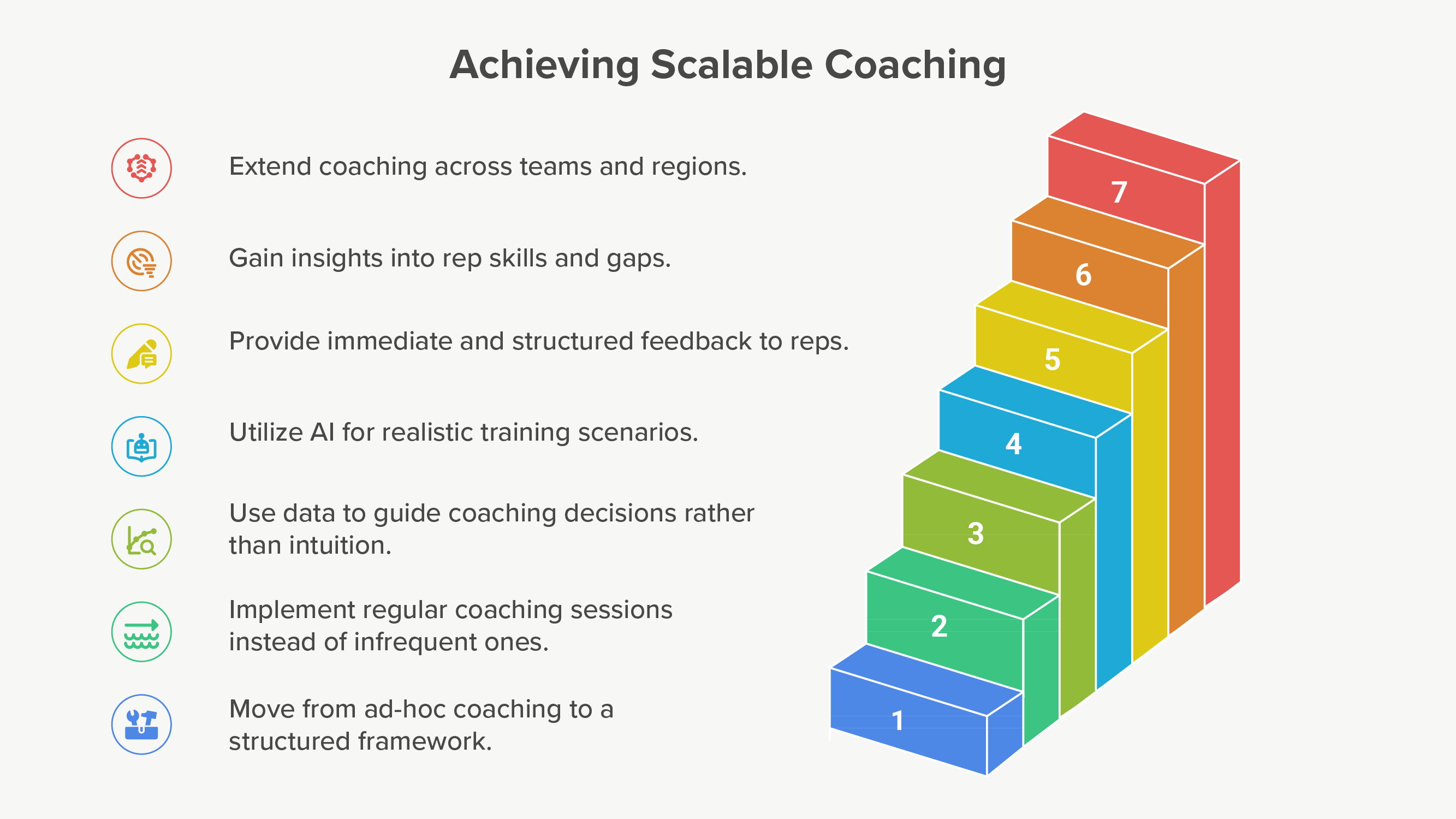
Shifting to readiness-based measurement only delivers its full value when it is paired with a field coaching cadence designed to act on what the measurement reveals. Many device organizations have the data to identify readiness gaps. Fewer have a systematic process for converting that data into targeted coaching interventions before the gap shows up in a field interaction.
The most effective coaching cadences for medical device specialist teams in 2026 share three structural features.
First, they are proactive rather than reactive. Managers review readiness dashboards before high-stakes account interactions and assign targeted practice sessions when they identify gaps, rather than reviewing performance after the fact.
Second, they are specific rather than general. Coaching conversations are grounded in scenario performance data across individual stakeholder conversation types, not in broad impressions of overall capability. A manager who can tell a specialist exactly which objection type their AI roleplay data shows them struggling with is having a fundamentally more useful coaching conversation than one who can only say that their presence in the field is strong.
Third, they close the loop between coaching conversation and preparation activity. A coaching conversation without a follow-through practice assignment often stays as intent rather than becoming readiness. Manager-assigned scenario practice, triggered directly from coaching conversation insights and tracked through the same dashboard, ensures that coaching produces structured preparation rather than remaining as verbal feedback alone.
As medical device commercial leaders look for platforms that move coaching measurement beyond activity dashboards, AI-powered sales enablement platforms are providing the behavioral readiness infrastructure that fills that gap. SmartWinnr AI Roleplay platform is built to make that shift practical and scalable.
How SmartWinnr Supports Coaching Effectiveness Measurement
SmartWinnr provides medical device managers and commercial excellence leaders with the data infrastructure to measure coaching effectiveness at the behavioral level that predicts field performance.
For medical device commercial and enablement leaders, SmartWinnr provides:
Rep-level readiness dashboards that track scenario performance, practice frequency, and improvement trajectories across all stakeholder conversation types, giving managers the data to allocate coaching resources where they are most needed.
AI roleplay scenarios across the full stakeholder conversation range that give specialists structured practice on surgeon, nurse, procurement, and administrator interactions, generating the performance data that makes coaching conversations specific and evidence based.
Team-level analytics that identify organization-wide readiness patterns and the highest-leverage improvement opportunities for L&D investment decisions.
Structured scenario performance data that gives managers and specialists a shared, objective foundation for coaching conversations, replacing general impressions with comparable behavioral evidence.
Coaching cadence support that connects conversation insights directly to assigned practice activity, ensuring that coaching produces measurable preparation change and not just verbal feedback.
Request a demo to see how SmartWinnr supports coaching effectiveness measurement for medical device teams through behavioral readiness signals, AI Roleplay, and manager dashboards.
Disclaimer: This content reflects industry practices and does not constitute medical, legal, or regulatory advice.
Last Updated: