
Smart AI Blog Summary
Get a quick blog summary from any of the below LLM's
What You'll Learn
Standardizing field messaging across your sales and clinical teams starts with recognizing that regulated industries like medical devices put multiple representatives of the same company in front of the same clinical stakeholder within a matter of weeks, and if their stories do not match, the account absorbs the cost. Consider a scenario common in device commercial organizations, where a senior orthopedic surgeon at a regional medical center has three interactions with the same device company in a single month.
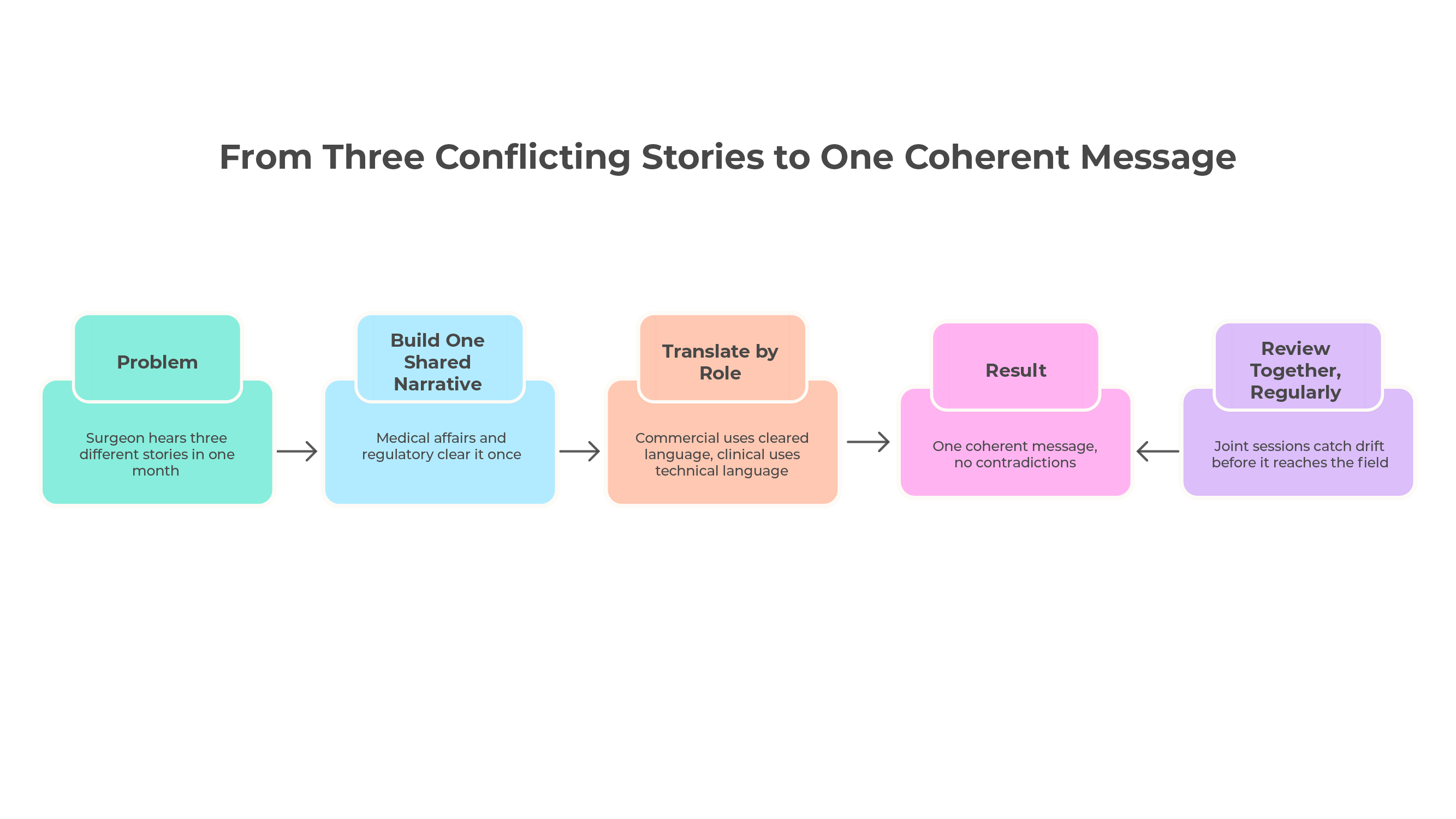
A device sales rep visits about a new tibial system and describes the implant's clinical data as showing consistent outcomes across patient populations, while a clinical application specialist who comes in the following week emphasizes specific patient subgroup performance instead, and a clinical educator at a sponsored dinner offers yet a third characterization of the same trial. The surgeon notes the inconsistency to all three representatives, and while she does not switch suppliers over it, her trust in the organization's clinical accuracy is damaged in a way that takes more than a year to repair.
What this reveals: three people from the same company delivered three different narratives about the same device, not because anyone was wrong, but because the messaging infrastructure never connected them.
What Is Cross-Team Messaging Alignment in Medical Device Sales?
Cross-team messaging alignment is the practice of ensuring your commercial reps and clinical education specialists draw from the same clinical evidence base, even though each team frames that evidence differently within its own compliance role. It is not about making both teams say identical words. It is about making sure neither team contradicts the other in front of the same clinical stakeholder.
Why Does Messaging Fragmentation Happen in Device Commercial Organizations?
Medical device commercial organizations typically operate with distinct commercial and clinical education functions that report to different organizational leaders with different priorities, train separately with different content and messaging frameworks, attend different internal events where different aspects of the device portfolio get emphasized, get evaluated on different performance criteria that may implicitly prioritize different aspects of the device's clinical story, and rarely have structured touchpoints where messaging consistency gets explicitly reviewed.
Fragmentation is the structural default in your organization. Coherence requires intentional design.
Messaging Coherence Without Role Confusion
Your commercial reps and clinical specialists operate under different expectations in institutional accounts. A device sales rep engaging a surgeon on product adoption is doing a promotional activity governed by cleared device claims and promotional guidelines. A clinical application specialist providing procedural support and technical education is performing a function that is explicitly non-promotional in many institutional contexts.
Cross-team messaging alignment has to preserve this distinction while making sure both teams communicate from the same clinical and scientific foundation. A unified scientific narrative for the device is not a promotional document, and it is not a clinical education script. It is the evidence base that both teams draw from within their respective roles.
Shared foundation: the clinical and technical evidence your organization stands behind.
Role-specific communication: how each team translates that foundation within its appropriate function and compliance framework.
What Practical Approaches Support Cross-Team Alignment?
A Shared Technical Narrative
The foundational step is a shared technical and clinical narrative for each major device, developed with input from medical affairs, clinical education, and regulatory, that establishes the clinical evidence and technical characterization your organization will stand behind across all interactions. Both your commercial team and your clinical team draw from this narrative in their role-specific communications.
Consider this approach: one global device company builds what it calls a "clinical story platform" for each major product line, reviewed by medical affairs and cleared by regulatory, that sits upstream of all field-facing communications. Commercial messaging and clinical education content are both derived from it, with role-specific translation, rather than developed independently.
What this reveals: a single upstream narrative, reviewed once and translated twice, prevents the drift that happens when each team builds its own messaging independently.
Role-Specific Messaging Guides
From the shared technical narrative, each field role gets a messaging guide that translates the shared evidence base into language and framing appropriate for its function. Your commercial guide reflects cleared promotional claims and healthcare professional (HCP) engagement language. Your clinical education guide reflects technical support and procedural education language.
Same foundation. Different translations. Compliant within their respective frameworks.
Joint Orientation Sessions
One of the most consistently high-value investments you can make in messaging coherence is a structured joint session where your commercial and clinical education representatives build mutual understanding of their respective roles, boundaries, and the questions each team should refer to the other.
This is not a session where they share messaging scripts. It is a session where they understand each other's function well enough to avoid contradicting each other with clinical stakeholders.
Shared Content Libraries with Role-Separated Access
Digital training platforms that maintain shared approved content libraries while providing role-specific learning paths give your commercial and clinical teams access to the same evidence base without collapsing the role distinctions that compliance requires.
Cross-Functional Communication Between Field and Clinical Leadership
Regular touchpoints between your commercial and clinical education leadership, quarterly at minimum, focused on what clinical stakeholders are hearing and asking from both teams, give you the intelligence needed to maintain coherence as the competitive and clinical landscape evolves.
How Do You Sustain Alignment as the Device Portfolio Evolves?
Device messaging alignment is not a one-time exercise. New clinical data, product updates, indication expansions, and competitive entries all create pressure on messaging coherence over time. Organizations that treat alignment as an ongoing practice, with a regular review cadence and a process for updating both commercial and clinical education messaging simultaneously, maintain coherence through these changes.
When clinical data changes, update both your commercial and clinical education messaging before either team delivers the new information in the field. When a new indication is added, both teams need updated messaging at the same time, not sequentially. When competitive entries change the clinical conversation landscape, both teams need the same updated clinical context.
Key Takeaways
Messaging fragmentation between your commercial and clinical teams is a structural default. Coherence requires intentional design.
Standardization means a shared clinical foundation, not identical language across roles.
Joint orientation sessions build mutual understanding of role boundaries without creating role confusion.
Shared content libraries with role-separated access operationalize alignment at scale.
Maintain alignment through portfolio and evidence base changes by updating both teams simultaneously.
How Does SmartWinnr Support Cross-Team Messaging Alignment?
Maintaining a coherent clinical narrative across your field sales and clinical education teams at scale takes platform infrastructure, not manual coordination. A shared, cleared content library feeds role-specific learning tracks through Digital Content Management and Targeted Learning, so both teams draw from the same approved foundation while keeping their compliance frameworks separate. AI Roleplay lets each team practice its own clinical conversation scenarios with feedback calibrated to its specific engagement framework, and assessments can check whether both teams are still operating from the same underlying clinical understanding from their respective functional perspectives.
When clinical evidence or cleared indications change, updated content reaches both teams on the same timeline instead of one team lagging behind the other. Dashboards surface emerging messaging drift between the two teams before it reaches a clinical account, and during a launch, both field teams can be brought to readiness on the same schedule. SmartWinnr is built to make that kind of shared-narrative model hold at field force sizes where manual alignment cannot.
Ready to see how a shared-narrative model could work across your teams? Request a demo to walk through it with your organization.
Frequently Asked Questions
What causes messaging fragmentation between commercial and clinical teams in medical device organizations?
Messaging fragmentation happens because commercial and clinical education functions typically report to different leaders, train on different content, and get evaluated on different criteria. Without a structured touchpoint to review consistency, divergence becomes the default rather than the exception. Left unaddressed, this fragmentation tends to surface first with the clinical stakeholders both teams visit, not internally.
Does standardizing messaging mean commercial and clinical teams should say the same words?
No. Standardization means both teams draw from the same underlying clinical evidence base, not that they use identical language. Commercial reps translate that foundation into promotional, cleared-claim language, while clinical specialists translate it into non-promotional technical and procedural language.
What is a shared technical narrative, and why does it matter?
A shared technical narrative is a single clinical and scientific foundation for a device, developed with medical affairs, clinical education, and regulatory input, that both commercial and clinical teams draw from for their respective, role-specific communications. It prevents each team from independently developing its own version of the device story. Commercial and clinical teams still translate that narrative differently within their own compliance frameworks, but they start from the same evidence base.
How often should commercial and clinical leadership meet to maintain messaging alignment?
Quarterly touchpoints are a reasonable minimum, focused specifically on what clinical stakeholders are hearing and asking from both teams. More frequent contact may be needed during a launch, an indication expansion, or a period of active competitive pressure. The goal of these touchpoints is catching messaging drift before it reaches a clinical account, not simply reviewing what already happened.
What role do joint orientation sessions play in messaging alignment?
Joint orientation sessions help commercial and clinical education representatives understand each other's roles, boundaries, and referral points, so neither team contradicts the other with a shared clinical stakeholder. They are not a venue for sharing messaging scripts. The goal is mutual understanding of function, not identical talking points between the two teams.
Disclaimer: This content reflects industry practices and does not constitute medical, legal, or regulatory advice.
Last Updated: