
Smart AI Blog Summary
Get a quick blog summary from any of the below LLM's
What You'll Learn
Clinical readiness has become the deciding factor in how well your medical device field team performs in 2026. The clinical and commercial complexity your reps navigate every day has grown faster than traditional training models can support.
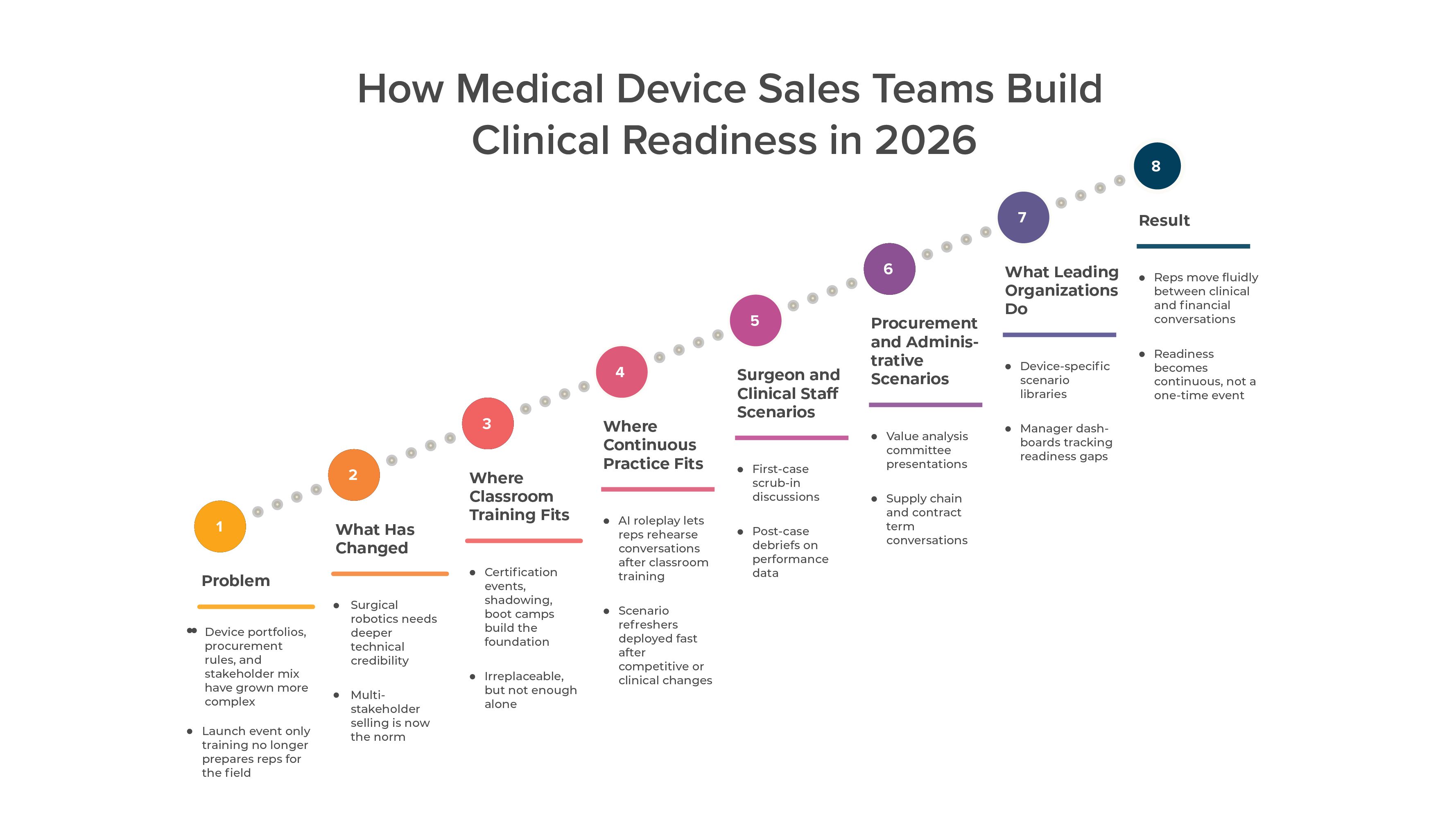
Your device portfolio is broader than it was three years ago. Hospital procurement processes are more rigorous, and surgical robotics and advanced procedure platforms demand a level of procedural fluency that a product knowledge module alone cannot deliver. The stakeholders your reps must be credible with in a single account, surgeons, scrub nurses, biomedical engineers, procurement officers, and hospital administrators, have never been more varied.
In this environment, training a rep at a launch event and sending them into the field is no longer enough on its own. The field interactions that determine your commercial outcomes are too complex, too varied, and too high stakes for preparation that happens only a few times a year. This is why medical device organizations are extending structured training with continuous, scenario-based practice.
What Is Clinical Readiness in Medical Device Sales?
Clinical readiness is the ability of a medical device rep or clinical specialist to hold a credible, accurate, and compliant conversation with any stakeholder in an account, from a surgeon in the OR to a procurement officer in a value analysis committee meeting, without hesitation or gaps in clinical or commercial knowledge. It extends beyond product knowledge into procedural fluency, stakeholder-specific communication, and the confidence to handle real-time questions in high-stakes settings.
What Has Changed in the 2026 Clinical Selling Environment?
The medical device commercial environment of 2026 is structurally different from even three years ago. Several forces have converged to raise the readiness bar for your team at the same time, creating a challenge that incremental adjustments to existing training programs cannot fully address.
Buying groups in healthcare procurement have grown larger and more cross-functional, often spanning clinical, financial, and administrative stakeholders on a single decision. For your reps, this means a single account now requires preparation for fundamentally different conversation types, simultaneously, rather than one conversation style repeated across a territory.
The specific forces reshaping your team's selling environment in 2026 include:
Surgical robotics adoption has accelerated significantly, requiring your clinical specialists to support increasingly complex procedural environments with deep technical credibility.
Value-based care contracting means hospital administrators and CFOs are scrutinizing device selection decisions with a level of financial rigor once reserved for larger capital purchases.
IVD and diagnostic portfolios have grown substantially more technically complex, demanding specialists who can hold genuinely detailed clinical conversations with laboratory directors and pathologists.
Multi-stakeholder selling is now the norm rather than the exception. One account interaction may simultaneously involve a surgeon, a scrub nurse, a biomedical team, and a procurement officer.
510(k) clearance timelines have compressed, requiring your commercial team to be product-ready and conversation-ready before a formal public launch announcement is made. The FDA's 510(k) premarket notification pathway outlines the clearance process your launch timelines are built around.
Where Does Classroom Training End and Continuous Practice Begin?
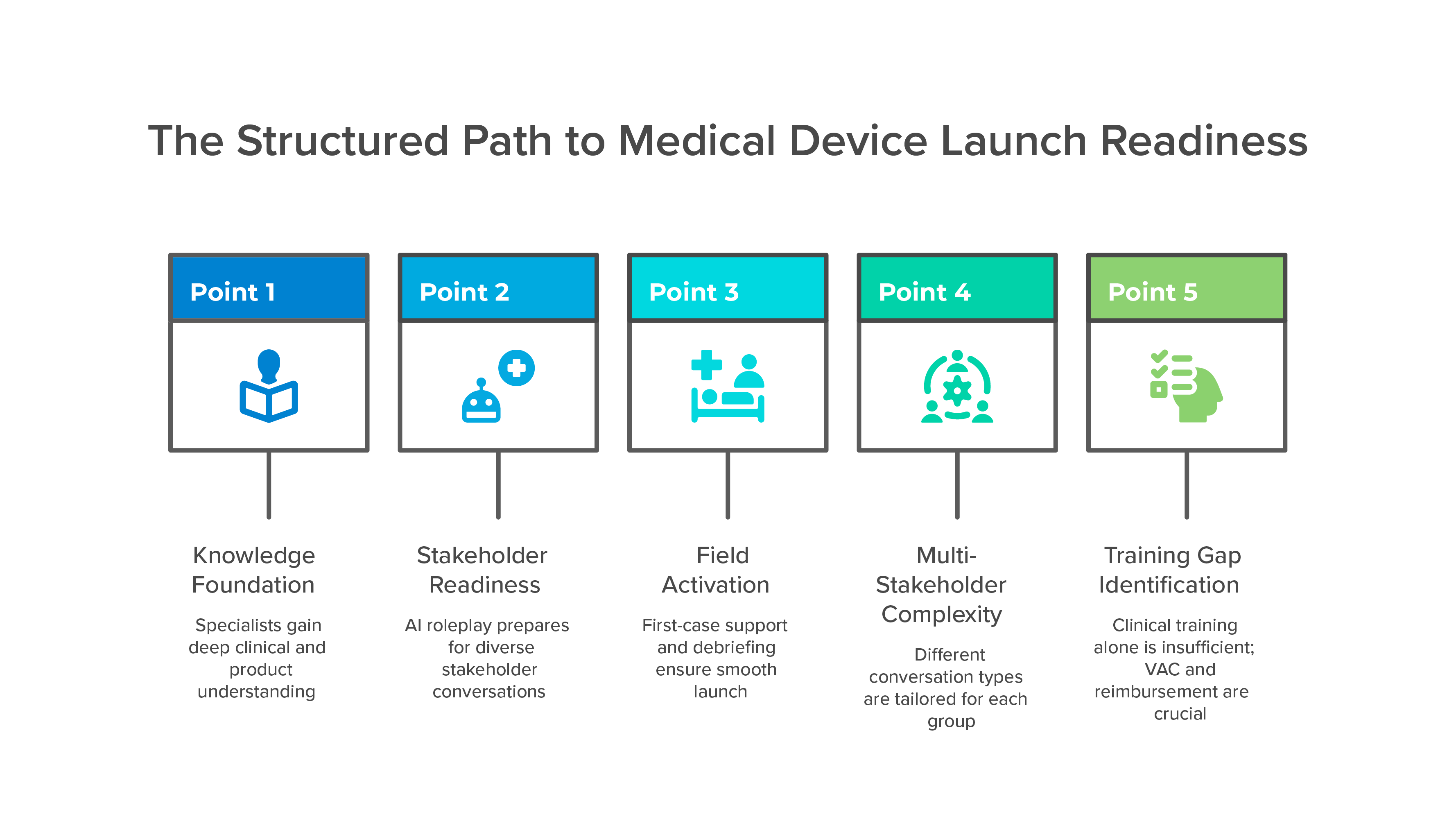
The answer to the clinical readiness challenge in medical device sales is not to abandon structured training programs. In-person certification events, clinical shadowing, launch training boot camps, and in-service simulation programs remain irreplaceable for building the procedural familiarity, product knowledge, and regulatory awareness your device roles require. These programs create the foundation every clinical specialist builds on.
What AI Roleplay adds is the ability for your team to practice the stakeholder conversations that follow clinical training in a structured, repeatable, and scalable way that does not require a live facilitator or a manager's time for every repetition. A clinical specialist can spend time in the simulation lab learning how to set up a device, and then immediately practice the surgeon conversation they will have in the OR the following morning. These two forms of preparation complement each other rather than compete.
In practical terms, continuous AI-supported practice extends your classroom training in these specific ways:
Your clinical specialists can rehearse surgeon objection conversations in detail the night before a first-case scrub-in.
New account managers can practice procurement and value analysis committee conversations before their first significant hospital interaction.
Refresher scenario modules can be deployed across your distributed specialist team within days of a new competitive device entry or clinical evidence publication.
Managers can assign targeted practice scenarios based on what they observe during field rides and post-call coaching conversations, an approach field coaching programs are built to support.
What Do Clinical Readiness Practice Scenarios Look Like in 2026?
Effective AI roleplay for your medical device team is grounded in the specific clinical and commercial interactions your specialists encounter across care settings. The scenarios that matter most in 2026 reflect the full range of stakeholder conversations, not just the surgeon conversation that tends to receive the most attention.
Surgeon and Clinical Staff Conversations
These interactions are the most technically demanding and require the highest level of clinical credibility. Your specialists practicing these scenarios are building the fluency to hold genuinely clinical conversations with confidence:
Preparing for a first-case scrub-in discussion with a cardiovascular surgeon who has not yet used the device and has specific questions about setup and procedural integration.
Practicing how to respond when a scrub nurse raises patient safety concerns about a device change during a live OR environment conversation.
Simulating a structured post-case debrief where the surgeon has questions about device performance data and wants to compare it against their existing approach.
What this reveals: the conversations your specialists need most are unscripted and time-sensitive, which is exactly why repeatable practice before the case matters more than a one-time certification event.
Procurement and Administrative Interactions
These conversations require a completely different kind of preparation than clinical discussions, combining financial fluency, contract awareness, and the ability to articulate value in the language of healthcare economics rather than clinical outcomes alone:
Preparing for a value analysis committee presentation that requires articulating total cost of care, reimbursement pathways, and clinical outcomes data simultaneously.
Practicing the conversation with a supply chain director who is comparing two competitive device offerings on contract terms and GPO eligibility.
Simulating a hospital administrator's questions about procedure reimbursement and the financial case for adopting a new platform.
What this reveals: your reps who can move fluidly between clinical and financial language in the same account are the ones who shorten the sales cycle, and that fluency comes from deliberate, repeated practice rather than instinct alone.
How Are Medical Device Organizations Building Readiness in 2026?
In medical device sales, where the launch window for a new platform can be decisive, a maturity gap in field readiness has direct commercial consequences.
The most field-ready medical device organizations in 2026 are building readiness infrastructure with these characteristics:
Device-specific scenario libraries that reflect the actual stakeholder conversations your specialists encounter across care settings, not generic sales conversation frameworks.
Clinical conversation simulations with AI feedback on accuracy, tone, and procedural appropriateness that give your specialists a consistent coaching voice between manager interactions.
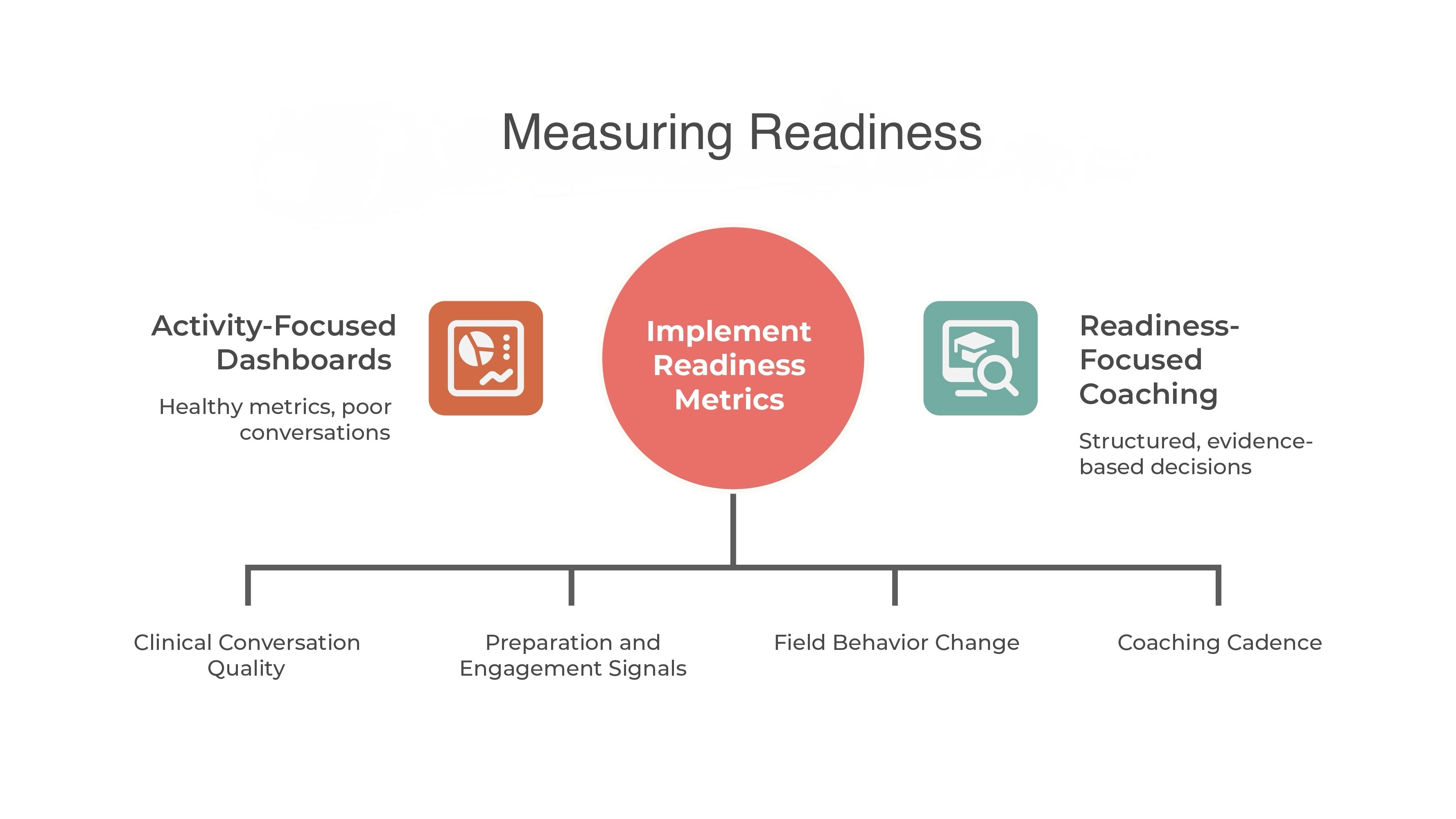
Manager dashboards that track readiness levels across your full commercial specialist team, enabling you to identify preparation gaps before they become field performance issues.
Modular, field-friendly practice formats designed for use between cases and account visits, not just in formal training sessions.
Quality frameworks such as ISO 13485 for medical device quality management systems reinforce why this level of structured, auditable preparation matters across your organization, not just at the individual rep level.
How Does an AI Roleplay Platform Support Medical Device Sales Readiness?
The most field-ready medical device teams in 2026 are practicing before the case, not just after the training event. Structured AI roleplay is making that level of preparation scalable across your distributed specialist team and giving you the visibility to act on readiness data before it matters in the field.
SmartWinnr's AI Roleplay platform supports medical device organizations by providing structured practice environments that mirror the genuine complexity of clinical and commercial interactions in the field. The platform is designed to complement your existing training programs, adding a consistent, scalable practice layer that keeps your specialists prepared between launch events and training certifications.
For your medical device commercial team, the platform provides:
Scenario libraries built around real device selling contexts, covering surgeon, nurse, biomedical, procurement, and administrator conversation archetypes across care settings.
Compliance-aware coaching that reinforces approved clinical messaging and stays within regulatory boundaries throughout the practice experience.
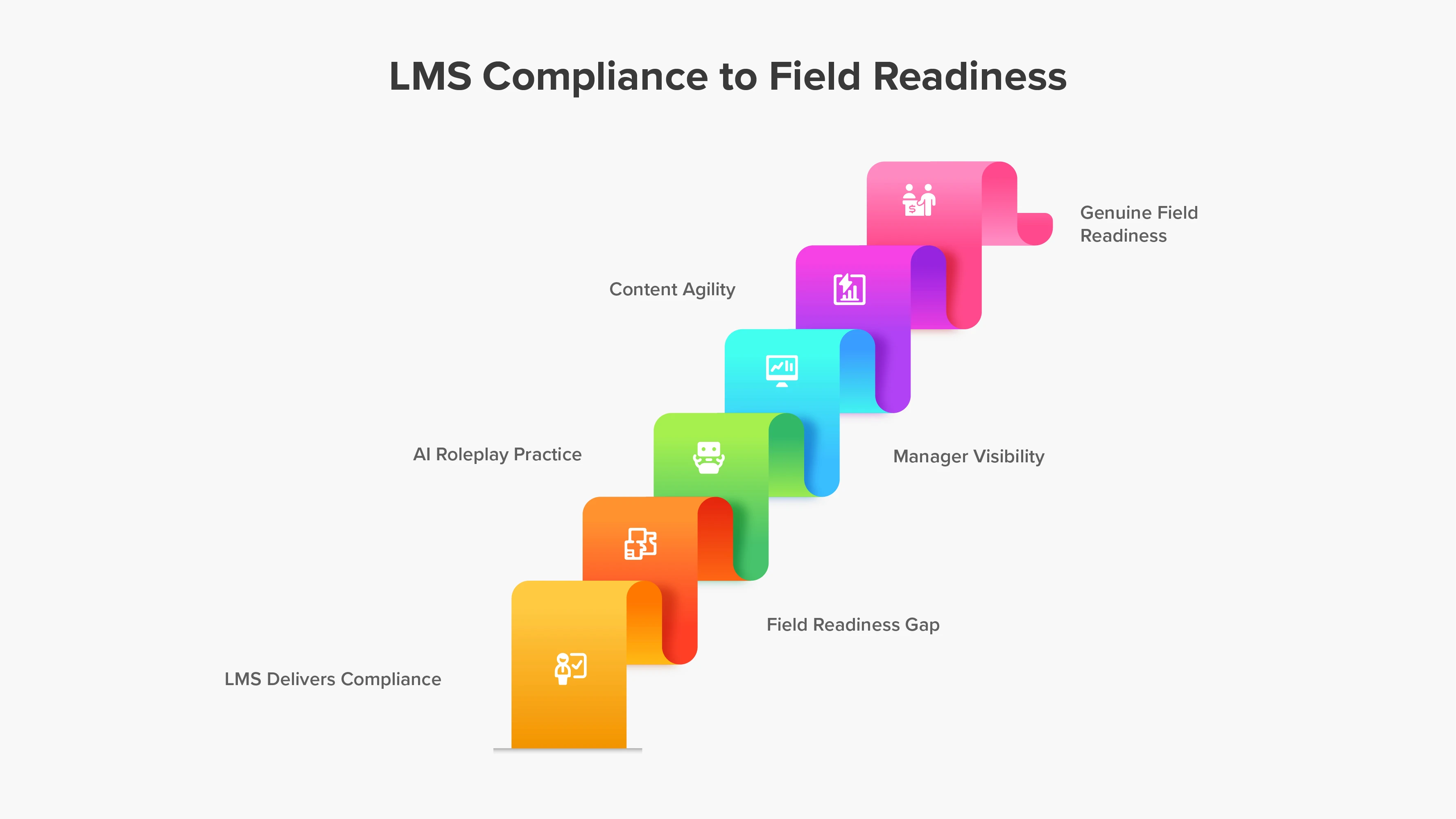
Integration with your existing LMS and enablement infrastructure for a connected readiness ecosystem that does not require reps to navigate separate platforms.
Manager visibility into individual and team readiness levels before high-stakes account interactions, giving you the information you need to deploy coaching resources where they are most needed.
Explore how this approach applies to pharma sales enablement as well, if your organization spans both categories.
Book a quick demo to explore how this approach supports clinical readiness for your organization.
Frequently Asked Questions
What is clinical readiness in medical device sales?
Clinical readiness is your team's ability to hold a credible, accurate, and compliant conversation with any account stakeholder, from a surgeon to a procurement officer, without gaps in clinical or commercial knowledge. It goes beyond product knowledge into procedural fluency and stakeholder-specific communication. Organizations build it through a combination of classroom training and continuous, scenario-based practice
How is AI roleplay different from traditional medical device sales training?
Traditional training, including certification events and clinical shadowing, builds the procedural and product knowledge foundation your specialists need. AI roleplay extends that foundation by letting your team practice the stakeholder conversations that follow, such as surgeon objections or procurement discussions, in a repeatable format that does not require a live facilitator for every session. The two approaches work together rather than replacing one another.
What stakeholder conversations should medical device reps practice most?
Your reps benefit most from practicing across the full range of stakeholders they encounter in an account: surgeons and clinical staff on procedural and outcomes questions, and procurement or administrative contacts on cost, contracting, and reimbursement questions. Multi-stakeholder accounts often require moving between both conversation types in the same visit, which is why practicing both matters.
How quickly can a medical device team deploy new scenario practice after a competitive launch or clinical update?
Refresher scenario modules can typically be deployed across a distributed specialist team within days of a new competitive device entry or clinical evidence publication, since AI-supported practice does not depend on scheduling a live trainer session. This lets your commercial leadership respond to market changes without waiting for the next in-person training event.
How do managers get visibility into a medical device team's readiness levels?
Manager dashboards track readiness levels across the full commercial specialist team, showing where individual reps or the broader team have preparation gaps before those gaps affect field performance. This visibility lets managers assign targeted practice scenarios based on what they observe during field rides and post-call coaching conversations, rather than relying on periodic certification checkpoints alone.
Disclaimer: This content reflects industry practices and does not constitute medical, legal, or regulatory advice.
Last Updated: