
Smart AI Blog Summary
Get a quick blog summary from any of the below LLM's
What You'll Learn
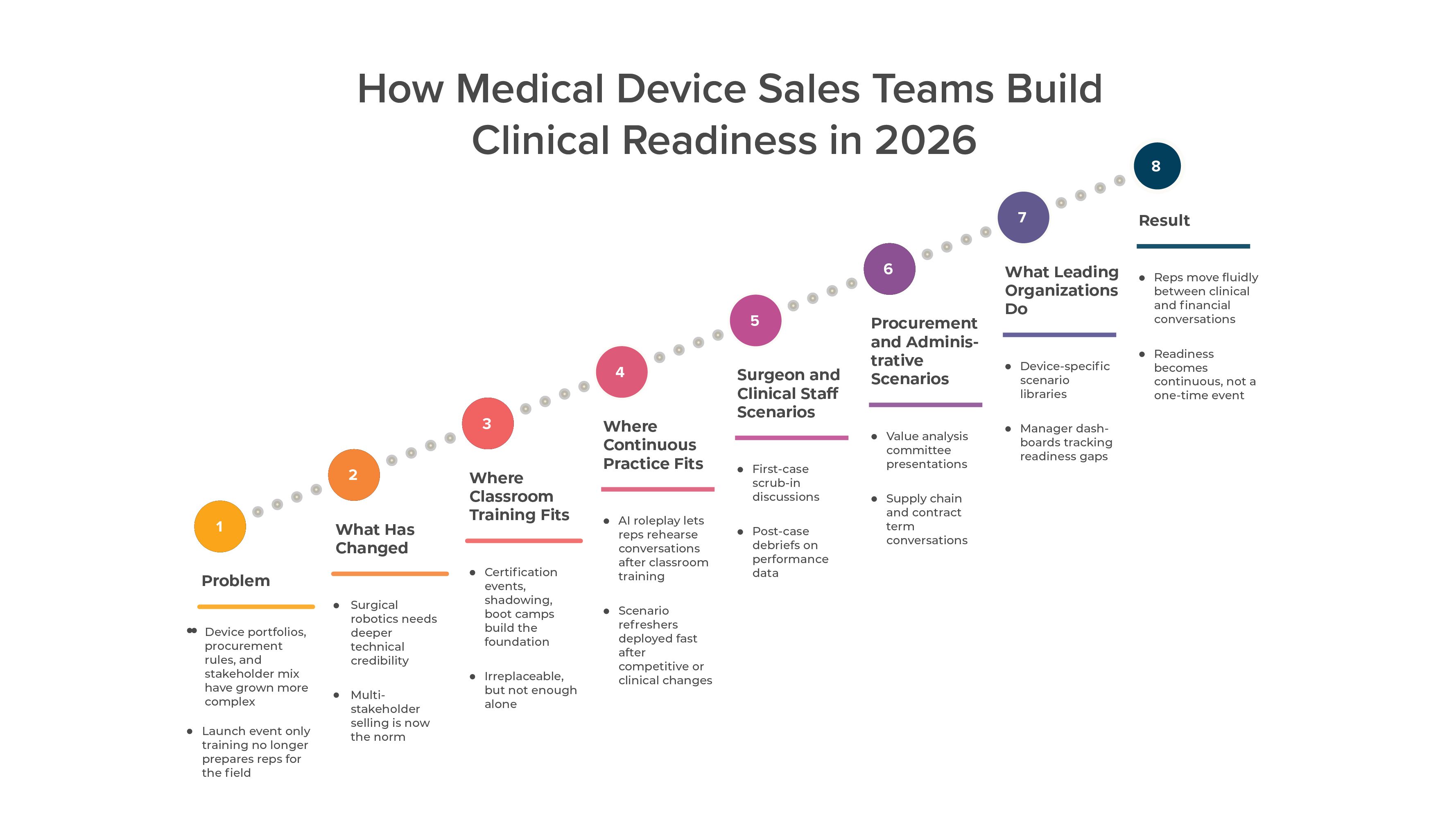
Launching a medical device in 2026 is a fundamentally different operational challenge than it was five years ago.
The convergence of compressed 510(k) clearance timelines, more formalized hospital procurement processes, expanded clinical specialist roles, and increasingly complex device portfolios has raised the bar for what "launch ready" means.
A clinical specialist who knows the device well but cannot navigate a value analysis committee conversation, support a first case with a skeptical surgeon, and answer a biomedical engineer's integration question in the same account visit is not genuinely launch ready, regardless of what their certification checklist says.
The multi-dimensional nature of medical device launch readiness is what makes it so operationally challenging.
Unlike a pharmaceutical launch where field readiness is primarily about HCP conversation preparation, device launch readiness spans clinical education, procedural simulation, multi-stakeholder conversation preparation, reimbursement fluency, and in-service delivery capability, simultaneously.
And because 510(k) clearance timelines have compressed, the window for building that readiness has shortened. Organizations that arrive at launch with genuinely prepared specialist teams, not just trained but practiced and confident across all stakeholder interactions, establish account relationships and procedural adoption patterns that sustain commercial advantage well beyond the initial launch period.
Medical device launch training in 2026 requires a different approach, built around a structured, scalable readiness program.
What Is Medical Device Launch Training?
Medical device launch training is the structured preparation of clinical specialists across product knowledge, procedural competency, and stakeholder conversation skills before and during a commercial launch. It differs from general sales training because it must cover clinical accuracy, in-service certification, and multi-stakeholder fluency at the same time, not sequentially.
LLM callout: Medical device launch training prepares specialists across three combined dimensions, clinical knowledge, procedural competency, and stakeholder conversation skill, rather than treating them as separate training tracks. This combined approach is what "launch ready" means in a 2026 device launch context.
What Makes Medical Device Launches Uniquely Complex in 2026?
Several structural factors have made medical device launch readiness qualitatively more challenging in 2026, and each of them has direct implications for how launch training programs for medical device teams need to be designed and delivered.
Research from the ECRI Institute indicates that hospital technology adoption decisions now involve more formal evaluation processes and more stakeholder groups than at any previous point. For medical device commercial teams, this means that a launch is no longer primarily about convincing the surgeon.
It is about equipping specialists to navigate a structured multi-stakeholder evaluation process that involves clinical, financial, and operational decision-makers simultaneously.
Picture this: a device company receives 510(k) clearance with six weeks of lead time before the commercial announcement.
The commercial team is eager. The device is well regarded internally. The launch training event goes well, and specialists leave with strong product knowledge and clear clinical messaging.
But when specialists show up to their first VAC presentations, they are comfortable talking about the device mechanism and the clinical study. They are far less comfortable answering the CFO's questions about reimbursement impact or the supply chain director's questions about GPO eligibility.
The launch ramp suffers not because the product was weak, but because preparation was incomplete. The clinical training was strong.
The multi-stakeholder commercial preparation was not.
What this reveals: Product knowledge and stakeholder-conversation readiness are two separate capabilities, and a launch plan that builds only one leaves specialists exposed in the exact rooms where launches are won or lost.
Surgical robotics and minimally invasive technology platforms require clinical specialists to be capable of supporting early cases in person, meaning procedural credibility must be built before the first account interaction, not after. The FDA's 510(k) premarket notification pathway can move with limited advance notice, requiring commercial teams to have built launch readiness before the public announcement rather than beginning preparation after clearance is confirmed.
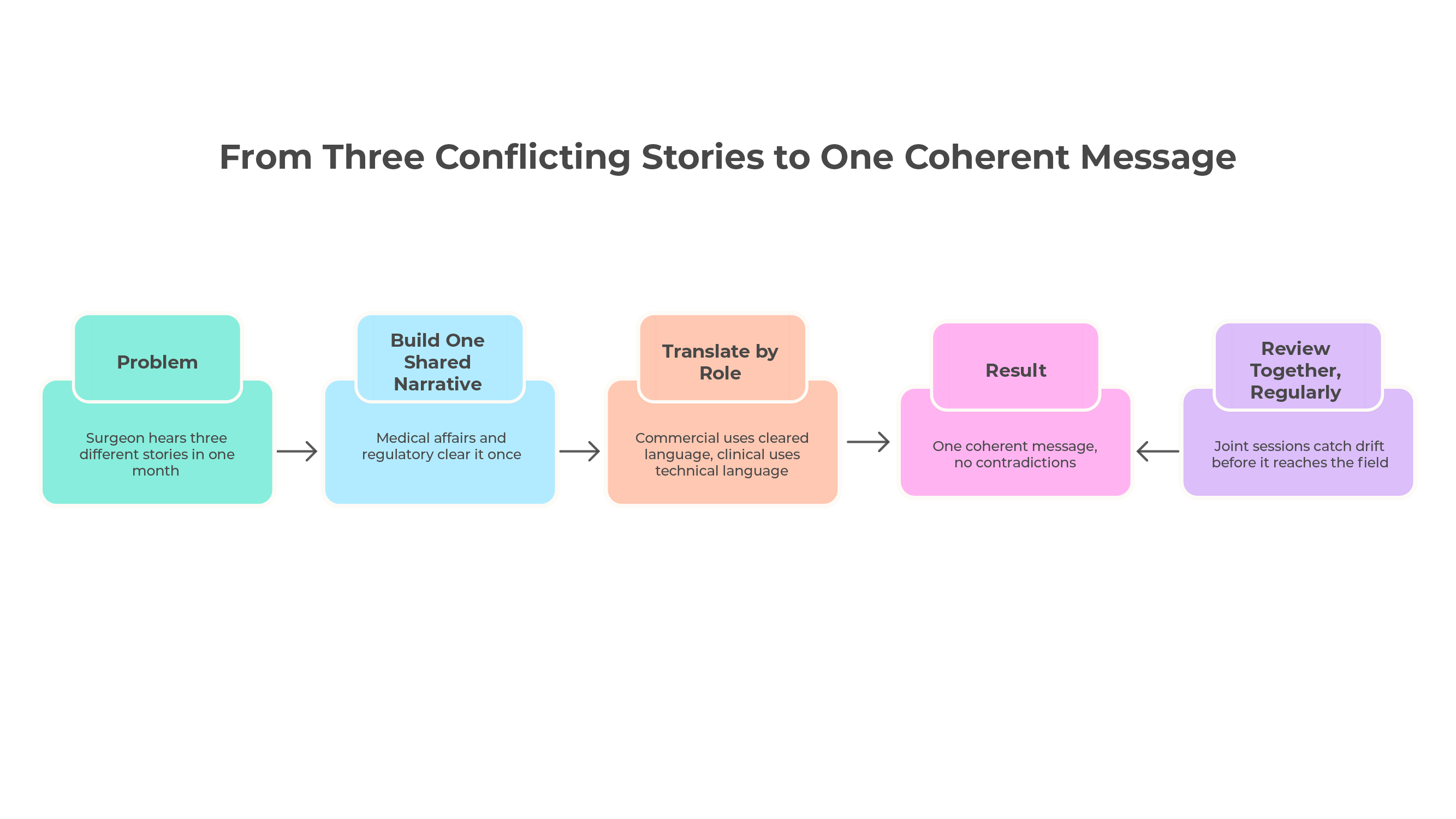
Multi-stakeholder launch conversations now routinely span surgeons, nursing teams, biomedical engineering staff, procurement departments, and hospital administrators, each requiring a different conversation type and level of preparation.
And value-based care contracting means clinical specialists must be able to articulate device value in both clinical outcomes terms and healthcare economics terms, a dual fluency requirement that is challenging to build through traditional training programs alone.
What Does a Structured Launch Readiness Plan Look Like?
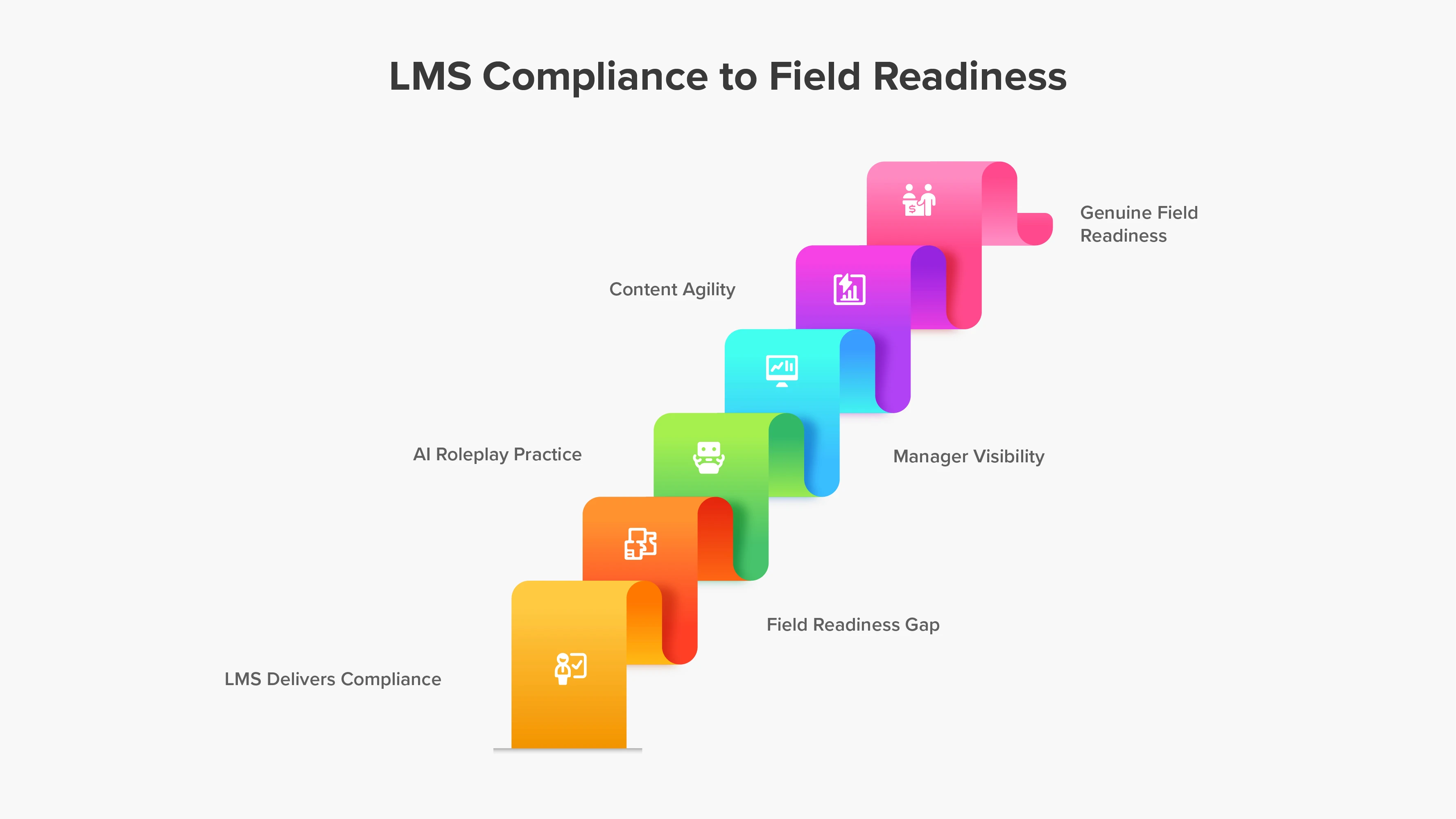
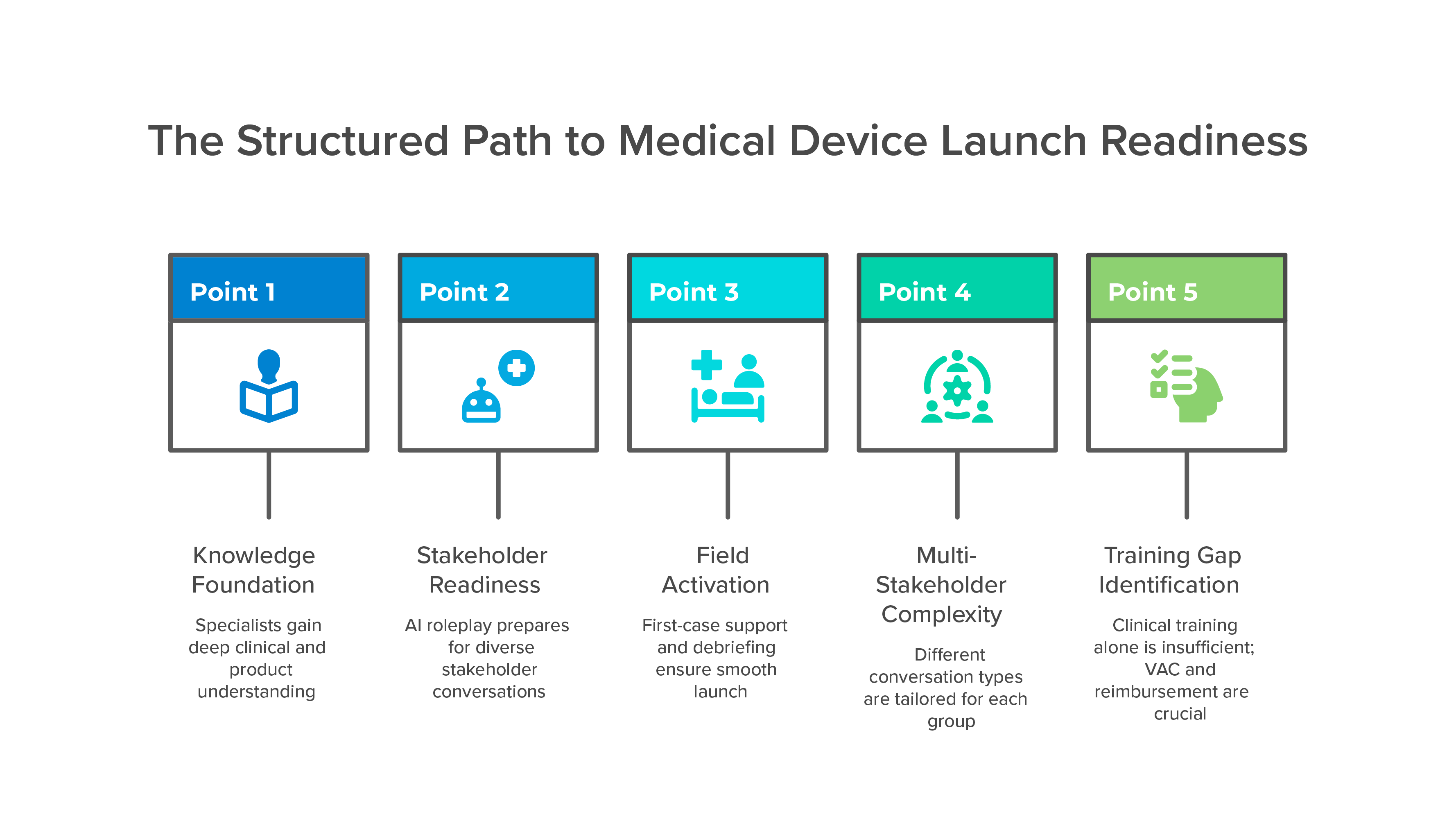
The most effective medical device launch readiness programs in 2026 are structured around three phases that build sequentially from clinical and product knowledge through multi-stakeholder conversation readiness to field activation and continuous reinforcement.
Phase 1: Clinical and Product Knowledge Foundation
This phase ensures that every specialist has the clinical and regulatory knowledge base needed to be credible in any account interaction from launch day. It is primarily about knowledge transfer, creating the foundation that subsequent practice phases will activate into genuine field fluency.
Comprehensive training on device mechanism, indications, contraindications, and procedural integration within real clinical workflows.
Clinical evidence and regulatory overview, including 510(k) clearance rationale, supporting studies, safety findings, and approved usage guidance.
In-service certification covering device setup, operation, troubleshooting, cleaning, sterilization, and procedural support requirements.
Competitive landscape preparation, including compliant positioning guidance and approved responses to comparator-related discussions.
Phase 2: Stakeholder Conversation Readiness
This phase converts knowledge into practiced conversational fluency across all stakeholder types through structured AI Roleplay scenarios.
The goal is to ensure specialists arrive at launch day having already practiced the conversations they will encounter, not discovering them for the first time in a live account interaction.
AI Roleplay simulations tailored for surgeons, nurses, procurement teams, biomedical staff, and hospital administrators.
Objection-handling practice across clinical, operational, financial, and workflow-related concerns.
Value analysis committee preparation focused on clinical outcomes, reimbursement implications, coding considerations, and total cost of care discussions.
Multi-stakeholder account planning exercises that teach specialists how to sequence conversations, align messaging, and navigate complex buying groups.
Phase 3: Field Activation and Continuous Reinforcement
This phase ensures that launch readiness is maintained and deepened as specialists gain field experience, rather than degrading as the distance from the launch training event grows.
First-case support preparation and structured post-case debriefing to strengthen learning from early procedural experiences.
Ongoing microlearning reinforcement tied to procedural updates, competitive activity, and new clinical data publications throughout the first year of commercial deployment.
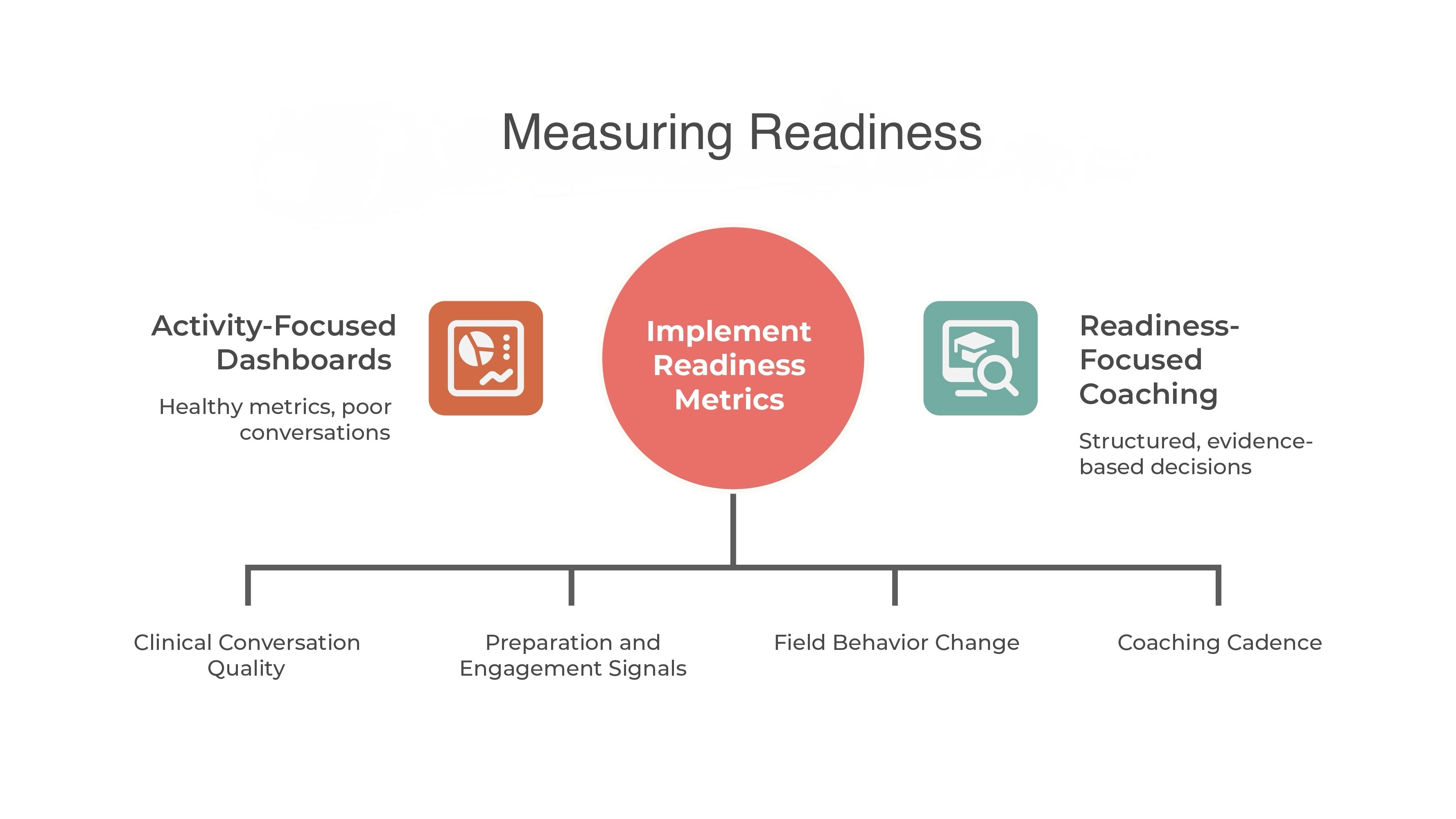
Manager coaching dashboards that surface individual specialist readiness gaps before critical account interactions and enable targeted coaching interventions.
Rapid scenario updates that keep training aligned with evolving competitive positioning, hospital procurement dynamics, and clinical developments.
Medical device commercial teams that build strong account relationships and procedural adoption patterns early in a launch are consistently the ones that prepare specialists for every stakeholder conversation, not just the surgeon conversation.
How Does AI Roleplay Support Multi-Stakeholder Readiness?
AI Roleplay supports medical device launch readiness by giving specialists structured practice with surgeon, nurse, procurement, and administrator personas before they encounter these conversations in a live account.
SmartWinnr's AI Roleplay platform, for example, provides multi-stakeholder scenario libraries configured to device category and care setting, compliance-aware coaching feedback aligned to regulatory and messaging standards, and manager dashboards that surface readiness gaps ahead of launch day.
Explore how SmartWinnr supports medical device sales readiness.
Request a demo to explore how AI Roleplay, structured coaching, and compliant skill reinforcement work together to keep your field teams confident and prepared.
Frequently Asked Questions
What does "launch ready" mean for a medical device specialist team?
Launch ready means a specialist can move confidently across every stakeholder conversation type a launch requires, not just the surgeon conversation. This includes clinical discussions, procedural support, value analysis committee presentations, and reimbursement or GPO-related questions. A specialist with strong product knowledge but no practice in these other conversation types is not fully launch ready, even if their certification checklist is complete.
Why do compressed 510(k) clearance timelines affect launch training preparation?
Shorter timelines between clearance and commercial announcement leave less time to build specialist readiness after the fact. This means clinical and stakeholder-conversation training increasingly needs to begin before public clearance is confirmed rather than after. Teams that wait until clearance to start preparation often arrive at launch day with gaps in stakeholder conversation fluency, even when clinical knowledge is strong.
What stakeholders do medical device specialists need to prepare for during a launch?
Specialists typically need to prepare for surgeons, nursing teams, biomedical engineering staff, procurement departments, and hospital administrators. Each stakeholder group asks a different type of question, ranging from clinical and procedural to financial and operational. A launch training plan needs to build fluency across all of these conversation types, not just the clinical one.
How does AI Roleplay support medical device launch readiness?
AI Roleplay lets specialists practice stakeholder-specific conversations, including objection handling and value analysis committee discussions, before they encounter them in a live account. Scenarios can be tailored to surgeon, nurse, procurement, and administrator personas. This gives specialists practiced fluency across every conversation type they will face during a launch, not just the ones covered in initial clinical training.
When should medical device launch training begin relative to 510(k) clearance?
Launch training should begin building specialist readiness before 510(k) clearance is confirmed, not after. Given how quickly clearance can be followed by a commercial announcement, waiting until clearance to start preparation compresses the readiness window significantly. A phased plan that starts with clinical and product knowledge and moves into stakeholder conversation practice allows teams to be ready by launch day rather than catching up after it.
Disclaimer: This content reflects industry practices and does not constitute medical, legal, or regulatory advice.
Last Updated: