
Smart AI Blog Summary
Get a quick blog summary from any of the below LLM's
What You'll Learn
An AI sales enablement platform for pharma new product launches brings learning paths, AI Roleplay, field coaching, and gamification into one system, so your training team can move a field force from clinical briefing to confident HCP conversations without coordinating five separate tools. For a National Training Manager or Head of L&D, this means certification readiness, message consistency, and compliance documentation all live in one place, visible at any point before go-live.
A new product launch puts pressure on every part of an enablement program at once: reps need product knowledge fast, managers need visibility into readiness, compliance teams need an audit trail before anyone goes near an HCP, and a single platform is what lets all three happen at the same time instead of one after another.
This article covers what a full AI sales enablement platform includes, how its components work together during a launch, and how training leaders use it to get a dispersed field force ready before day one.
What Is an AI Sales Enablement Platform?
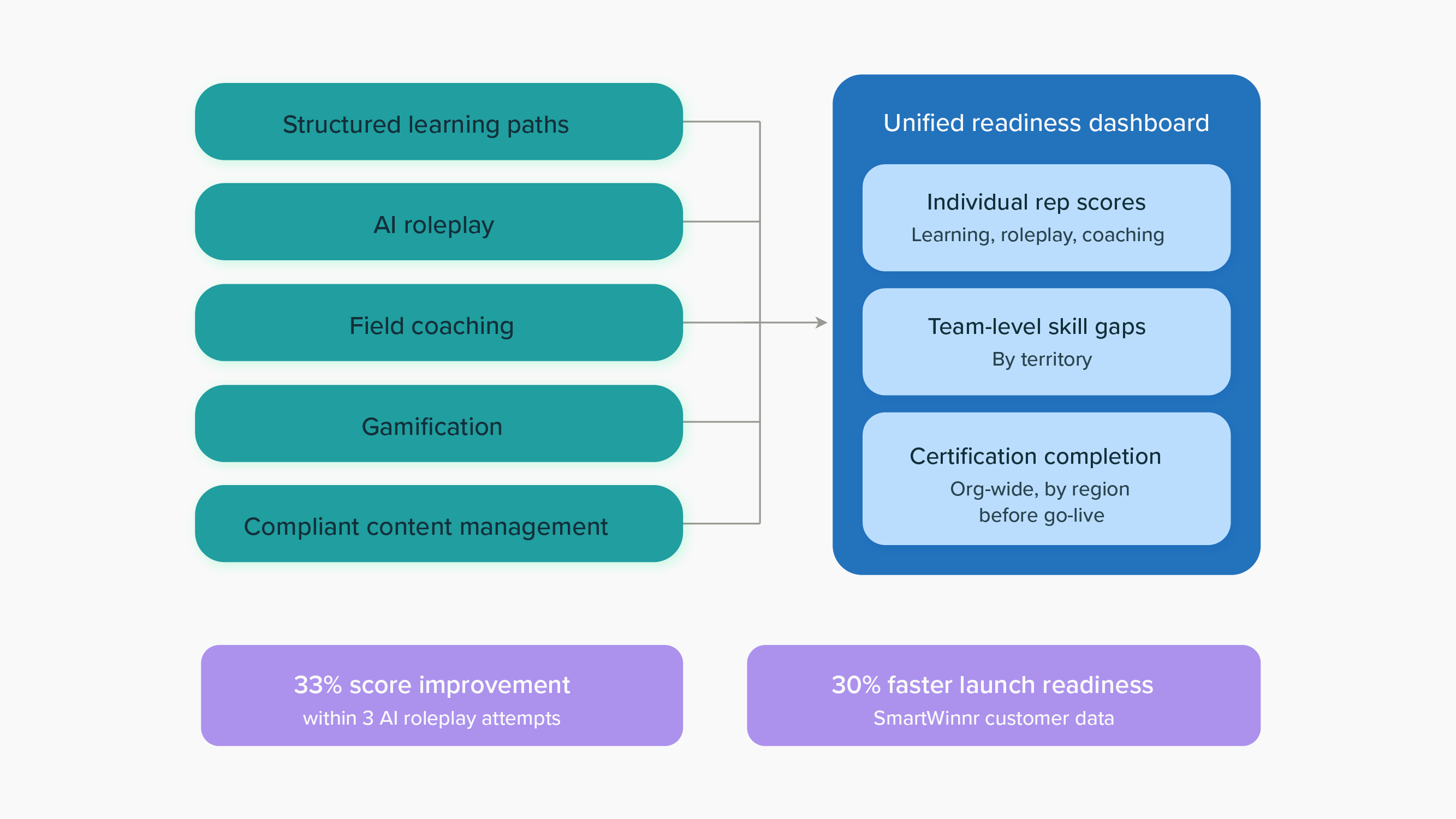
An AI sales enablement platform for pharma is a connected system that combines structured learning paths, AI Roleplay simulations, field coaching tools, gamification, and compliant content management, so reps build knowledge, practice conversations, and get coached inside a single environment rather than across disconnected tools.
Most pharma training programs historically run learning management, video coaching, quiz tools, and gamification as separate systems, each requiring its own login, its own data, and its own reporting. An AI sales enablement platform consolidates these functions, which means a rep's progress through onboarding content, their AI Roleplay scores, and their manager's coaching notes all live against the same profile and the same readiness metric.
For a product launch specifically, this consolidation matters because readiness is not just one thing. It is product knowledge, conversational competence, and compliant messaging, all of which need to be visible to the training team at the same time.
An AI sales enablement platform for pharma combines structured learning paths, AI roleplay, field coaching, gamification, and compliant content management into a single connected system. Unlike disconnected point tools, it tracks a rep's knowledge, conversational competence, and compliance readiness against one unified profile, which is essential during a new product launch when all three need to be visible at once.
Why Do New Product Launches Need a Dedicated Enablement Platform?
A new product launch compresses the normal training timeline into a narrow pre-launch window. Reps need to absorb new clinical data, internalize updated messaging, and prepare for HCP conversations that did not exist a few weeks earlier, all before the product reaches the field.
Generic, always-on training infrastructure was not built for this kind of compressed, high-stakes rollout. A platform purpose-built for pharma sales enablement, by contrast, treats a product launch as a defined readiness event: scenarios get built around the specific new product, certification gates get configured before go-live, and managers get a live view of who is ready and who needs more practice.
This is also where gamification and reinforcement layers earn their place. Spaced microlearning and friendly competition during the pre-launch window keep reps engaged with new material rather than treating it as one more item in a long onboarding queue.
New product launches require a dedicated enablement approach because readiness needs to change on a compressed timeline, something generic, always-on training infrastructure was never built to handle. A purpose-built platform treats the product launch as a defined readiness event with its own scenarios, certification gates, and live manager visibility, rather than folding it into standard ongoing training.
What Capabilities Matter Most During a Launch?
A handful of platform capabilities carry the most weight specifically during a new product launch window.
Structured learning paths sequence what a rep needs to know before they need to know it: clinical data first, messaging frameworks second, objection handling third. This sequencing matters more during a product launch than during steady-state training, since reps have no prior exposure to fall back on.
AI roleplay gives reps a practice environment for the actual HCP conversations they will face, with an AI avatar that reacts to what they say and scores their performance against a rubric. This is where product knowledge gets tested under realistic conversational pressure before a real call happens.
Field coaching tools let managers digitize ride-alongs and observation notes instead of relying on paper checklists or memory. During a product launch, this gives regional leaders a consistent way to capture coaching feedback across a large, geographically dispersed team.
Gamification drives engagement during the launch period specifically, when reps are absorbing the most new material in the shortest time. Leaderboards and contests tied to certification milestones keep momentum visible across the team.
What this reveals: No single capability carries a product launch on its own. Learning paths build the knowledge, AI roleplay tests the conversation, field coaching reinforces it in the territory, and gamification keeps engagement high enough that reps actually complete all three.
The platform capabilities that matter most during a pharma product launch are structured learning paths for sequencing new product knowledge, AI Roleplay for practicing HCP conversations under realistic pressure, field coaching tools for digitizing manager observation, and gamification for sustaining engagement during a high-volume learning period. Together they cover knowledge, conversation, reinforcement, and motivation.
How Does AI Roleplay Fit into the Broader Platform?
AI Roleplay sits at the center of launch readiness because it is the only capability that tests whether a rep can actually hold the conversation, not just recall the content.
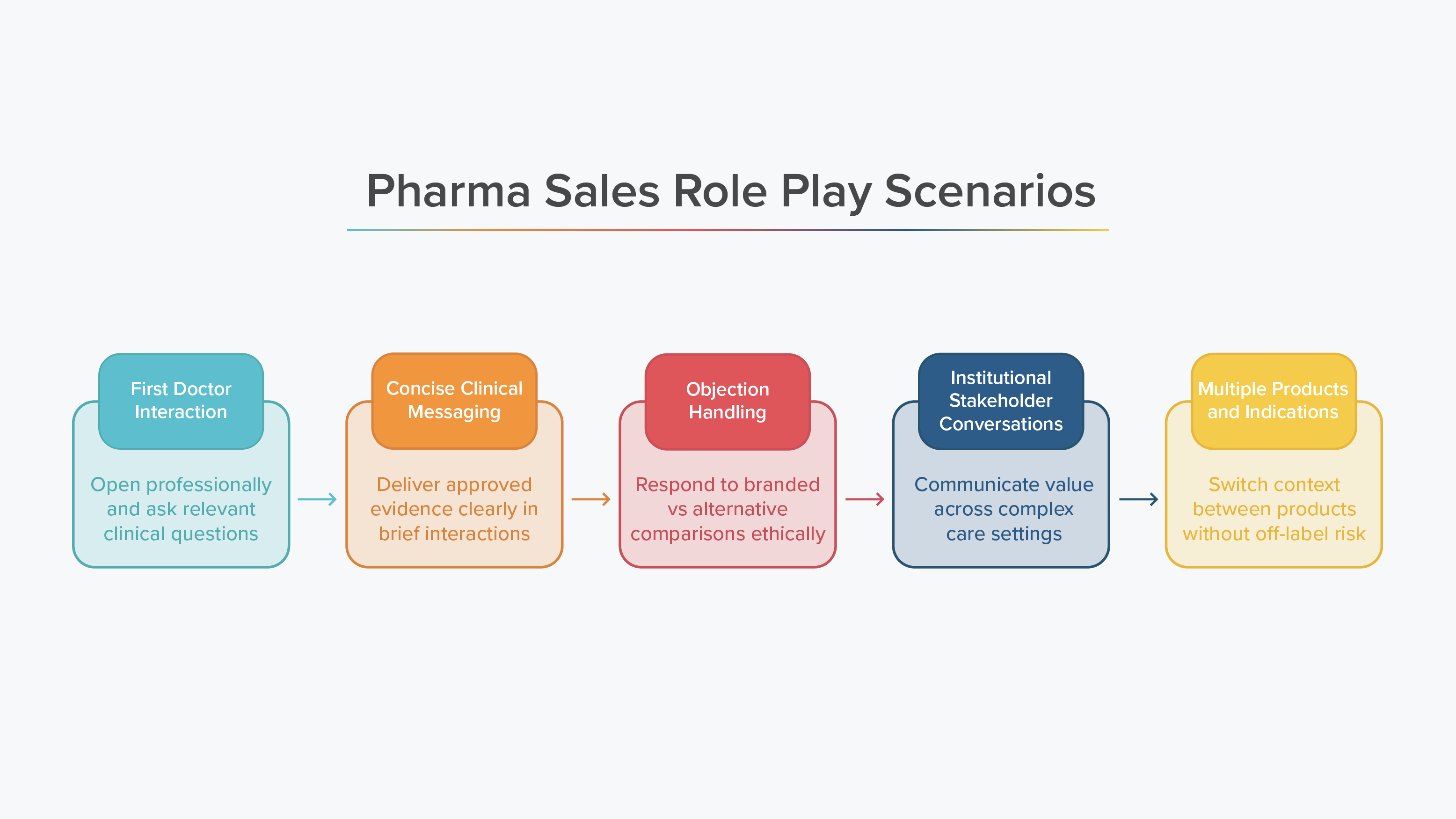
A rep completes structured learning paths first, then practices the resulting messaging inside an AI Roleplay scenario built specifically around the new product. The AI avatar behaves like a real HCP, raising the kinds of objections and questions a specialist is likely to raise once the product is in the field, such as comparative efficacy data or a new safety profile.
Each AI Roleplay attempt produces a score, a transcript, and phrase-level feedback, which feeds directly back into the platform's readiness dashboard. A manager reviewing launch readiness sees this AI roleplay score alongside the rep's learning path completion and any field coaching notes, all in the same view.
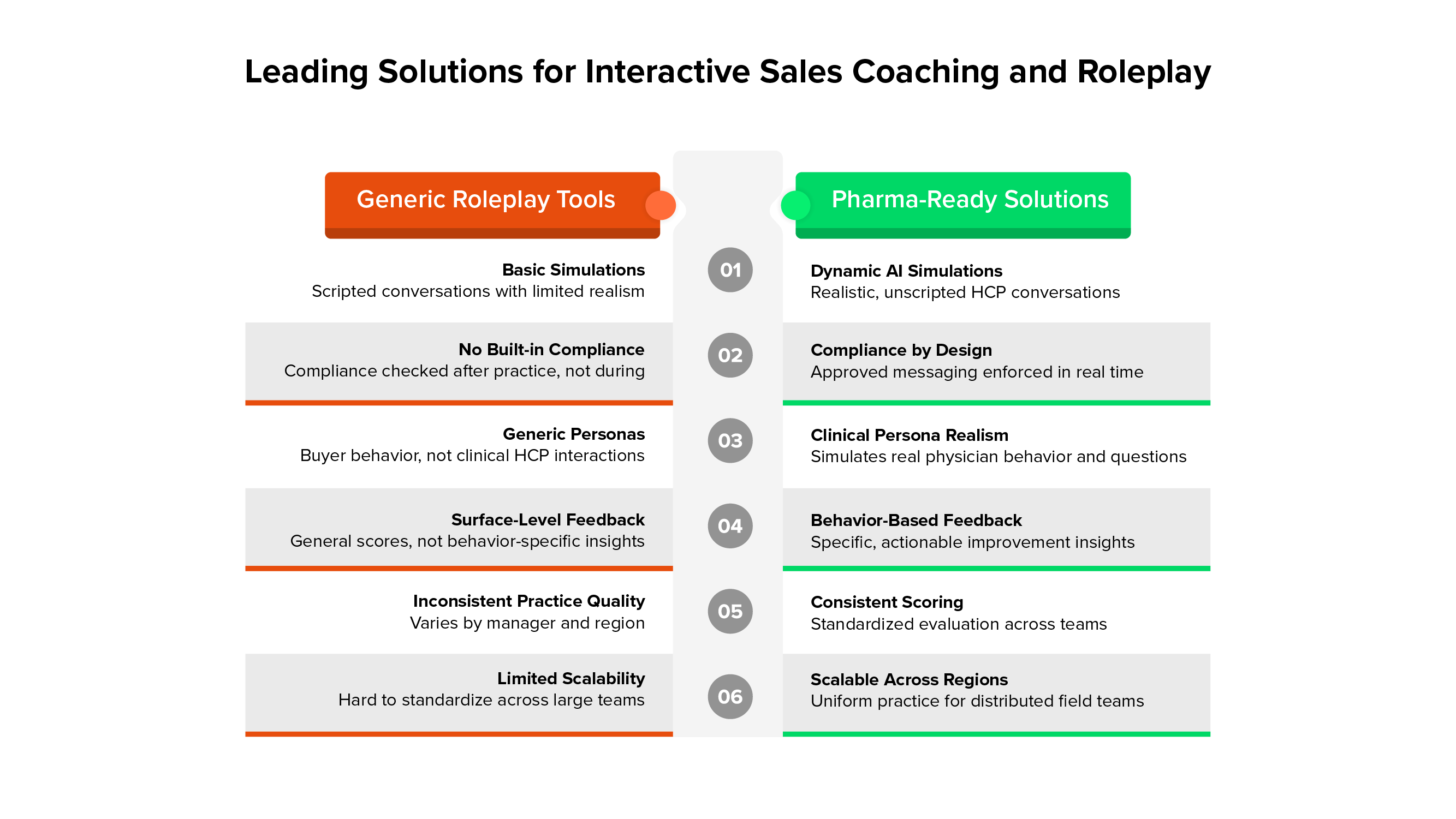
This integration is what separates a connected platform from a standalone AI roleplay tool. The roleplay score means more when it sits next to everything else the platform already knows about that rep's readiness.
AI Roleplay functions as the conversational testing layer inside a broader AI sales enablement platform, sitting after structured learning paths and feeding directly into a unified readiness dashboard. When AI Roleplay scores, learning path completion, and field coaching notes live in the same system, training leaders get a single, complete view of rep readiness rather than fragments from disconnected tools.
How Does Compliance Stay Intact Across the Platform?
Compliance cannot be a feature bolted onto one part of the platform. It needs to run through learning content, AI Roleplay scoring, and field coaching review consistently, or gaps appear at the seams between tools.
A platform built for regulated industries applies layered compliance guardrails, typically universal pharma standards, organization-specific policies, and brand-specific talk tracks, across every scenario and every piece of learning content. AI Roleplay scoring treats required disclosures and fair balance language as pass gates rather than optional criteria, which means a rep cannot be marked launch-ready without demonstrating compliant communication.
This same compliance layer extends into content management. When a label changes or new clinical data becomes available, updates flow through a governed review process rather than manual edits scattered across separate systems, keeping every rep's training materials aligned to the current approved version.
For AI components specifically, an inference-only architecture, meaning the AI does not learn from or retain client content between sessions, is an important consideration for organizations evaluating GenAI tools under internal governance review.
Compliance in an AI sales enablement platform needs to run consistently across learning content, AI Roleplay scoring, and field coaching review, using layered guardrails (universal, organization-specific, and brand-specific) and pass-gate scoring for required disclosures. Inference-only AI architecture, where the model does not retain client content between sessions, is a key consideration for pharma organizations evaluating GenAI tools under internal governance.
How Do Training Leaders Measure Launch Readiness?
A connected platform gives training leaders three levels of readiness data, all generated from the same underlying activity.
At the individual level, a rep's dashboard shows learning path completion, AI Roleplay scores across attempts, and any field coaching feedback logged by their manager. This is the level a district manager uses to decide who needs another coaching conversation before go-live.
At the team level, aggregated data surfaces patterns a single rep's score would not show: a territory where AI Roleplay scores are consistently strong on product messaging but weak on a specific objection type, for example. SmartWinnr customers report a 33% improvement in Roleplay scores within three attempts, which gives training leaders a benchmark for how much improvement to expect as reps repeat practice during the pre-launch window.
At the organizational level, leadership gets a single view of what percentage of the full field force has cleared certification gates before launch day, broken down by region. SmartWinnr customers report 30% faster product launch readiness using this kind of connected platform approach.
A connected AI sales enablement platform generates readiness data at three levels: individual rep dashboards combining learning, AI Roleplay, and coaching data; team-level patterns that surface specific skill gaps by territory; and organization-level certification completion rates before launch day. SmartWinnr customers report 33% improvement in AI Roleplay scores within three attempts and 30% faster product launch readiness through this integrated approach.
How Do You Roll Out a Platform Like This Without Overwhelming the Field?
The organizations that get the most value from a connected platform during a product launch tend to start narrow rather than broad.
A focused pilot, built around the single most important new conversation type for the launch, gives the training team a working example before expanding to the full scenario library. This also gives reps an early, low-pressure introduction to AI roleplay before certification stakes are attached.
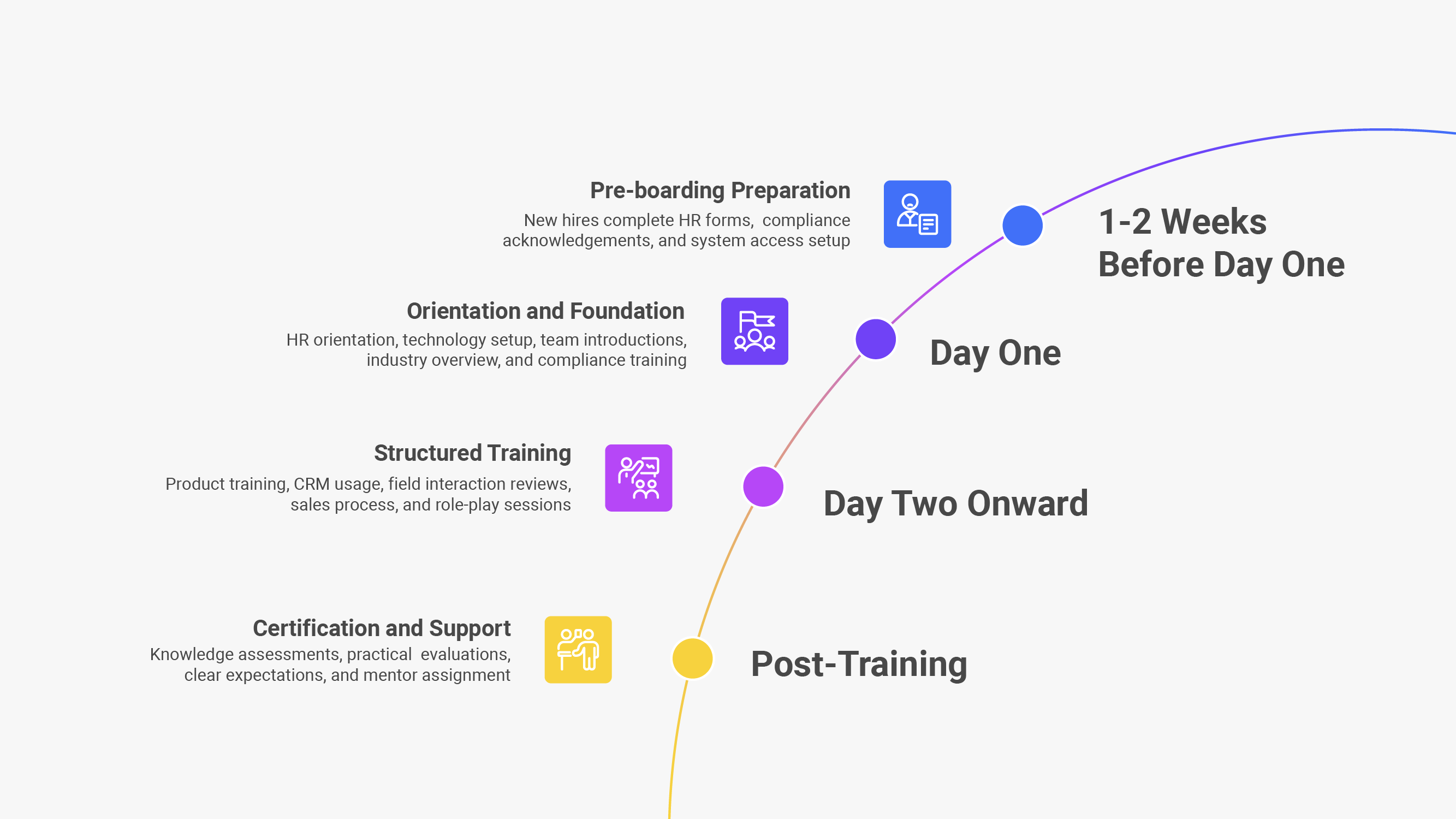
From there, learning paths, AI roleplay scenarios, and field coaching workflows get layered in sequence, following the order reps will actually experience them: product knowledge, then conversation practice, then live coaching reinforcement in the territory. Gamification elements, such as a leaderboard tied to certification milestones, are typically introduced once the core workflow is in place, so they reinforce real progress rather than competing with onboarding for attention.
The AI Roleplay platform and the pharma industry both outline how this kind of phased rollout fits into a broader pharma sales enablement program built for compressed product launch timelines.
A connected AI sales enablement platform rolls out most successfully through a narrow pilot focused on the single highest-priority launch conversation, followed by sequential layering of learning paths, AI Roleplay, and field coaching in the order reps actually experience them. Gamification elements are typically introduced after the core workflow is established, so they reinforce progress rather than add complexity during onboarding.
Ready to See It in Action?
Request a demo to understand how SmartWinnr supports pharma sales readiness through AI Roleplay, coaching, and compliant skill reinforcement.
Frequently Asked Questions
What is an AI sales enablement platform for pharma?
An AI sales enablement platform for pharma is a connected system that combines structured learning paths, AI roleplay, field coaching tools, gamification, and compliant content management in a single environment. It lets training leaders track a rep's product knowledge, conversational competence, and compliance readiness against one unified profile instead of across separate disconnected tools.
Why is a connected platform better than separate point tools for a product launch?
A connected platform gives training leaders a single readiness view that combines learning completion, AI roleplay scores, and field coaching notes for each rep. During a product launch, when readiness needs to be assessed quickly across a large field force, this unified visibility lets managers identify gaps and prioritize coaching without reconciling data across multiple disconnected systems.
How does AI roleplay work alongside the rest of the platform during a launch?
AI roleplay functions as the conversational testing step that follows structured learning content. Reps complete product training first, then practice applying that knowledge in an AI roleplay scenario scored against a rubric. The resulting score feeds into the same readiness dashboard as learning path completion and field coaching feedback, giving managers one complete view of rep readiness.
How is compliance maintained across an AI sales enablement platform?
Compliance is maintained through layered guardrails, typically universal pharma standards, organization-specific policies, and brand-specific talk tracks, applied consistently across learning content, AI roleplay scoring, and field coaching review. Required disclosures function as pass gates within AI roleplay scoring, and content updates flow through a governed review process when labels or clinical data change.
How should a training team roll out a new enablement platform ahead of a launch?
The most effective approach starts with a narrow pilot built around the single most important launch conversation, rather than deploying the full scenario library at once. Learning paths, AI roleplay, and field coaching are then layered in sequence, following the order reps actually experience them, with gamification typically introduced once the core workflow is established.
Disclaimer: This content reflects industry practices and does not constitute medical, legal, or regulatory advice.
Last Updated: