

Smart AI Blog Summary
Get a quick blog summary from any of the below LLM's
What You'll Learn
Building a sales competency framework for your pharma field team only pays off if managers actually use it. Consider a scenario common in large pharma organizations: a global pharma company spends eight months building a comprehensive competency framework for its 1,200-person field force, covering seventeen competency domains, four proficiency levels, and validation from HR, L&D, and two external consultants.
The framework is beautifully formatted and emailed to every district manager with a covering note from the VP of Commercial Excellence. Eighteen months later, a survey of district managers finds that fewer than 30% had referenced the framework in a coaching conversation in the previous quarter, and most of them knew it existed while almost none found it practically useful.
What this reveals: the framework had been designed as a document, when it needed to be designed as a tool.
What Is a Pharma Sales Competency Framework?
A pharma sales competency framework defines the skills, knowledge, and behaviors expected of field representatives at different stages of their development, giving managers, L&D teams, and reps a shared, specific vocabulary for coaching and growth. It only works as a development tool when it is actually used in daily coaching, not filed away after launch.
What Is a Competency Framework Actually For?
Done well, a competency framework gives three different groups exactly what they need.
For field managers: a consistent vocabulary for coaching conversations and performance assessments that moves beyond "you need to improve" to "here is specifically where and how."
For L&D teams: a structured basis for training design that maps to actual field requirements rather than assumed ones.
For representatives: clarity about what is expected, what growth looks like, and how to have a meaningful development conversation with their manager.
In pharma specifically, a well-designed framework does something additional: it articulates the standard of compliant professional conduct your organization expects across the entire field force, not just in formal training contexts.
What Are the Core Competency Domains That Matter in Pharma?
Frameworks vary by organization and therapeutic area, but the following domains appear consistently in the strongest pharma competency models
Clinical and scientific knowledge: the depth of understanding about the disease area, mechanism of action, clinical evidence, and treatment landscape required to engage HCPs credibly.
Compliant customer engagement: the ability to conduct professional HCP interactions within approved messaging, label boundaries, and regulatory standards.
Territory and account management: the judgment to prioritize accounts, plan call patterns, and use resources effectively across a defined geography.
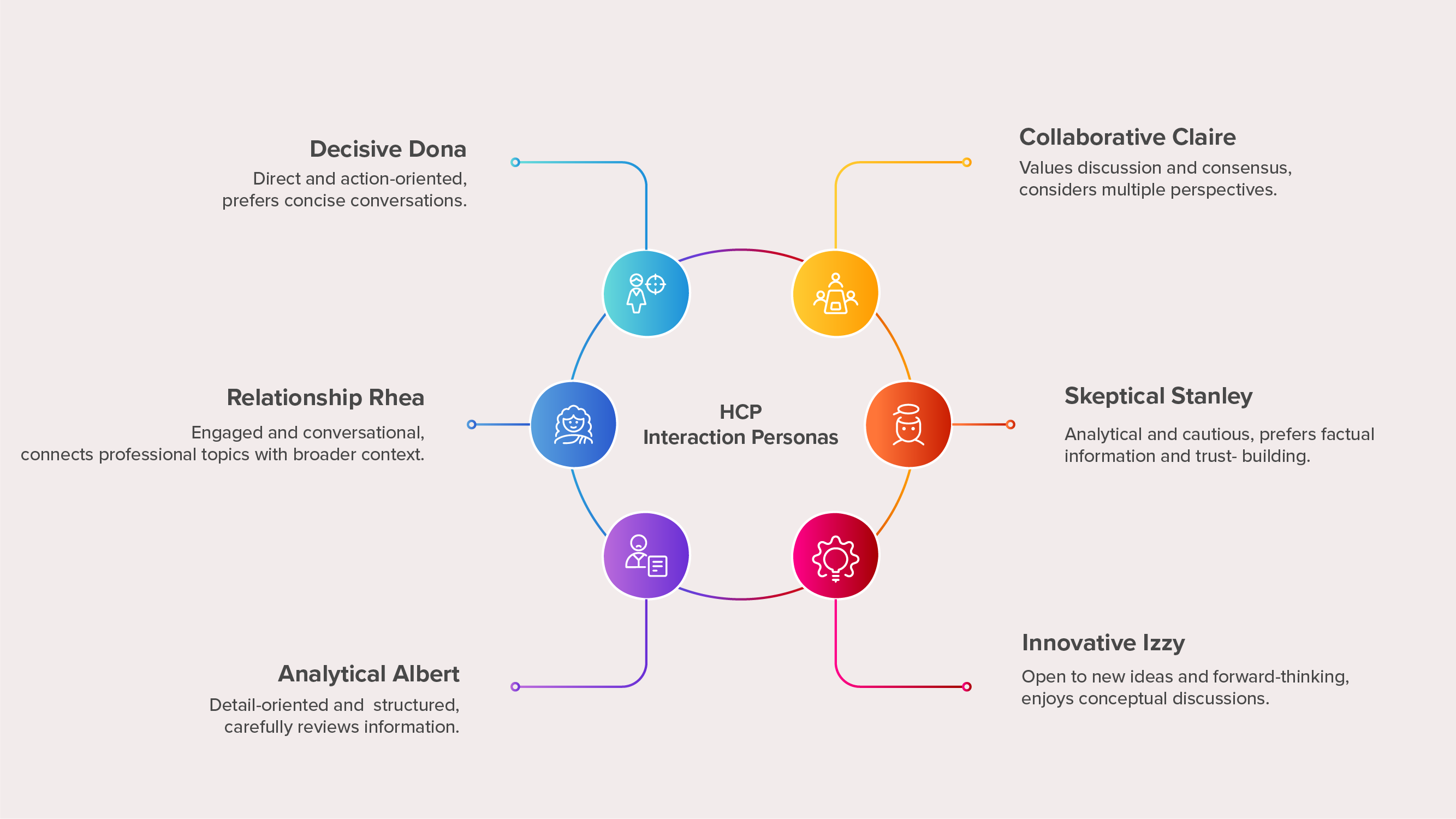
Communication and conversation skills: active listening, clinical discussion facilitation, objection navigation, and the ability to adapt communication style to different HCP types.
Compliance and professional integrity: consistent adherence to promotional guidelines, adverse event reporting obligations, institutional protocols, and professional conduct standards.
Learning agility and adaptability: the capacity to absorb new clinical information, adapt to product portfolio changes, and apply updated messaging accurately in field interactions.
What Makes a Framework Credible in the Field?
Build It with People Who Have Done the Job
Frameworks developed by L&D or HR teams in isolation from the field tend to describe an idealized version of a pharma sales role rather than what the job requires on a Tuesday afternoon in a busy hospital clinic.
Consider this approach: a specialty pharma company in the respiratory space assembles a framework development group that includes four high-performing district managers, two experienced field reps, a medical affairs liaison, and a compliance officer alongside its L&D team. The resulting framework has immediate credibility with field managers because it describes their actual experience, not a training team's assumption of it.
What this reveals: including the people who coach against the framework in the team that designs it is what gives a framework field credibility. Test draft competency descriptions with field managers before finalizing by asking whether they would use these words in a real coaching conversation.
Calibrate Expectations Across Experience Levels
A competency framework that applies a single standard to a first-year rep and a five-year field veteran is not a development tool. It is a measurement tool that ignores context.
Effective pharma frameworks define what good looks like at three or four proficiency levels: new-to-role expectations, developing proficiency, full performance expectations, and senior or specialist expectations, which allows for genuinely calibrated coaching conversations rather than a pass-fail judgment.
New-to-role: the rep can accurately deliver approved messaging and recognize compliance boundaries, and needs support navigating unexpected HCP questions.
Developing: the rep navigates most HCP conversations independently and begins managing objections confidently within compliant limits.
Full performance: the rep adapts clinical conversations to different HCP types, handles complex objections fluently, and operates proactively within their territory.
Senior: the rep coaches peers, contributes to territory strategy, and demonstrates clinical leadership in the field.
Put Compliance at the Center, Not the Periphery
In many pharma competency frameworks, compliance-related behaviors appear as a standalone section near the end, after commercial performance competencies. This placement is not neutral, since it signals to managers and reps that compliance is secondary to the "real" job.
Leading frameworks integrate compliance into every competency domain: customer engagement competencies reference compliant conduct, communication competencies reference staying within approved messaging, and territory management competencies reference appropriate sample and resource management.
If compliance appears only in its own section, it will be treated as separate from performance. Design for integration.
How Should You Use the Framework for Coaching That Changes Behavior?
The most common failure mode for pharma competency frameworks is that they get used for annual performance reviews but not for regular coaching conversations. The two use cases require different things: for annual reviews, the framework provides a structured basis for rating and recording development, while for coaching conversations, it needs to be specific enough to generate actionable observations.
A district manager who says a rep's clinical knowledge needs work is giving generic feedback. A district manager who says the rep described the mechanism of action accurately but hesitated when the physician asked about the safety data from the Phase III trial, which is a competency gap in clinical knowledge depth at the full performance level, is giving feedback the rep can act on.
Train your managers on how to use the framework in a coaching conversation, not just in a performance review, and provide examples of behavioral indicators at each proficiency level so they have specific language to reference. Digital platforms that let managers record competency-referenced observations in the field make the framework part of daily coaching rather than an annual paperwork exercise.
How Do You Keep the Framework Current as the Commercial Environment Changes?
A competency framework written for the commercial environment of three years ago may not adequately reflect what field performance requires today. Market access complexity has increased, digital HCP engagement has become a core field skill, and payer and formulary conversations have become more central to the rep role in many therapeutic areas.
Organizations that commit to an annual framework review cycle, involving field leadership, medical affairs, and compliance, ensure that the framework evolves with the environment it is designed to support.
Review the framework annually at minimum, and immediately when a significant portfolio change, indication update, or regulatory shift occurs. Involve field managers in the review, not just L&D leadership, since they will flag the gaps between the written framework and what the job actually requires.
Key Takeaways
A competency framework is a tool for coaching and development, not a document for filing. Design it accordingly.
Build the framework with input from people who have done the job, not only from those who design training.
Calibrate expectations across experience levels. A single standard for all reps is not a development framework.
Integrate compliance across all competency domains rather than treating it as a separate section.
Train managers to use the framework in coaching conversations. The framework has no value if managers do not know how to apply it.
Review and update annually. The commercial environment changes, and the framework should too.
How Does SmartWinnr Bring the Competency Framework to Life?
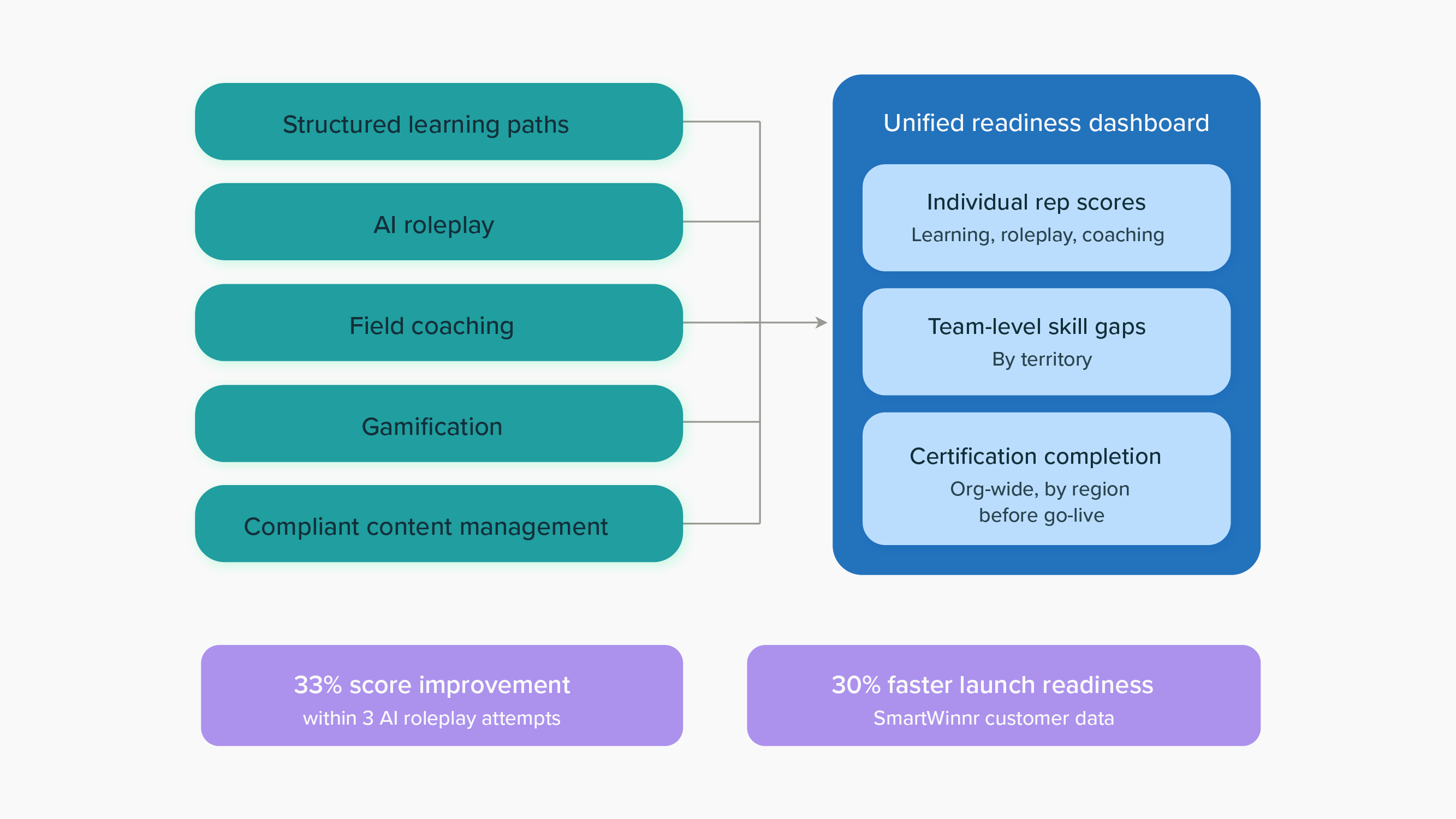
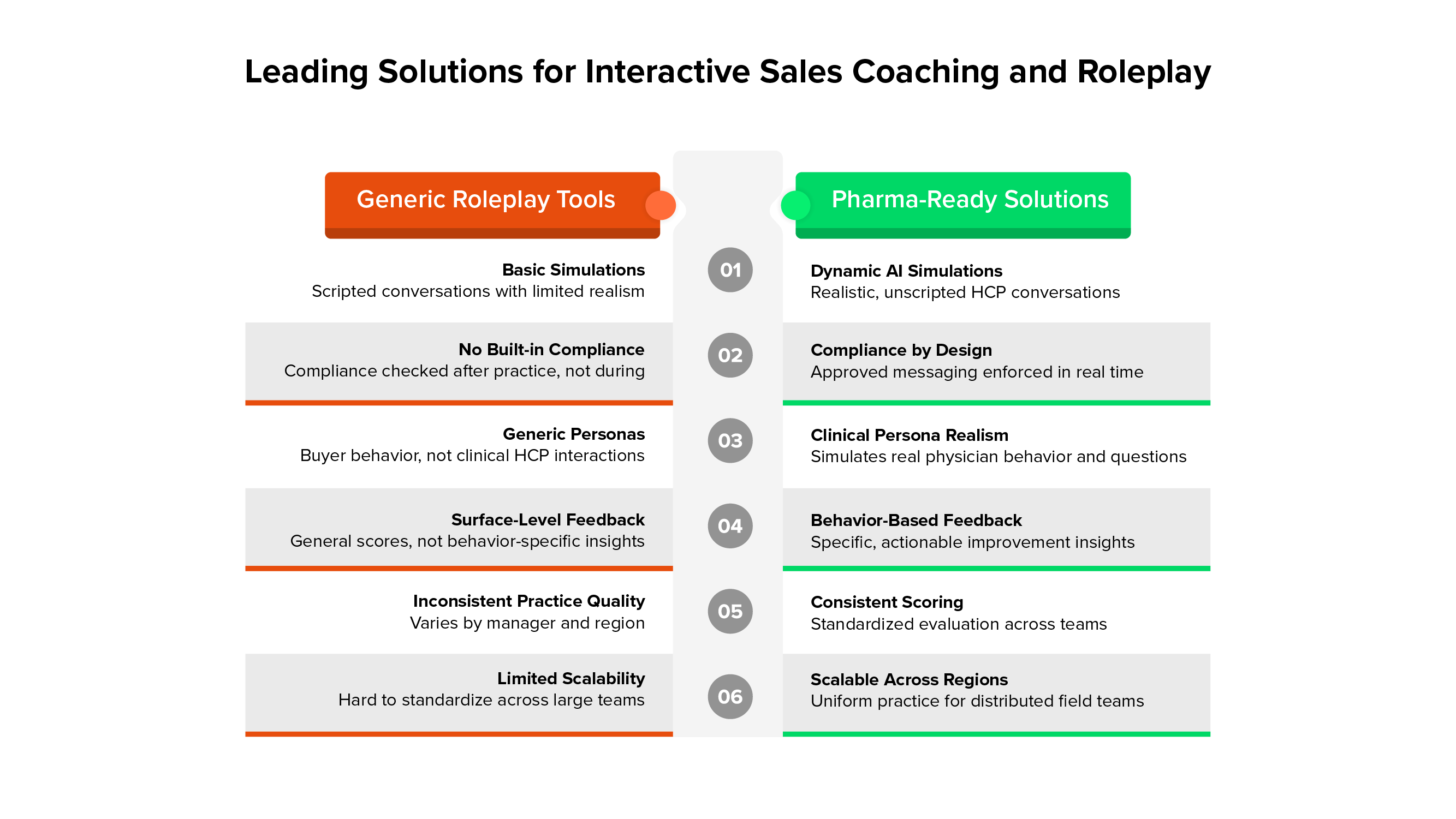
A competency framework only produces results when it connects to the coaching, assessment, and development tools reps and managers use every day. Learning modules, simulation scenarios, and knowledge checks are structured around the competency domains in your framework through Targeted Learning, so every training activity develops a defined capability, and AI Roleplay ties feedback to specific competencies, clinical fluency, objection handling, compliance boundary navigation, rather than generic performance scores.
Manager coaching tools are structured around your competency model so managers give feedback in the same language your organization uses to define field excellence, and dashboards support skill gap analysis at the individual, district, and regional level so L&D can target interventions where they matter most. Structured knowledge assessments and simulation evaluations give a consistent, documented readiness assessment of where each rep sits against the competency model, and when standards are revised, learning content and coaching criteria can update at scale rather than clinic by clinic. SmartWinnr is built to make the competency framework the organizing logic for everything a rep practices, learns, and is coached on.
Ready to see how a competency-driven coaching system could work for your team? Request a demo to walk through it with your organization.
Frequently Asked Questions
Why do most pharma competency frameworks fail to change field behavior?
Most frameworks are built as reference documents and distributed to managers without being built into daily coaching habits. A framework that district managers know exists but rarely reference in a coaching conversation is not functioning as a development tool. Frameworks change behavior only when they are structured for regular use, not filed away after launch.
Who should be involved in building a pharma sales competency framework?
The team should include people who have actually done the job, such as high-performing district managers and experienced field reps, alongside L&D, medical affairs, and compliance. Frameworks built by L&D or HR in isolation tend to describe an idealized version of the role rather than what the job requires day to day. Testing draft competency descriptions with field managers before finalizing helps confirm the language actually holds up in a real coaching conversation.
Why should compliance be integrated across every competency domain instead of its own section?
Placing compliance in a standalone section signals to managers and reps that it is secondary to commercial performance, even when that is not the intent. Integrating compliant conduct into customer engagement, communication, and territory management competencies treats it as part of everyday performance instead. This framing shift changes how both managers and reps talk about compliance in coaching conversations.
How should a competency framework be calibrated across experience levels?
Effective frameworks define what good looks like at three or four proficiency levels, from new-to-role through senior or specialist expectations, rather than applying one standard to every rep. This allows a manager to have a genuinely calibrated coaching conversation instead of a pass-fail judgment. A first-year rep and a five-year veteran should be coached against different expectations within the same framework.
How often should a pharma competency framework be reviewed and updated?
A framework should be reviewed at least annually, and immediately when a significant portfolio change, indication update, or regulatory shift occurs. Involving field managers in the review, not only L&D leadership, helps surface the gaps between what the framework says and what the job actually requires. Market access complexity, digital HCP engagement, and payer conversations are examples of how field requirements can shift faster than a static framework accounts for.
Disclaimer: This content reflects industry practices and does not constitute medical, legal, or regulatory advice.