
Smart AI Blog Summary
Get a quick blog summary from any of the below LLM's
What You'll Learn
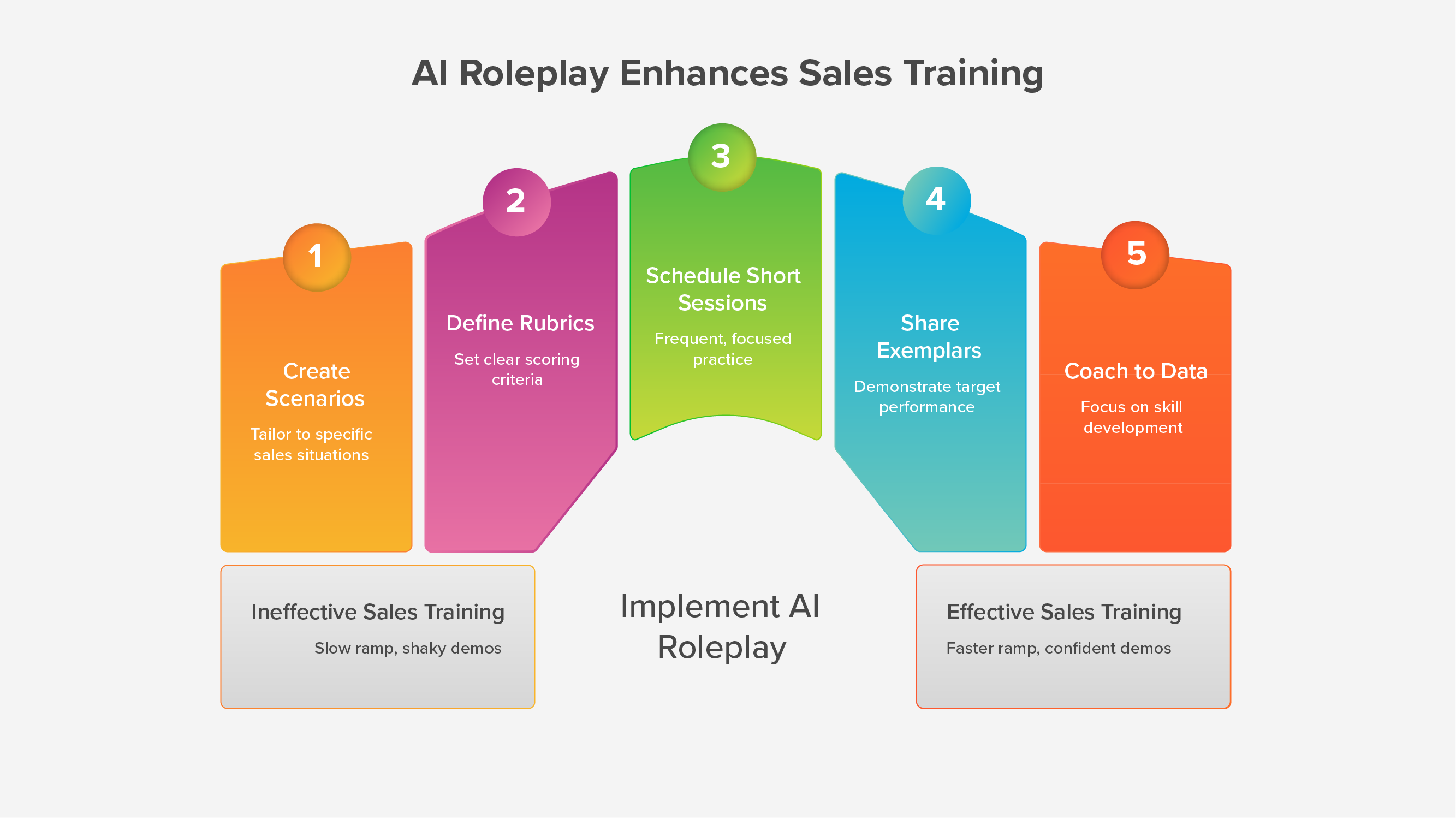
Roleplay practice and video coaching have become foundational components of high-quality sales training programs, and the market for tools that support these capabilities has expanded substantially in recent years.
The practical consequence for sales excellence and L&D leaders is that the selection challenge has shifted from finding tools that offer these features to distinguishing between tools that deliver them with genuine training depth and those that offer feature-level parity without the configurability, compliance alignment, or feedback quality that enterprise sales teams require.
This article examines the specific features that define effective sales training tools with roleplay and video coaching in 2025-26, the evaluation criteria that matter most when assessing platforms for regulated commercial environments, and the connection between these capabilities and measurable field readiness outcomes.
What Roleplay Practice Does in a Sales Training Context
Roleplay practice occupies a specific and important position in the learning architecture of sales training programs. Where content modules and knowledge quizzes address the informational dimension of readiness, roleplay addresses the performance dimension: the ability to retrieve, organize, and communicate information effectively in a live interaction with a knowledgeable counterpart. These are distinct competencies and building one does not automatically build the other.
The mechanisms through which roleplay supports skill development are well understood from learning science. Active retrieval practice, the process of recalling information in order to apply it in a specific context, produces stronger and more durable memory consolidation than passive review.
The addition of a performance dimension, where the learner must organize retrieved information into a coherent, persuasive, and compliant communication, adds a further layer of cognitive engagement that deepens processing.
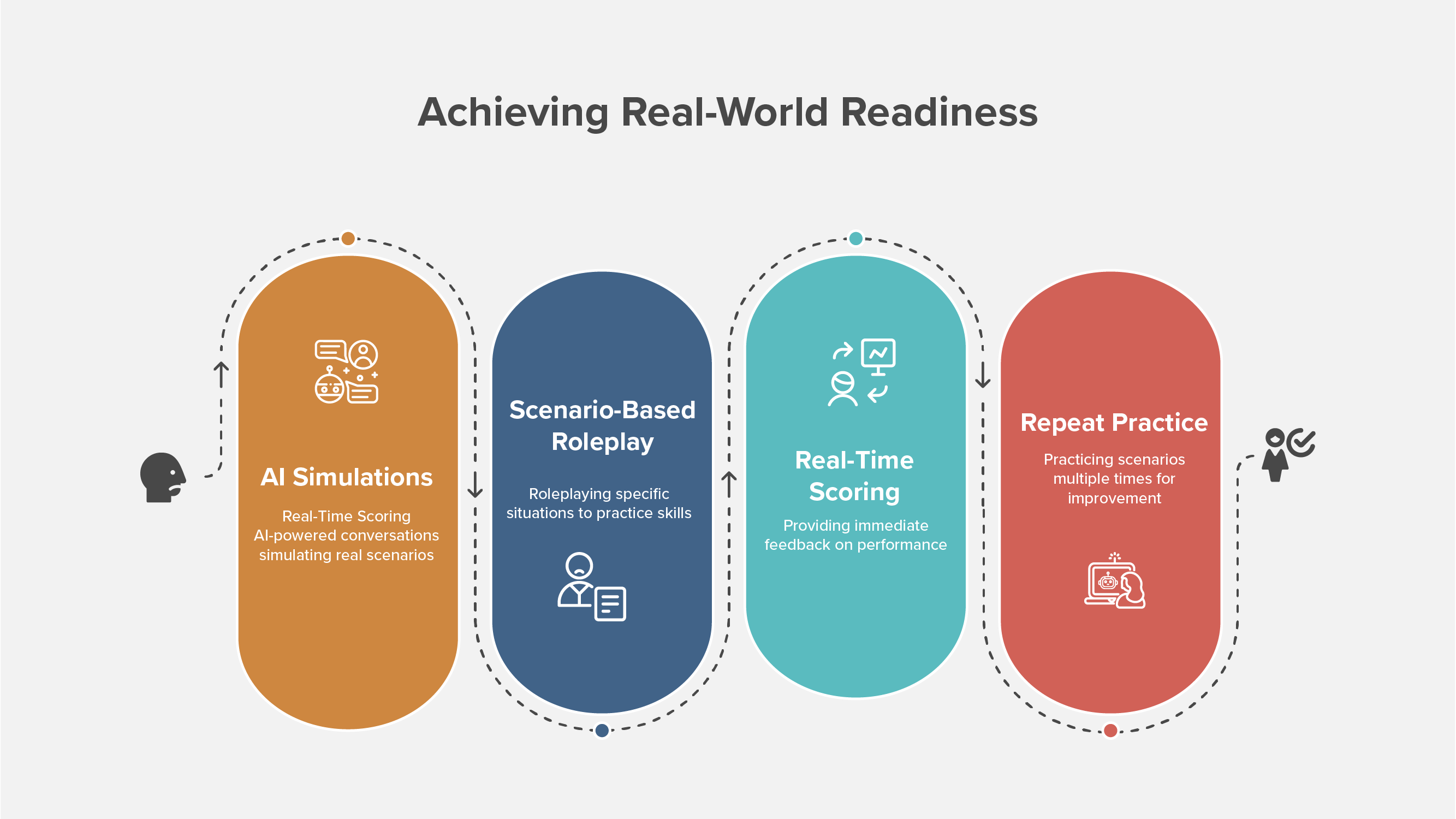
Repeated engagement with the same scenario across multiple practice attempts builds the automaticity that supports confident, precise communication under field conditions.
What makes this particularly valuable in pharma and regulated industries is the compliance dimension. Precision of language is not aspirational in these contexts. It is a regulatory requirement.
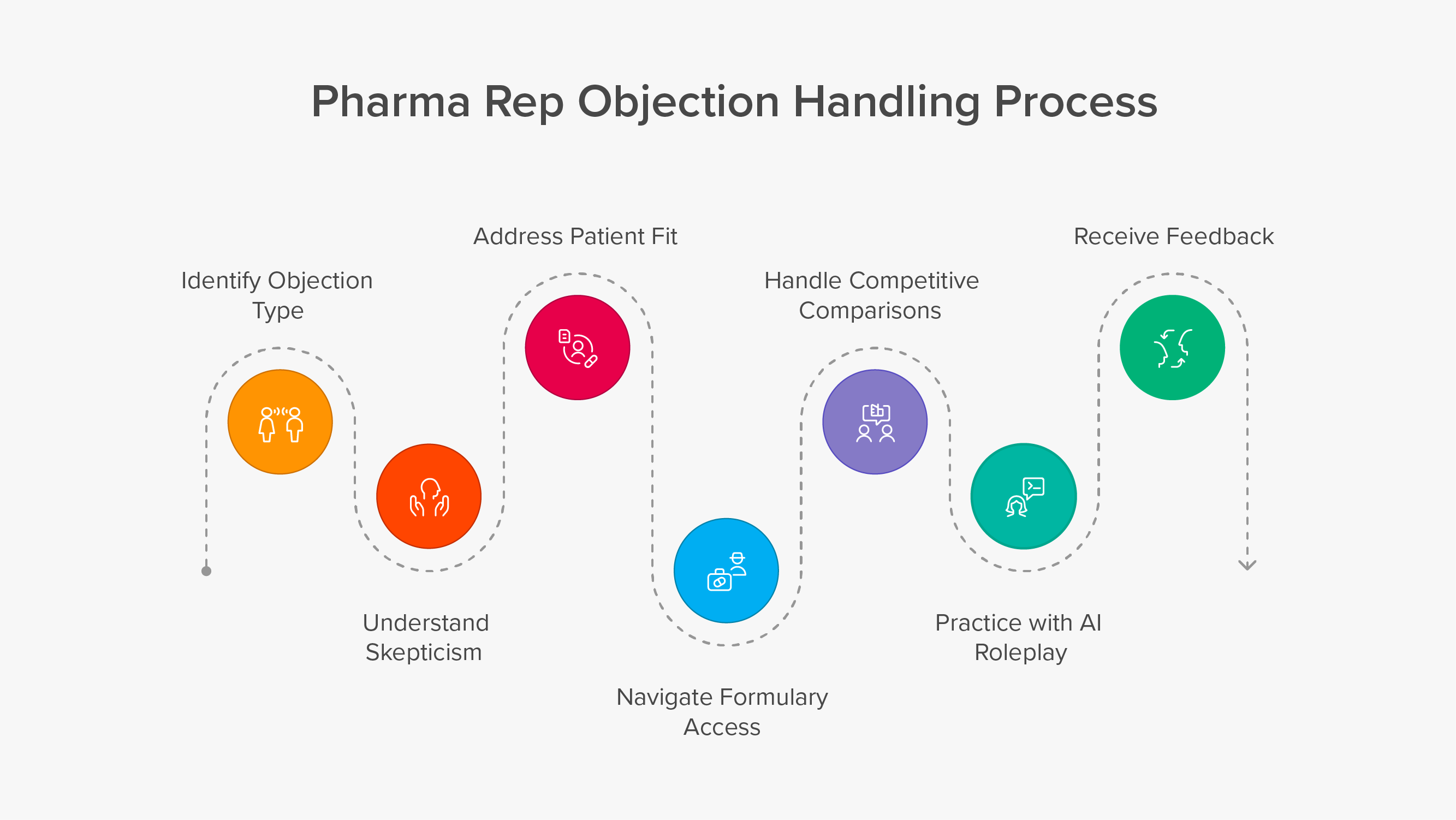
Representatives who practice within approved messaging frameworks repeatedly, under conditions that simulate the pressure and unpredictability of real interactions, develop the behavioral fluency that supports accurate communication even when the conversation presents unexpected challenges.
What Video Coaching Adds to the Training Experience
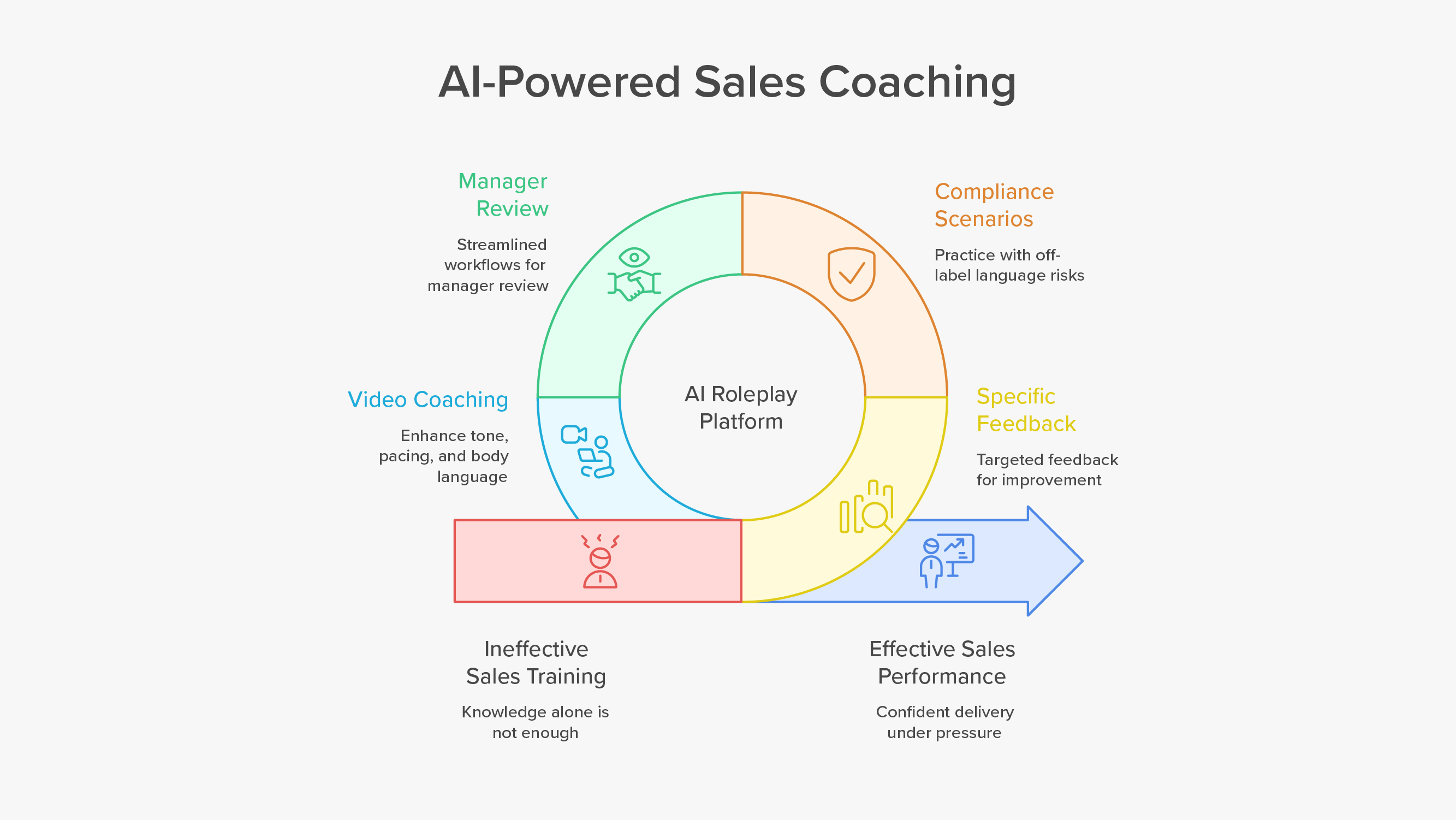
Video coaching captures dimensions of communication that written or typed simulations cannot assess. When a representative records a video response to a scenario, their tone of voice, pacing, confidence in delivery, eye contact, and body language become part of the assessment.
For pharma representatives who engage with specialist physicians, nurse practitioners, and formulary committee members, the non-verbal dimensions of communication have genuine impact on how their messages are received.
Training that addresses only the verbal content of communication, and not how it is delivered, is incomplete preparation for field interactions.
The reflective dimension of video submission is also worth noting. A sales rep who watches a playback of their own submission before it is reviewed by a manager gains self-assessment insight that is qualitatively different from reading feedback on a text response.
Seeing themselves deliver a message reveals things about their communication style that they may not be aware of a tendency to speak too quickly under pressure, a habit of breaking eye contact when addressing a challenging clinical question, or a pattern of hedging language that undermines the confidence of their delivery.
This self-awareness is a valuable coaching input that accelerates development.
Video coaching also creates a longitudinal record. The arc from a representative's first submission in onboarding to their certification submission tells a story about their development that neither a quiz score nor a simulation performance metric can fully capture.
This developmental record supports richer coaching conversations, more nuanced performance management, and organizational learning about what the training program is and is not building over time.
AI-Enhanced Roleplay and Coaching
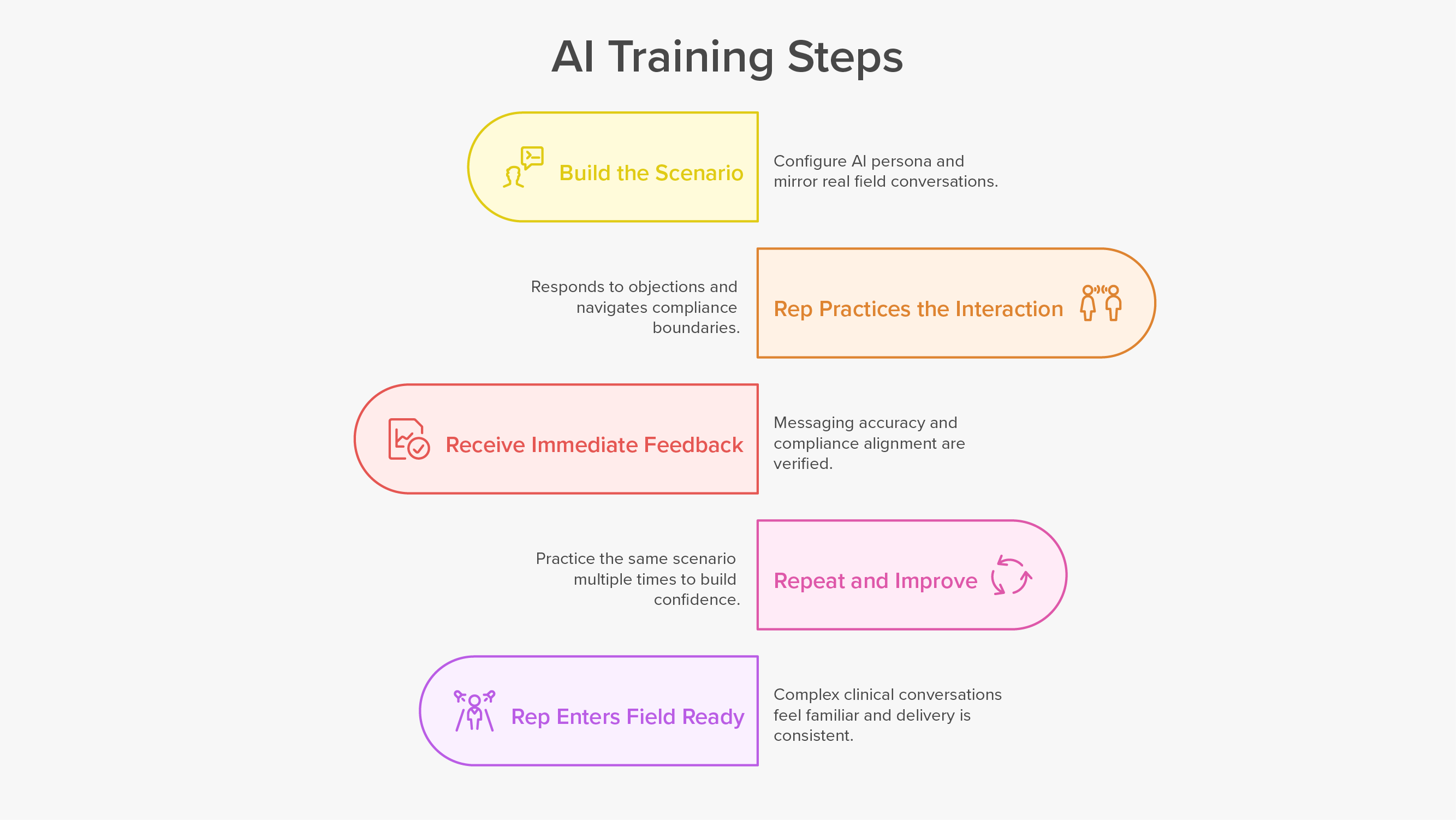
AI integration has transformed the scale at which roleplay and coaching can be delivered. Before AI-enhanced tools, the primary constraint on roleplay practice was the availability of a skilled coach or a prepared training peer to serve as the practice partner.
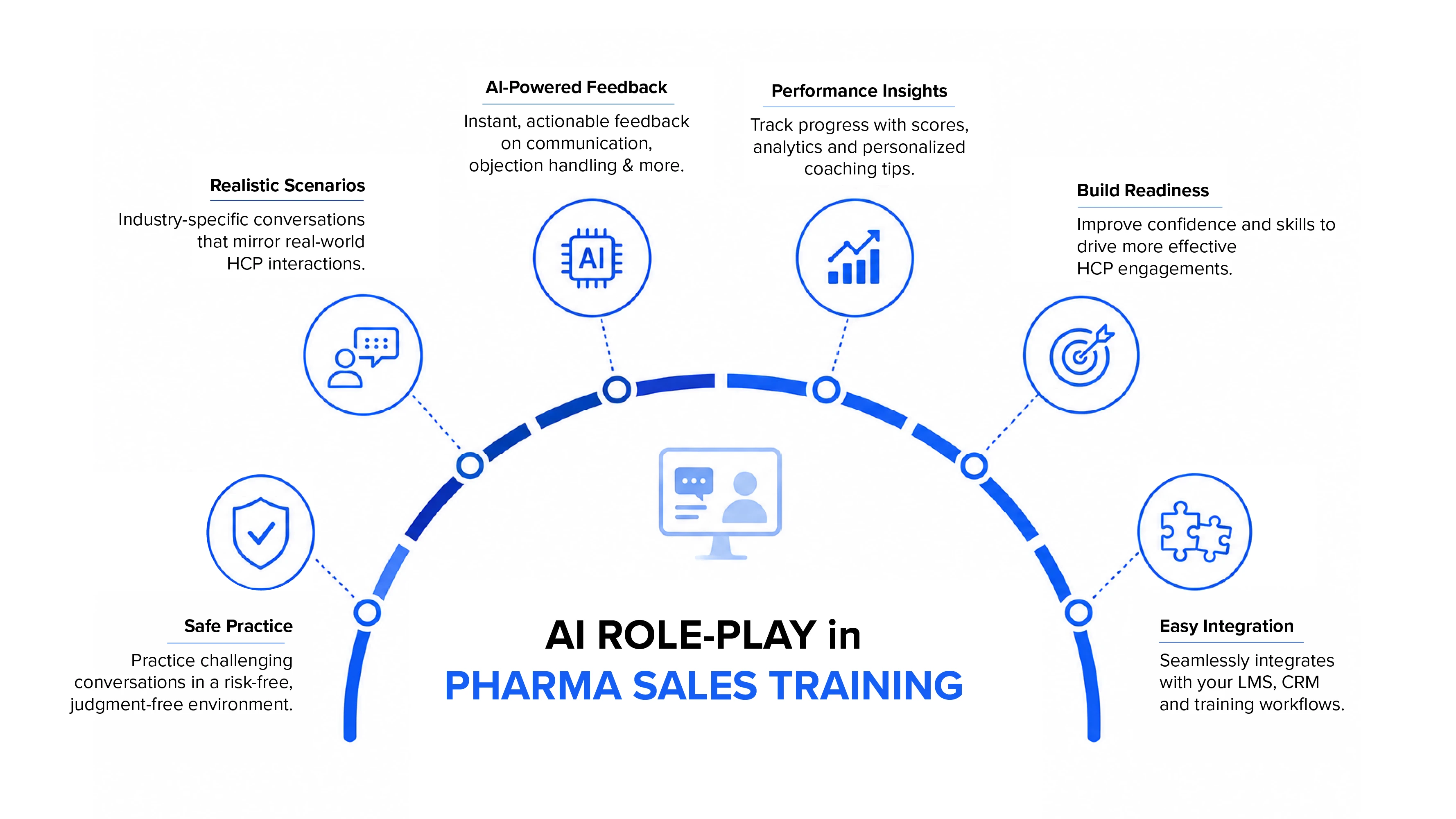
AI simulations remove this constraint entirely, making structured, feedback-rich practice available to every representative on their own schedule and at whatever frequency their development requires.
The quality of AI feedback is the variable that most determines whether this expanded access translates into actual development. Platforms that provide specific, element-level feedback, identifying precisely what the representative addressed well and precisely where their response fell short of the standard, produce meaningful development opportunities with each practice attempt.
Platforms that return aggregate scores or generic commentary provide practice volume without the coaching quality that converts that volume into improved performance.
For regulated industries, AI feedback quality also has a compliance dimension. Feedback systems that evaluate only communication fluency without assessing messaging alignment will fail to identify when a representative's response incorporates off-label language or makes claims outside approved parameters.
The most capable AI coaching tools for pharma sales environments evaluate responses against compliance criteria as well as communication quality, providing a training experience that reinforces both dimensions of field readiness simultaneously.
Manager Review Workflows and Feedback Quality
Even in AI-enhanced coaching environments, manager review retains an important and irreplaceable function. Managers bring contextual judgment about the specific market, customer relationships, and organizational culture that AI systems cannot replicate.
Their involvement in reviewing video submissions signals to representatives that the training investment is being taken seriously at the leadership level, which has a motivational dimension that AI feedback alone does not provide.
The practical challenge is ensuring that manager review is scalable. A regional manager with twelve direct reports who each submit a weekly video roleplay faces a significant time investment if the review process is inefficient.
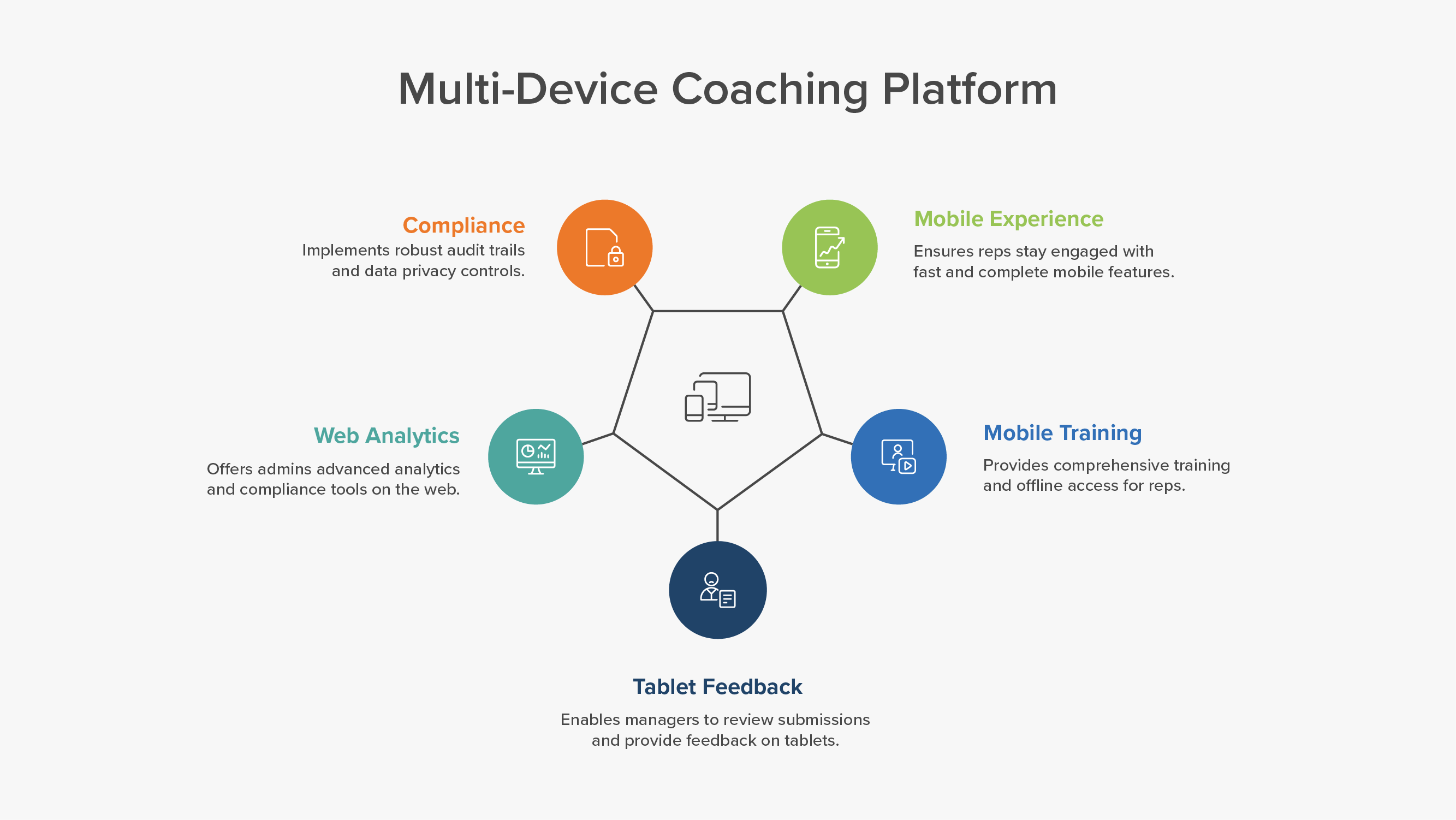
Platforms that support rubric-based evaluation, where the manager works through a defined set of criteria rather than composing open-ended feedback from scratch, and that allow inline annotation at specific moments in the video reduce the per-submission review time substantially without compromising feedback quality.
Feedback delivery within the platform, rather than through external channels, creates a closed loop that keeps the coaching conversation connected to the specific submission and makes it easier for representatives to act on the feedback through a follow-up practice attempt in the same environment.
Compliance Alignment in Roleplay Scenarios
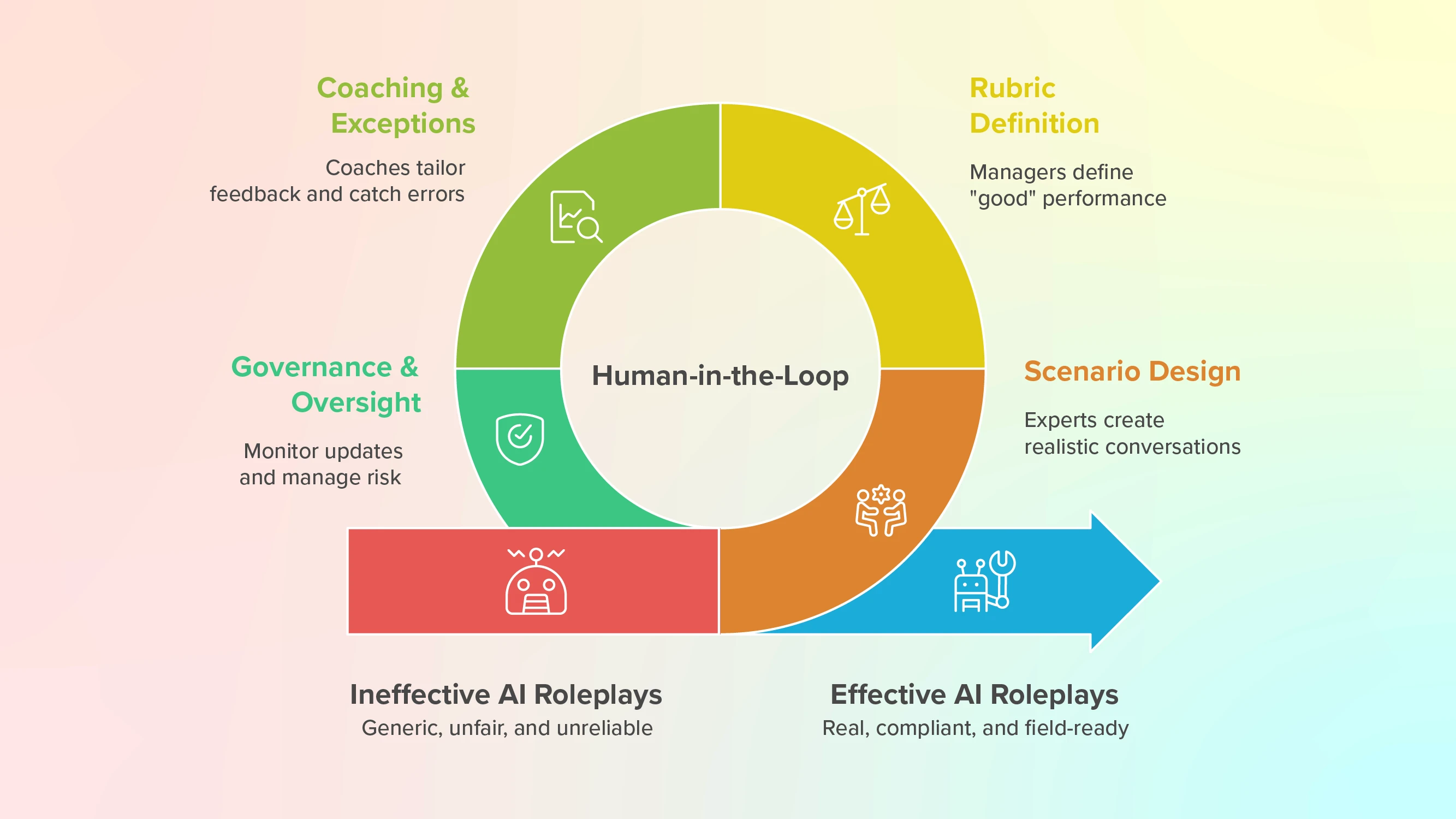
For organizations in regulated industries, the compliance architecture of roleplay tools is a non-negotiable evaluation criterion. Scenarios must be developed within approved messaging frameworks. Feedback must evaluate responses against compliance criteria as well as communication quality.
Content governance workflows must ensure that scenario content has been reviewed by appropriate medical and regulatory stakeholders before reaching the field.
And the platform must not allow unreviewed content to be deployed to representatives in a way that could introduce compliance risk into the training environment.
Organizations evaluating platforms in this category should test the compliance architecture during the evaluation process rather than taking vendor assurances at face value.
“How does the platform handle a scenario response that incorporates off-label language?”
“What does the feedback say, and what controls prevent that response from being reinforced rather than corrected?”
These are practical questions with answers that reveal more about platform suitability than any feature description
Evaluation Criteria for 2025-26
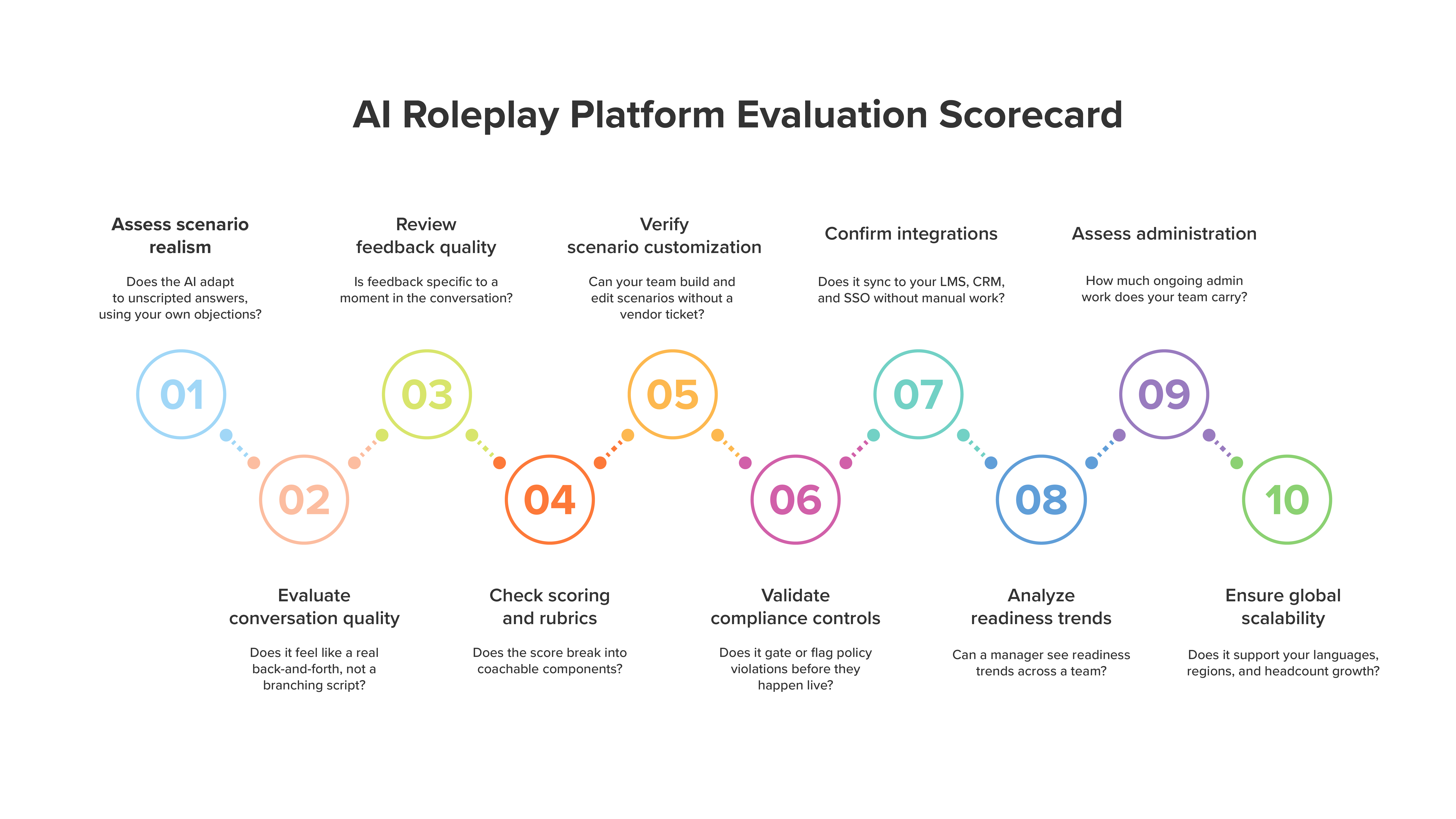
By this stage, the question is no longer whether a platform supports roleplay and coaching, but how effectively it delivers these capabilities in practice. Feature parity across vendors is common, but execution quality, scalability, and compliance alignment vary significantly.
The following criteria are intended to help sales and L&D leaders evaluate platforms based on real-world performance, not demonstration environments or feature claims.
Quality and specificity of AI-powered simulation feedback, evaluated through live demonstration
Flexibility and speed of scenario authoring for non-technical training team members
Manager review workflow usability and efficiency at realistic team scale
Video capture quality and reliability on the device types of your field team uses
Compliance control mechanisms and governance workflow for regulated industries
Integration with LMS, certification management, and other relevant systems
Mobile accessibility for field representatives with full feature parity on smartphone
Analytics depth at individual, team, regional, and organizational levels
Platforms such as SmartWinnr reflect this approach, where roleplay, coaching, and compliance are treated as interconnected components rather than standalone features.
How SmartWinnr Delivers Roleplay and Video Coaching
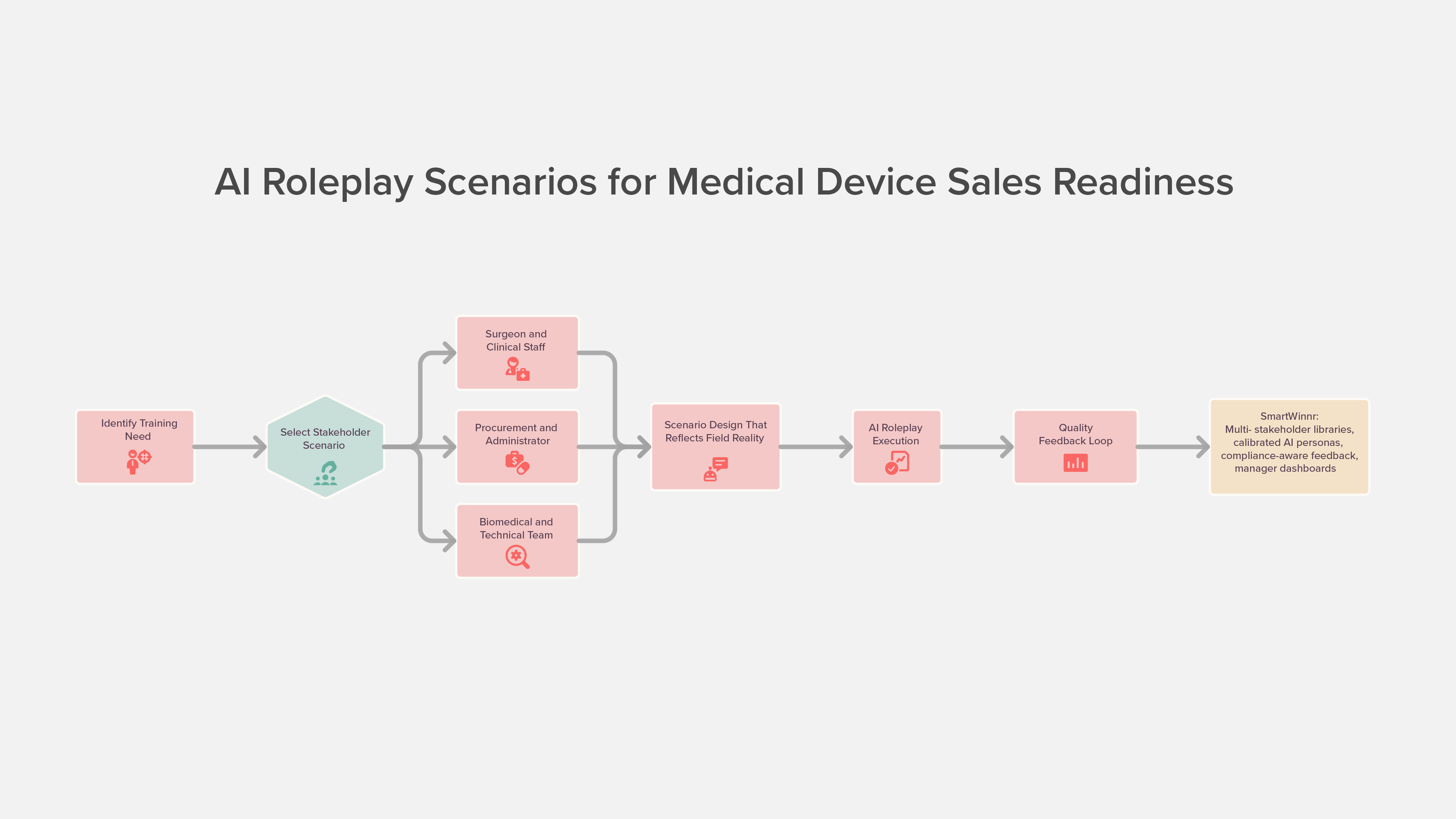
SmartWinnr Platform provides AI-powered roleplay simulations, video submission and review capabilities, and structured manager coaching workflows within a unified training environment. The platform supports compliance-aligned scenario design with configurable feedback criteria, making it suited to the specific requirements of pharma, biotech, and medical device sales teams where messaging precision is a regulatory requirement.
SmartWinnr's video coaching features are designed for practical use at the scale of real field organizations, with rubric-based review interfaces that support consistent evaluation across a large manager population and direct feedback delivery that keeps the coaching loop closed within the platform. The platform's AI simulation feedback is built to assess both communication quality and messaging alignment, ensuring that every practice session reinforces both the skills and the compliance behaviors that field readiness requires.
Request a demo to see how SmartWinnr supports roleplay practice and video coaching for sales teams in regulated industries.
Disclaimer: This content reflects industry practices and does not constitute medical, legal, or regulatory advice.
Last Updated: