

Smart AI Blog Summary
Get a quick blog summary from any of the below LLM's
What You'll Learn
Role-based AI coaching gives each field role its own track, built on the competency framework your field force already uses. A track sets the AI Roleplay scenarios the role practices, the level it must reach on each competency, how often it practices and how its manager coaches.
For a US pharma field force, start with five tracks: new territory reps, tenured territory reps, hospital reps, key account managers and first-line managers.
What Is a Role-Based AI Coaching Program?
A role-based AI coaching program is one in which field roles practice the conversations their own customers bring. AI Roleplay scores the attempts with a weighted rubric built from your competency framework, and the role's pass threshold sets the bar. Managers coach from those scores and from what they see on field rides.
A new rep and a key account manager are scored on the same objection-handling criteria, and the account manager's threshold is higher.

The four parts a role sets, on one shared framework.
If your field force doesn't have a framework yet, building a sales competency framework for pharma field teams covers the domains and how to write them.
Which Field Roles Need Their Own Track?
Give a role its own track when it talks to different customers or is held to a different standard. Add others to these five, such as a launch team, when your structure needs them.
Role | Who the track practices with | What the track practices |
|---|---|---|
New territory reps | AI personas of office-based physicians and their staff | Opening a call, key messages and required statements |
Tenured territory reps | The same HCPs, with call history | Harder objections on formulary status, prior authorization, safety and competitor data, plus the new messages from the latest POA |
Hospital reps | AI personas of specialists, hospital pharmacists and clinic staff | Clinical depth and the hospital formulary process |
Key account managers (KAMs) | AI personas of health-system pharmacy directors and formulary leads | Access conversations, care pathways and multi-stakeholder meetings |
First-line managers | Recorded rep attempts, scored in calibration | Scoring against the rubric and coaching after field rides |
Specialty reps who call on office-based specialists can follow the territory tracks with specialist personas. For the tenured track, the objection categories in AI Roleplay platforms for pharma objection handling make a good starting list.
How Do You Set a Target for Each Role?
Keep one set of competencies and give each role a target level on them. Map the levels to bands on your rubric, such as 2 of 5 for Foundation, 3 for Proficient and 4 for Advanced, so a score shows whether a rep has reached the role's target.
Competency | New reps | Tenured reps | Hospital reps | KAMs | Managers |
|---|---|---|---|---|---|
Call opening and objective | Proficient | Advanced | Advanced | Advanced | Advanced |
On-label clinical messaging | Proficient | Advanced | Advanced | Proficient | Advanced |
Objection handling | Foundation | Advanced | Advanced | Advanced | Advanced |
Account and access planning | Foundation | Proficient | Proficient | Advanced | Proficient |
Multi-stakeholder meetings | Not targeted | Foundation | Proficient | Advanced | Proficient |
Coaching to the rubric | Not targeted | Not targeted | Not targeted | Not targeted | Advanced |
Fair balance and off-label referral | Pass gate | Pass gate | Pass gate | Pass gate | Pass gate |
An illustrative target grid. Adjust the competencies and levels to your own framework.
Write the levels as behaviors a rubric can score. For account and access planning, the three levels might read:
Foundation, for new reps: states the formulary status of the accounts in the territory correctly.
Proficient, for tenured reps, hospital reps and managers: uses formulary status to choose the call objective and the approved access resources.
Advanced, for KAMs: builds an access plan for a whole health system, with a next step for each decision-maker.
The bottom row of the grid never changes. Fair balance and the referral of off-label questions to Medical Information are pass gates in every track, because FDA's Office of Prescription Drug Promotion exists to help ensure that "prescription drug promotion is truthful, balanced, and accurately communicated."
How Do You Design the Tracks?
Set a practice cadence and a manager rhythm that fit each role's calendar, then write the scenarios from the role's real conversations. Treat the cadences below as starting points to test in a pilot.
Track | Practice cadence | Manager rhythm |
|---|---|---|
New territory reps | Short sessions several times a week until certification | Review every attempt that misses a pass gate |
Tenured territory reps | One refreshed scenario a month, plus one after each POA | Review score trends monthly |
Hospital reps | Before a new hospital account or a protocol change | Review before the first call on a new account |
Key account managers | Longer sessions before major account meetings | Review the rehearsal before the meeting |
First-line managers | A calibration session at each POA cycle | A second-line manager reviews coaching quality |
For KAMs, the track card below sets longer rehearsals before major account meetings, with a pharmacy director or formulary lead as the persona and the manager reviewing the rehearsal first. When a persona asks for evidence beyond your approved materials, the KAM refers the request to Medical Affairs, and the rubric scores that handoff.

An illustrative track card for the KAM track.
The feedback below shows one KAM rehearsal scored against that track's targets. The KAM met both pass gates and fell short on one competency, so the manager assigns one more rehearsal before the meeting.

Illustrative feedback in demo data. Scores are read against the role's targets.
Pair the tracks with learning paths for the knowledge behind the practice. Integrating AI coaching and role-based learning paths covers how the two work together, and the pharma sales rep onboarding checklist covers the rest of the new rep program.
The track planner at the end of this guide has a blank target grid and track cards. To see how a track is set up in SmartWinnr, request a demo.
How Do You Build the Manager Track?
Teach first-line managers to score attempts the way the rubric does, and calibrate them before their scores count toward any certification. Start the manager track alongside the first rep track, because managers coach every other track.
In a calibration session, managers from different districts score the same recorded attempts and compare their scores criterion by criterion. They agree on an example answer for each level, then rescore a sample to check that their scores have moved closer. Without that step, the same attempt can be scored differently in two districts.
Calibration takes managers out of the field, so hold it next to the POA meeting, when they are already together, and again whenever a rubric changes.
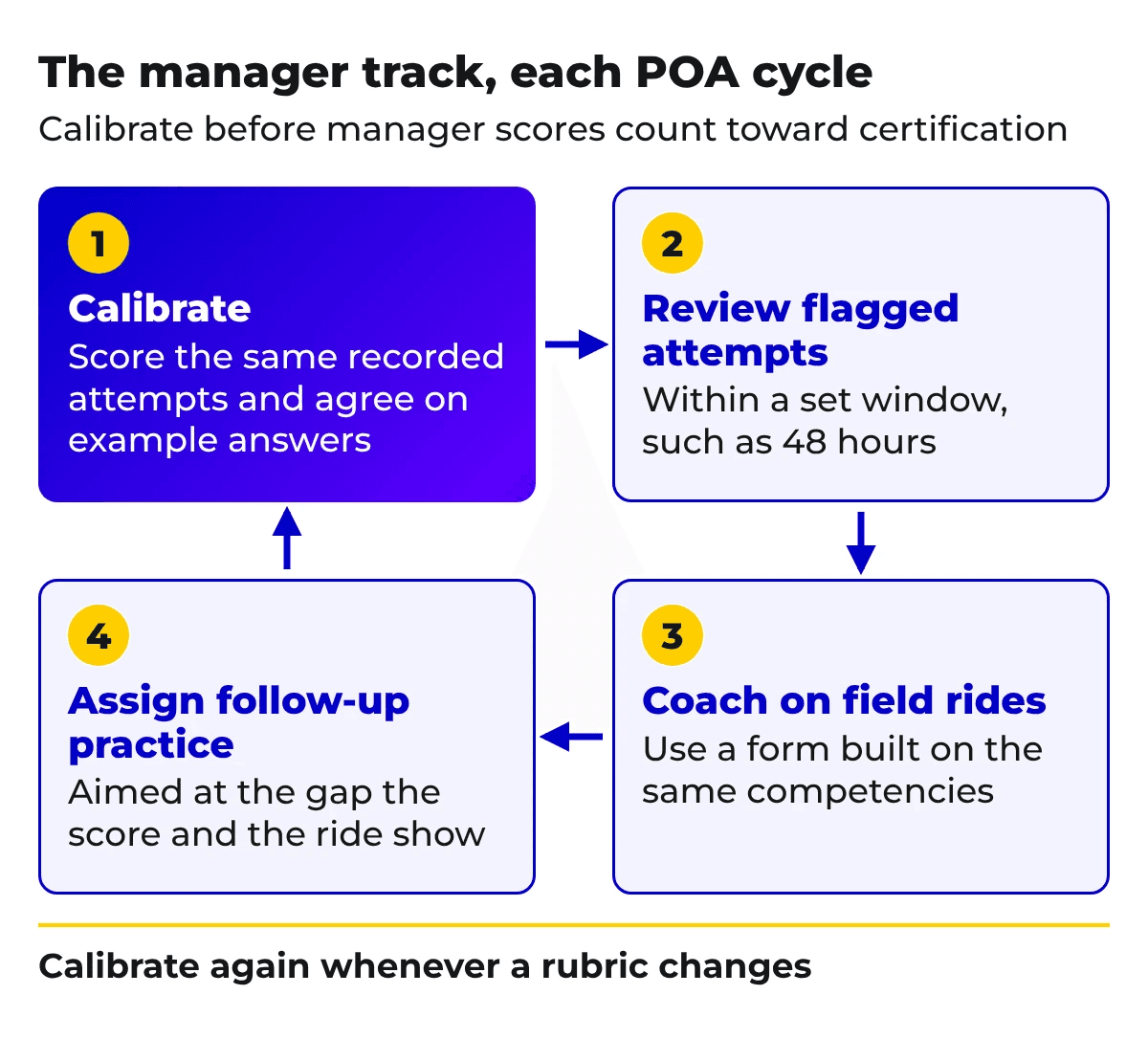
The manager track runs as a loop each POA cycle.
Use the same competencies on the field ride form, so what a manager sees on a call and what AI Roleplay scores line up. Set a window for reviewing flagged attempts, such as 48 hours, and report it as coaching coverage.
Who Reviews the Tracks?
Privacy, MLR and Medical Information review all five tracks, Legal and Compliance also review the KAM track, and IT security and AI governance review the vendor once. Plan the reviews in this order:
IT security and AI governance review the vendor once, before any content reaches it.
Privacy approves how practice recordings are stored and who can replay them, including the recordings managers score in calibration.
MLR, or your company's review for internal training material, approves the persona briefs, required statements and feedback wording, and each approved version is kept with its date.
Medical Information checks the off-label questions and the referral wording.
Legal and Compliance also review KAM scenarios that touch pricing or contracting.

Most reviews happen once, and changed scenarios go back to MLR at each POA cycle.
For the coaching records that follow practice, compliant sales coaching in pharma covers what compliance teams look for.
How Do You Measure a Role-Based Program?
Report the tracks against their own targets each quarter. Because the levels map to rubric bands, a score of 3 puts a new rep above target on account and access planning and a KAM below it.
Track | Practice measure | Field measure |
|---|---|---|
New territory reps | Days from start date to certification | Field ride rating on key messages |
Tenured territory reps | Score on the scenarios refreshed after each POA | Field ride rating on the new messages |
Hospital reps | Score on specialist and pharmacist scenarios | Manager rating on calls to new hospital accounts |
KAMs | Score on rehearsals before major meetings | Manager review after the meeting |
First-line managers | Spread of scores in calibration | Share of flagged attempts reviewed within the window |
Across all tracks, report participation and the share of reps at target on each competency.

An illustrative quarterly readout in demo data.
Commercial Excellence may ask for sales results next to this readout. Show the two side by side, and note what else changed that quarter, such as a launch or a formulary decision, before anyone credits the coaching.
Where Does SmartWinnr Fit?
SmartWinnr runs the practice, learning paths and field coaching inside a track, where managers define weighted rubrics and set pass thresholds.
Track need | In SmartWinnr | Confirm in the demo |
|---|---|---|
Personas for each role's customers | AI characters mirror real physicians, pharmacists and hospital decision-makers, and trainers choose personas and upload talk tracks and clinical PDFs | Personas for all five tracks |
Role targets and pass gates | Managers set required statements and pass gates, define weighted rubrics and set pass thresholds | A different pass threshold per track |
Learning paths by role | Targeted Learning builds role-based learning paths and delivers microlearning and certifications that fit each role | One path per track |
Manager coaching | Field Coaching has templates for joint visits, launches and label updates, shared forms with weighted rubrics and mandatory items for compliance | Field ride forms built on your competencies |
Reporting | Readiness analytics show time to first pass, skill-level scores, keyword coverage and trends by team and region | Results grouped by track |
SmartWinnr's AI Roleplay uses your approved clinical and messaging content, and SmartWinnr for pharma tracks certification across brands and regions. The five tracks are a structure your team defines, so ask in the demo how results can be grouped by track.
Plan Your Tracks
Download the role-based coaching track planner. It holds a blank target grid and a track card per role on one page, ready to print and complete before the pilot. When you're ready to see a track set up in SmartWinnr, request a demo.
Frequently Asked Questions
Should MSLs be part of a role-based coaching program?
Run their training as a separate program. MSLs sit in Medical Affairs and their scientific exchange is non-promotional, so their scenarios and reviewers differ from the sales tracks.
What if one person covers two roles?
Give them the higher target wherever the two roles share a competency, and scenarios from both tracks. A hospital rep who also manages two health systems, for example, practices access meetings from the KAM track as well.
When should role targets change?
Review them at each POA cycle and when a role changes, such as a launch that adds hospital accounts to a territory. Recalibrate managers before a raised target counts toward certification.
Disclaimer: This content reflects industry practices and does not constitute medical, legal, or regulatory advice.
Last Updated: