
Smart AI Blog Summary
Get a quick blog summary from any of the below LLM's
What You'll Learn
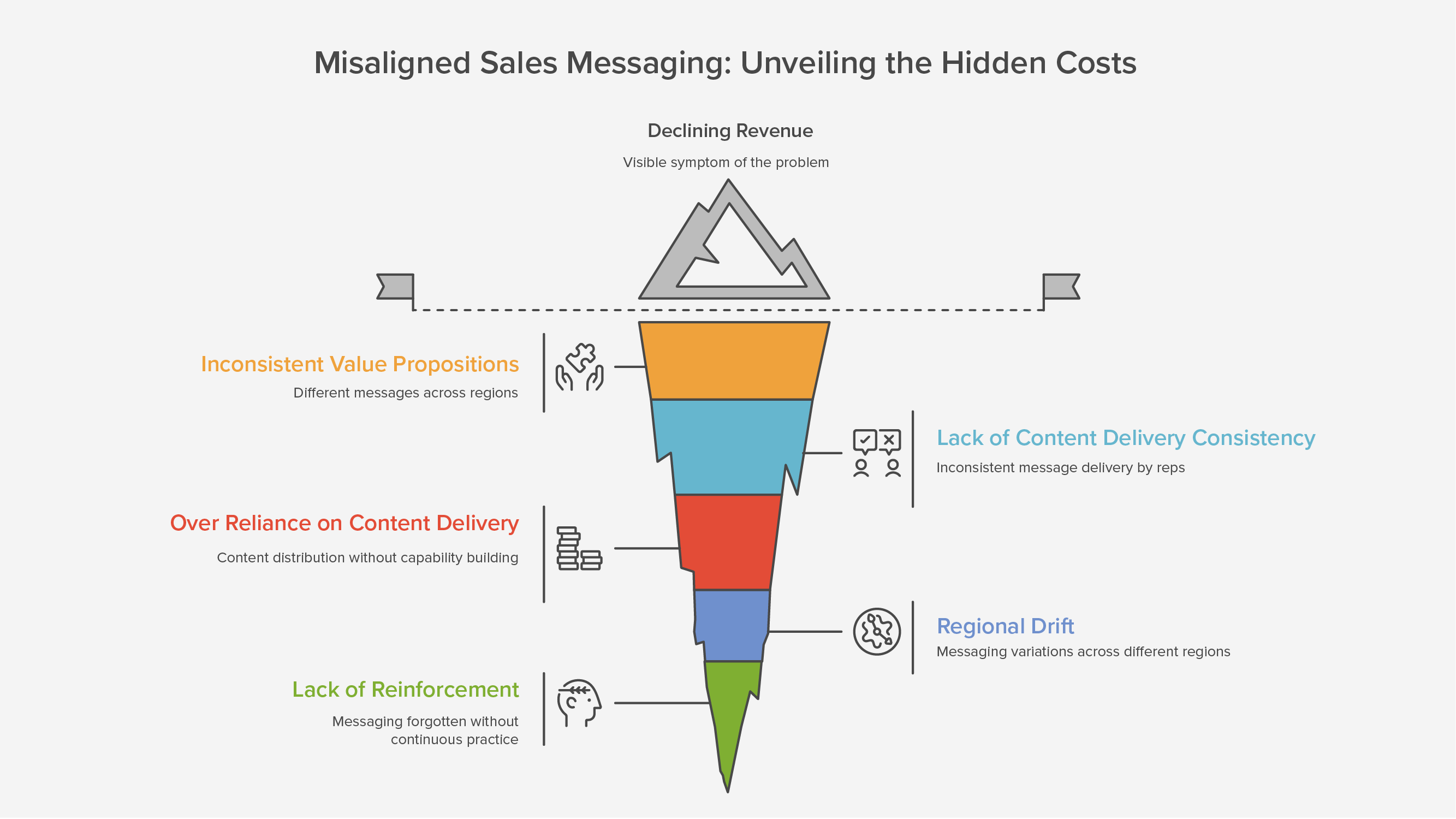
Choosing an AI Roleplay platform is a revenue decision, not just a training decision. When a regional team misses quota, the root cause is often a rep who was never tested on the objection that came up in the field, and no amount of static content fixes that gap.
Most vendor demos focus on the conversation itself: how natural the AI sounds, how quickly it responds, how smooth the interface feels. VP Sales and Regional Sales Directors need a wider lens. The right question is not whether the AI can talk. It is whether the platform can turn practice into measurable readiness across territories, roles, and quarters.
This guide lays out what to evaluate before you sign a contract: scenario realism, scoring rigor, customization depth, integrations, governance, and what a pilot should prove. Use it alongside a live demo, not instead of one.
What Is an AI Roleplay Platform?
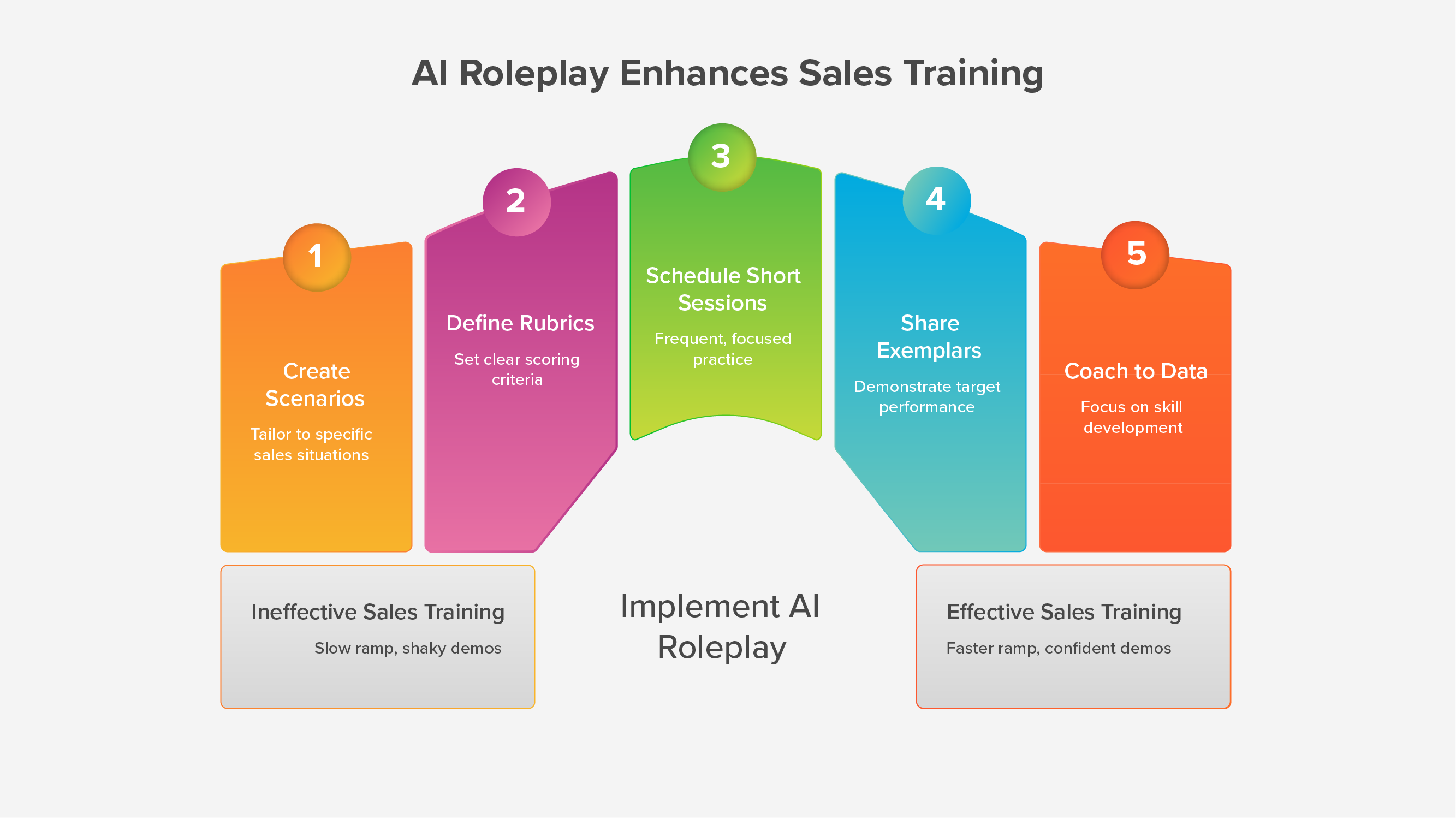
An AI Roleplay platform provides interactive simulated conversations in which reps practice realistic customer scenarios and receive structured feedback against defined performance criteria. Reps talk to an AI-driven persona (a buyer, a physician, a claims adjuster, a distributor) that responds in real time and adapts based on what the rep says.
The output is not just a transcript. A working platform scores the interaction against a rubric, flags specific skill gaps, and rolls that data up so managers see readiness trends across a team rather than one conversation at a time.
This distinguishes AI Roleplay from two adjacent categories that often get bundled into the same conversation. Conversation intelligence tools analyze real calls after they happen. Traditional e-learning delivers static content with no live back-and-forth. AI Roleplay sits between the two: a rehearsal environment that produces the same kind of performance data a live call would, without waiting for a live call to happen.
What Should Revenue Leaders Evaluate Before Choosing an AI Roleplay Platform?
Evaluate an AI Roleplay platform as a sales-readiness system, not as a conversation tool. A vendor that only demonstrates a smooth chat experience is showing you a fraction of what the platform needs to do.
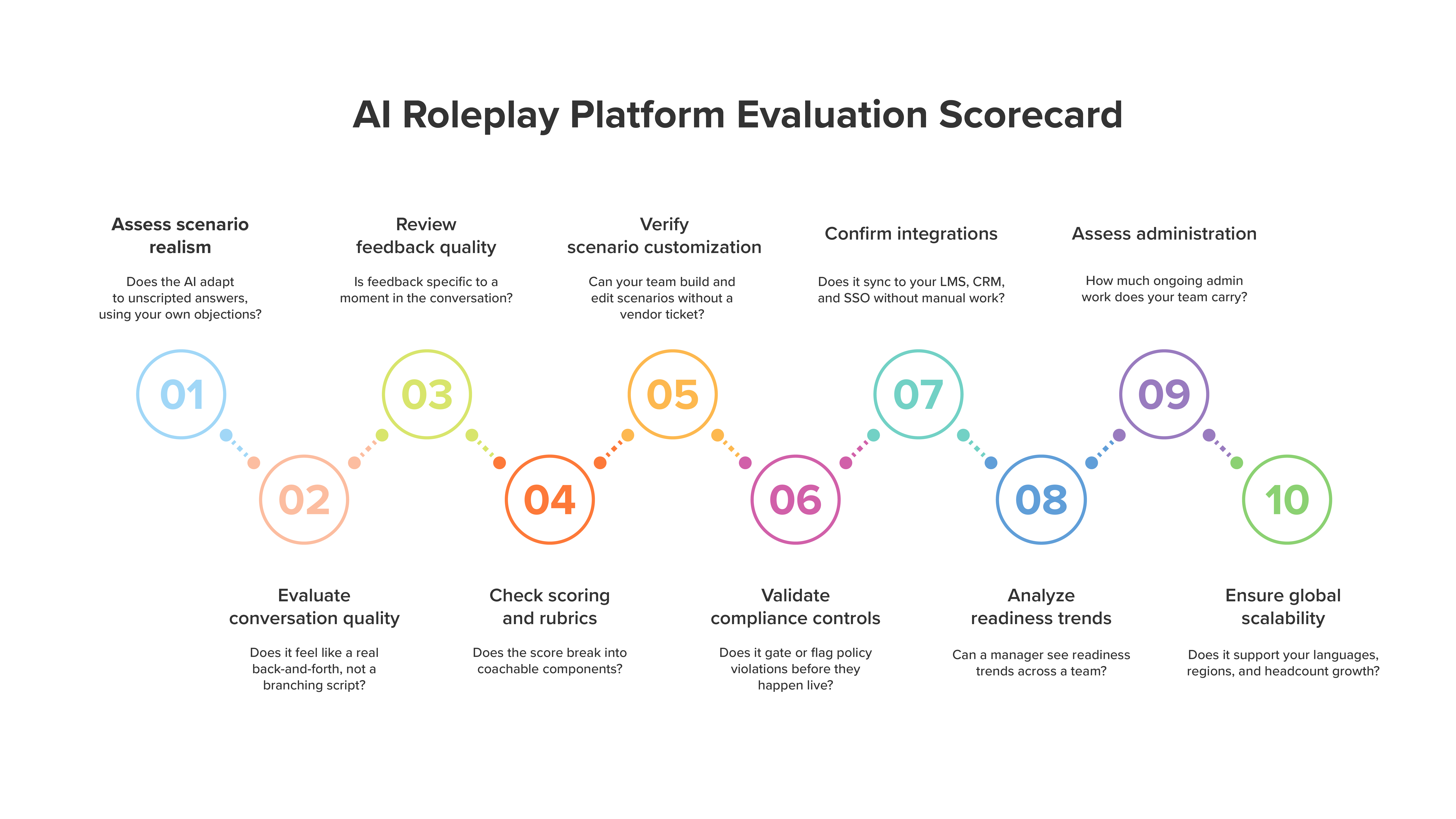
Ten areas deserve direct attention during evaluation: scenario realism, conversation quality, feedback quality, scoring rubrics, scenario customization, compliance controls, integrations, analytics, administration, and global scalability. A platform that scores well on realism but has no rubric-based scoring will produce practice sessions that feel good and prove nothing. A platform with strong analytics but no way to customize scenarios for your product line will not hold up past the pilot.
Treat each area as a pass or fail check tied to a business outcome. Realism should predict how a rep handles the real conversation. Scoring should predict who is ready and who needs more reps. Administration should predict how much work your enablement team carries once the platform is live across 500 or 5,000 reps.
The Association for Talent Development's sales enablement research makes a related point: enablement investment only shows up in revenue outcomes when it is measured against specific skill and readiness metrics, not general satisfaction with the training. Build that same discipline into how you score a platform demo.
How Realistic Are the AI Roleplay Scenarios?
Realistic scenarios respond to what the rep says in the moment, rather than following a fixed script, and they reflect the specific objections, personas, and settings your reps face. A generic "angry customer" scenario tests almost nothing. A scenario built around a specific objection your product hears in the field tests something real.
Ask a vendor to build a scenario live, using an objection from your own product line, not a canned demo script. Watch what happens when a rep gives an unexpected answer. A platform built on scripted branches will stall or loop. A platform built on genuine two-way conversation will adapt and keep the exchange moving.
Scenario realism example: a field sales rep at a cycle meeting. A regional team gathers for a quarterly cycle meeting after a new competitor enters the territory. The manager runs the group through an AI Roleplay scenario built around the exact pricing objection reps have been hearing that week, not a generic discount pushback.
Reps who handle the live scenario well move straight into ride-alongs. Reps who stumble get flagged for a follow-up coaching session before their next customer visit.
What this reveals: Scenario relevance, not scenario polish, is what separates practice that changes field behavior from practice that just fills a training hour.
How Does the Platform Evaluate Rep Performance?
Performance evaluation should score each attempt against a defined rubric, not a subjective impression, and should surface specific skill gaps a manager can coach against. Look for scoring criteria tied to observable behaviors: did the rep acknowledge the objection, did they ask a clarifying question, did they close with a clear next step.
A rubric that only produces a single overall number is hard to act on. A rubric that breaks the score into components, product knowledge, objection handling, compliance language, tone, gives a manager something specific to coach. Ask a vendor to show you the rubric itself, not just the score screen.
Scoring exists to direct coaching time, not to produce a leaderboard number. If a score cannot tell a manager what to fix, it is not doing its job.
Can AI Roleplay Be Customized for Different Roles and Industries?
Customization should extend to persona, objection library, product content, and compliance language, not just scenario titles. A platform that lets you rename a template but not rebuild its logic is not customizable in any way that matters at scale.
For a distributed revenue organization, this matters across roles as much as across industries. A new hire onboarding scenario looks nothing like a scenario for a tenured rep defending a renewal. A channel partner conversation looks nothing like a direct enterprise sale. Ask whether your own enablement team can build and edit scenarios without a vendor ticket, and how long that takes.
Customization depth determines whether the platform scales with your business or becomes another fixed template library your team outgrows in a year.
How Should You Evaluate AI Coaching and Feedback?
Coaching and feedback should be specific, tied to the rubric, and delivered fast enough for a rep to apply it before the next call. Vague feedback ("good job" or "needs improvement") gives a rep nothing to change. Feedback tied to a specific moment in the conversation, the exact sentence where an objection went unanswered, gives them something concrete.
Evaluate whether feedback reaches the manager as well as the rep. A platform that only shows the rep their own score leaves managers guessing about who on their team needs attention this week. A platform that rolls scores into a manager dashboard turns individual practice into a coaching plan for the whole territory.
What Integrations Matter for Enterprise AI Roleplay?
The integrations that matter most connect AI Roleplay results to the systems your managers and reps already use daily: your LMS for completion tracking, your CRM for readiness visibility ahead of a launch, and single sign-on for enterprise access control. A platform that lives entirely on its own, disconnected from everything else in your stack, adds a login your team has to remember instead of a workflow they use without thinking about it.
Ask specifically how AI Roleplay completion and scores sync back to your LMS, and whether readiness data can surface inside the CRM record a manager already checks before a territory review. A platform without clear answers here will create a reporting gap the moment you try to show leadership a readiness number across the whole org.
How Should Security, Compliance, and Governance Be Evaluated?
Governance evaluation should cover data handling, model behavior, and audit visibility, not just a checkbox on a security questionnaire. Ask directly whether the platform trains on your proprietary content between sessions, or whether it uses inference only, with no retention that could leak your content into another customer's environment.
For regulated or channel-driven organizations, ask about compliance gating: can the platform block or flag language that violates your internal policy before a rep ever says it to a real customer. Ask whether every AI Roleplay session generates an audit trail your compliance or legal team can pull on demand.
The NIST AI Risk Management Framework and ISO/IEC 42001 AI management system standard both give a structured way to question a vendor's governance claims rather than taking a compliance slide at face value. Ask a vendor which of these frameworks, if any, informs how they built their controls.
Governance questions separate vendors that have built compliance into the product from vendors that have only built a slide about compliance for the sales deck.
The AI Roleplay Platform Evaluation Scorecard
Score every vendor against the same ten dimensions so comparisons stay objective across demos that happen weeks apart.
Dimension | What to check |
|---|---|
Scenario realism | Does the AI adapt to unscripted answers, using your own objections? |
Conversation quality | Does the exchange feel like a real back-and-forth, not a branching script? |
Feedback quality | Is feedback specific to a moment in the conversation, not generic praise? |
Scoring and rubrics | Does the score break into coachable components, not one number? |
Scenario customization | Can your team build and edit scenarios without a vendor ticket? |
Compliance controls | Does the platform gate or flag policy violations before they happen live? |
Integrations | Does the platform sync to your LMS, CRM, and SSO without manual work? |
Analytics | Can a manager see readiness trends across a team, not just one session? |
Administration | How much ongoing admin work does the platform require your team to carry? |
Global scalability | Does the platform support your languages, regions, and headcount growth? |
Do not average these into a single composite score. A platform that fails compliance controls or global scalability should not advance regardless of how it scores on the other eight, because those two failures are the ones that surface only after rollout, when they are most expensive to fix.
What Should an AI Roleplay Vendor Demonstrate During a Pilot?
A pilot should demonstrate the platform working on your content, with your reps, against your actual objections, not a polished vendor-built demo scenario. Insist on building at least one scenario together using a real product and a real objection before you agree to a broader rollout.
Run the pilot with a specific, measurable question in mind: does time to first passing score drop, does manager coaching time per rep drop, does the compliance audit trail hold up when your legal team reviews it. A pilot that only produces positive anecdotes from a handful of reps has not tested the platform.
A pilot exists to surface the platform's weak points before a full rollout does, not to confirm what the vendor already told you during the sales cycle.
Where SmartWinnr Fits in the Evaluation
SmartWinnr is one option worth including in this evaluation, built around two-way AI Roleplay conversations, rubric-based scoring, role and industry customization, a three-layer compliance framework, and readiness analytics designed for enterprise revenue organizations. It supports 35 or more languages and integrates with common LMS and CRM systems.
It is not the only platform that will pass this scorecard, and it should not be the only one you demo. Run the same ten dimensions against every vendor on your shortlist and let the results, not the sales pitch, decide the outcome.
See how AI Roleplay scores every attempt against your rubric and rolls results into a manager view, so you know who needs coaching this week.
Request a demo
Frequently Asked Questions
What should I look for in an AI Roleplay platform?
Look for scenario realism tied to your own objections, rubric-based scoring that breaks into coachable components, customization your team can manage without a vendor ticket, integrations with your LMS and CRM, and clear compliance controls with an audit trail. Weigh all ten dimensions in the evaluation scorecard together rather than picking the platform with the smoothest demo alone.
How do companies measure AI Roleplay effectiveness?
Companies typically measure effectiveness through time to first passing score, coaching touchpoints per rep per month, knowledge retention over 30 days, and downstream metrics like ramp time or quota attainment. SmartWinnr customers report a 30 percent faster product launch readiness timeline when AI Roleplay scores are tracked alongside these metrics rather than in isolation.
How accurate is AI Roleplay?
Accuracy depends on how closely the AI responds to what a rep says, rather than following a fixed script, and on whether the persona is built from your real product content and objections. Test this directly during a demo by giving an unexpected answer and watching whether the conversation adapts naturally. SmartWinnr customers report a 74 percent increase in rep confidence for complex conversations after using AI Roleplay to practice against realistic personas.
Can AI Roleplay be customized?
Yes, on platforms built for it. Customization should extend to the persona, the objection library, product-specific content, and compliance language, not just a scenario title or a color scheme. Ask whether your enablement team can build and edit a new scenario directly, without submitting a request to the vendor.
Does AI Roleplay integrate with Salesforce?
Many enterprise AI Roleplay platforms integrate with Salesforce and other CRMs, typically to surface rep readiness scores or completion status inside the records a manager already reviews before a territory or account check-in. Confirm the specific integration depth with each vendor, since "integrates with Salesforce" can mean a full data sync or a one-way status flag depending on the platform.
Disclaimer: This content reflects industry practices and does not constitute medical, legal, or regulatory advice.
Last Updated: