

Smart AI Blog Summary
Get a quick blog summary from any of the below LLM's
What You'll Learn
Use CRM data to decide which AI Roleplay conversations new reps practice. Pull segment-level patterns from Veeva Vault CRM or Salesforce, such as the objections reps log with each HCP segment, and turn each pattern into a persona and rubric that pass MLR review. Keep anything that identifies an HCP out of the scenario.
This guide is for commercial training leaders at US pharma companies who onboard new reps and want their practice to match the HCPs those reps will call on.
What Does CRM-Based Personalization Mean in AI Roleplay?
It means the persona a new rep practices with, and the rubric that scores them, come from patterns among the HCPs that rep will call on. The CRM tells you who those HCPs are and what they push back on.
You can personalize at two levels. Segment-level practice builds one persona from patterns across many HCPs, such as high-decile cardiologists in health-system practices. HCP-level practice prepares one rep for a call with one named HCP.

Segment-level personas need only aggregated data. HCP-level practice waits for privacy approval.
Start at segment level. One scenario then serves a whole new-hire class, and no individual HCP's information enters your practice platform.
The CRM won't tell you how a persona talks. For that, pick an interaction style, such as the ones in buyer personas in pharma sales.
Which CRM Data Should Shape a Scenario?
The useful fields are the ones that change how a conversation goes, pulled as patterns across a segment.
CRM data | What it changes in the AI Roleplay |
|---|---|
Specialty and practice setting | The persona's clinical priorities and vocabulary, and who else is in the room, such as a practice manager |
Segment or decile band | How familiar the persona is with the category and your brand, and so which call objective the rep practices |
Access notes, where your CRM tracks them | How long the conversation runs, and whether the rep meets office staff first |
Objections logged on calls | The objections the persona raises, in the order reps meet them |
Medical information request topics | The off-label question the rep practices referring to Medical Information |
Formulary status across the territory's accounts | The coverage and prior authorization objections |
Key messages delivered on recent calls | Which approved message the rep practices next |
Check how complete each field is before you build. If reps rarely log objections, ask district managers for the three they hear most on field rides, and take the segment and access data from the CRM. The objection types pharma reps face gives you categories to sort them into.
Two fields need a second owner's agreement. Medical information request topics come from Medical Affairs, so ask Medical Information before you use them. If your decile and segment fields come from prescriber data licensed from a data vendor, ask the team that manages the license whether it covers training content.
What to Leave Out
Leave out anything that identifies an HCP or a patient, such as names, NPI numbers and individual prescribing volumes. Free-text call notes are the riskiest field, because they can hold details nobody meant for training content. Summarize their themes and leave the text in the CRM.

What shapes the persona, and what stays in the CRM.
How Do You Turn One CRM Pattern Into a Scenario?
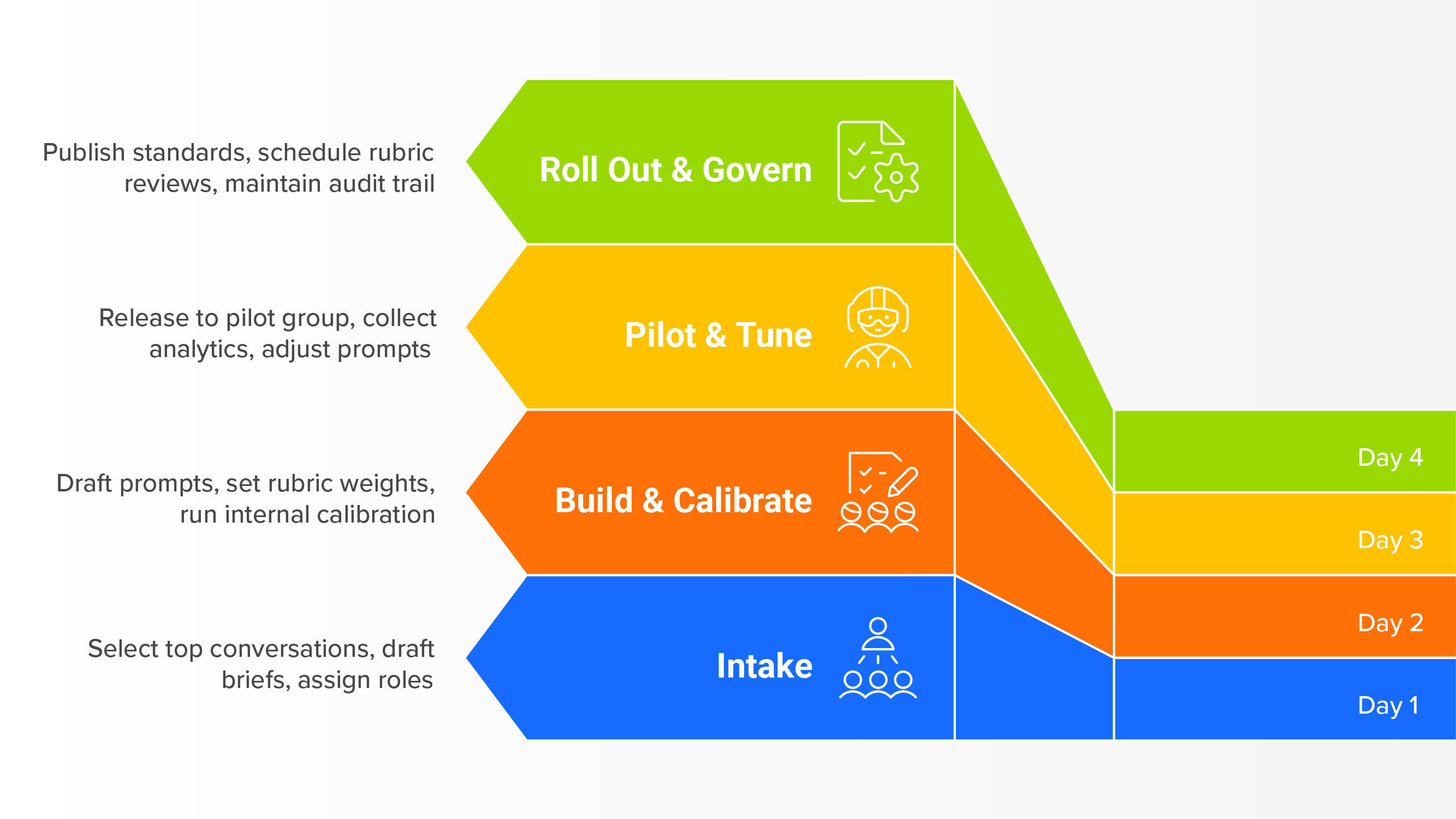
Work in five steps: pull one pattern, strip the identifiers, write a persona card, build the rubric, then test the scenario and take it through review. Start with a pattern new reps will meet in their first weeks in territory.

Five steps between one CRM report and a scenario in the new-hire curriculum.
1. Pull One Pattern
Ask Commercial Operations for one report, such as the objections logged on second calls with cardiologists in one region over the last two quarters. A scenario built on one pattern gives you a score you can trace back to one moment in the conversation.
2. Strip the Identifiers
Keep counts and themes. Agree with your privacy team on a minimum number of HCPs behind each pattern, so no single HCP can be recognized from the scenario.
3. Write the Persona Card
Translate the pattern into a persona card, written in plain language your reviewers can check against the label. If you build it in a practice platform, IT security and AI governance should have reviewed the vendor first. The example below shows one way to lay it out.
4. Build the Rubric
Weight the criteria toward the moments the pattern predicts. Make the required statements a pass gate, with fair balance for any benefit claim, and do the same for the referral to Medical Information. An attempt that misses a gate fails however well the rest went. Agree on the weights with a district manager and Commercial Excellence.
5. Dry Run, Review and Release
Have your trainers and two or three experienced reps run the scenario first, and fix whatever sounds wrong to them. Then send the final version through MLR, or through your company's review for internal training material if it has a separate one, and have Medical Information check the referral wording. Release it to the new-hire class once both have approved it.
An Example: Prior Authorization in a Cardiology Segment
Imagine the report for one region shows that reps calling on cardiologists in health-system practices log prior authorization burden as the top objection on second calls. Medical information requests from the same segment keep coming back to patients on dialysis, who fall outside Brand A's label. Brand A is fictional, and so is the pattern.

An illustrative persona card. Every field comes from a segment-level pattern.
The largest weight, 30 of 100 points, sits on the prior authorization objection, the one the pattern puts at the top of second calls.

An illustrative rubric. Missing either pass gate fails the attempt.
The dialysis question carries the compliance risk. The persona raises it mid-conversation, as an HCP would, and the rep passes that gate only by offering a medical information request without discussing the data. The feedback below shows an attempt that handled both objections well and still failed.

Illustrative feedback on one attempt. A high score still fails when a pass gate is missed.
The worksheet at the end of this guide has a blank persona card and rubric for your own pattern. To see how a scenario like this is set up in SmartWinnr, request a demo.
Who Reviews a CRM-Based Scenario?
Privacy, Commercial Operations and Medical Information sign off before you pull the first report, because they decide what data you can use at all. IT security and AI governance review the vendor before any of your content reaches it, and MLR and Medical Information sign off before release.
Privacy confirms that only aggregated patterns reach the scenario, and sets the minimum number of HCPs behind each one.
Commercial Operations confirms the data license covers training use, and runs the reports.
Medical Information agrees to the use of request topics, then checks the off-label question and the referral wording before release.
IT security and AI governance ask the vendor where data and recordings are stored and whether your content trains any AI model. A connection between the CRM and the practice platform gets its own review.
MLR approves the persona card, source content, required statements and feedback wording.
For the coaching records that follow practice, compliant sales coaching in pharma covers what compliance teams look for.

The data, the vendor and the content each get their own checkpoint.
When Should You Refresh a CRM-Based Scenario?
Re-pull the report at each POA cycle, when messaging changes anyway, and sooner when the label, a large account's formulary or the competition changes. Send every changed scenario back through MLR before reps see it.
Trigger | What to re-pull from the CRM | What changes in the scenario |
|---|---|---|
POA meeting | The same pattern, for the latest two quarters | Key messages and the objection order |
Label update | Medical information request topics | Required statements and the off-label question |
Formulary change in a large account | Access and coverage objections for that account's segment | The prior authorization objection |
Competitor launch or new competitor data | Objections that mention the competitor | The comparative objection |
How Do You Tell Whether It Shortens Time to Productivity?
Compare the new-hire class that practiced on CRM-based scenarios with the class before it, on milestones you set before the class starts. Read practice results from the platform, field ride ratings from coaching forms and call activity from the CRM.

Set the milestones before the class starts, and read each one from the same source every time.
Metric | Definition | Where to read it |
|---|---|---|
Time to certification | Days from start date to a passed certification attempt | Practice platform |
Score on CRM-flagged moments | Change between a rep's first and most recent attempt on the rubric items the pattern drives | Practice platform |
Referral accuracy | Share of attempts in which the rep refers the off-label question correctly | Practice platform |
Field ride rating | The district manager's rating on the practiced objections during early field rides | Coaching forms |
Call plan attainment | Share of planned calls on target HCPs completed in the first 90 days in territory | CRM |
A class-to-class comparison won't prove the scenarios caused a difference. Territories and managers change between classes, and so does the launch calendar, so record what else changed and read the result as a signal for whether to keep going. Leave prescription trends out of it; they move for too many reasons to judge a training change.
The pharma sales rep onboarding checklist covers the rest of the program these milestones sit in, and how AI coaching supports faster field readiness covers practice across the whole ramp.
Where Does SmartWinnr Fit?
SmartWinnr handles the build and practice steps in this guide. Pulling the CRM pattern and running the reviews stay with your teams.
Step | In SmartWinnr | Confirm in the demo |
|---|---|---|
Persona | Trainers choose personas and upload talk tracks and clinical PDFs, and AI characters mirror real physicians, pharmacists and hospital decision-makers | How a persona card from your CRM pattern becomes a persona |
Rubric | Managers set required statements and pass gates, define weighted rubrics and control what the avatar can say | How the referral to Medical Information works as a pass gate |
Feedback | Reps get an explainable score, a transcript, missed-statement flags and an auditable trail | What MLR and compliance can see before and after release |
CRM connection | Connects with your CRM, LMS and communication platforms (the homepage names no specific CRM) | Whether your CRM is supported, which fields would move, and what IT security reviews |
Coaching | In Field Coaching, managers assign an AI Roleplay, a SmartQuiz or a micro-lesson with due dates, and completion and scores roll back into the rep profile | How field ride ratings and practice scores sit side by side |
Reporting | Coaching coverage, frequency and skill trends by rep, team and region | Reporting by new-hire class |
SmartWinnr's AI Roleplay uses your approved clinical and messaging content, and Targeted Learning adds personalized journeys by role, region and product. SmartWinnr for pharma tracks certification across brands and regions.
You don't need a CRM connection to start. Ask in the demo whether persona details could update from your CRM later, and plan on building the first scenarios by hand from a CRM report.
Build Your First CRM-Based Scenario
Download the CRM-to-scenario worksheet. It puts the pattern, a blank persona card and rubric, the reviews and the measurement plan on one page. When you're ready to see the steps in SmartWinnr, request a demo.
Frequently Asked Questions
Does MLR need to review AI Roleplay scenarios built from CRM data?
Plan on it. Agree with your reviewers in advance on what they approve, such as the persona card, the rubric and the feedback wording, and show them how the platform limits what the persona can say.
Can the same scenarios serve POA retraining?
Yes, with changes. Re-pull the pattern for the new cycle, add the refreshed key messages to the rubric and send the changed scenario back through MLR. Give experienced reps the harder objections from the segment as well.
What if a segment is too small to de-identify?
Merge it with a neighboring segment or region until the group meets the minimum your privacy team set. If it still falls short, build the persona from the objections district managers report from field rides.
Disclaimer: This content reflects industry practices and does not constitute medical, legal, or regulatory advice.
Last Updated: