

Smart AI Blog Summary
Get a quick blog summary from any of the below LLM's
What You'll Learn
Deploy an AI Roleplay platform across countries in three phases: a pilot in one affiliate, a wave of two or three affiliates that differ from it, and a global standard that every affiliate adapts. Clear the program approvals before the pilot starts. Before the second country joins, settle who owns each part of a scenario and what a score means in every market.
This guide is for global commercial training leaders at pharma companies who are taking AI practice from one market to many.
What Does an AI Roleplay Platform Do in a Global Program?
An AI Roleplay platform lets sales reps practice two-way conversations with an AI persona, such as a hospital physician or a pharmacist, and get a score against criteria your team sets. In a global program, it should also show which scenario version each rep practiced and how they scored, so compliance can audit any market.

An illustrative record of one attempt. Every market should produce the same fields.
A pilot in one country mostly tests whether reps use the practice and improve. A rollout across affiliates also tests whether your affiliate trainers and local reviewers can work from shared scenarios without waiting on the vendor for every change.
Who Needs to Approve a Global Rollout, and When?
Commercial training usually owns the program, and six other groups can stop it. A late objection in one country can hold up every affiliate queued behind it, so clear the program approvals before the pilot starts. Three groups sign once, privacy and HR check each new country before it joins, and local reviewers approve every adapted scenario.

Six groups can stop a rollout. Each card shows when that group signs.
IT security asks where data is hosted and how access works, and may ask for certifications such as ISO/IEC 27001.
Privacy asks where practice recordings are stored, who can play them back and how consent works in each country. For reps in the EU, it will check how the vendor handles personal data under the General Data Protection Regulation (GDPR).
Legal and compliance check that scenarios follow the codes of practice you work under, such as the PhRMA Code in the US and the national codes in European markets.
AI governance asks whether your content or your reps' recordings train any AI model. For EU markets, it will also want the vendor's position on the EU Artificial Intelligence Act. Get both answers in writing before you share any content.
Local medical, legal and regulatory reviewers in each affiliate approve every adapted scenario before reps see it.
HR confirms whether recording and scoring employees needs agreement from employee representatives in any of your markets.
Procurement joins at the contract stage, and the LMS owner joins when completions need to reach your learning system. Compliant sales coaching in pharma covers what compliance teams look for in coaching records.
Which Capabilities Should You Test Before You Sign?
Test six capabilities with one of your own approved scenarios, run in the language of your hardest market. A platform that works well in one market can still stall when the second language or the second review process arrives.
Capability | What to see in the demo | Who checks it |
|---|---|---|
Language depth | A full conversation in the affiliate's language, with scoring and feedback in that language too | An affiliate trainer who speaks it |
Compliance at more than one level | Rules for the company, the brand and the affiliate, each edited by its owner without touching the others | Compliance and a local reviewer |
Affiliate authoring | An affiliate trainer adapting a scenario without a vendor ticket, with the change logged | Regional training lead |
Version history | The scenario version behind every attempt, with its approval date | Compliance |
Reporting by affiliate | Participation and scores by affiliate, rolled up to one global view | Global commercial training |
Data handling | Hosting region, encryption, access controls and the written answer on model training | IT security, privacy and AI governance |
In the language test, listen for register as well as vocabulary. A German physician persona that addresses a rep with the informal du at a first meeting will sound wrong to German reps, however good the rest of the translation. Breaking language barriers makes the wider case for training reps in their own language, and the objection types pharma reps face gives each persona its pushback.
How Should You Phase a Global Rollout?
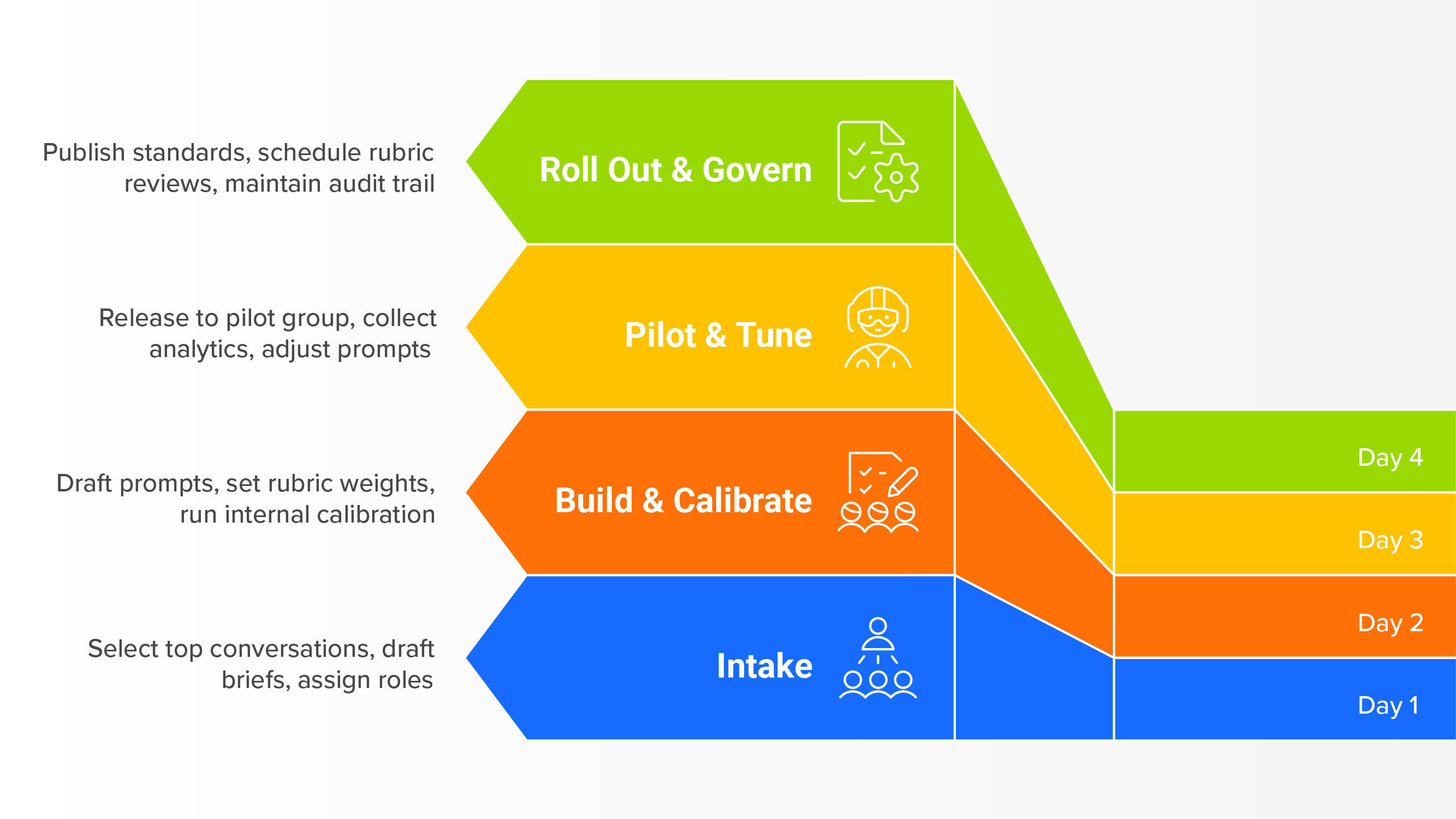
Phase it in three stages, and end each stage with a go or no-go decision on criteria everyone agreed on before it started.

Three phases, two gates. Agree on the gate criteria before each phase begins.
Phase 1: One Affiliate, One Brand, One Use Case
Tie the pilot to a date that won't move, such as a launch or the next POA meeting, so practice has a deadline. Agree on the go criteria on day one, such as the share of reps who complete a scored attempt and the score gain over their attempts. Keep the scenario set small enough to revise every week.
Phase 2: Two or Three Affiliates That Differ From the Pilot
Pick affiliates that differ from the pilot in language or review process, and include the one you expect to be hardest. A wave of easy markets tells you little about the next one. Record every adaptation each affiliate makes and why, because those notes become the template for the next wave.
Phase 3: A Global Standard That Affiliates Adapt
Lock the core scenarios and scoring rubrics at the global level. Give affiliates written rights over the parts they own, and add the remaining markets in waves. Once the standard holds, add onboarding as a use case; the pharma sales rep onboarding checklist covers the full program.
Once AI governance has the vendor's written answer on model training, request a demo and test the six capabilities with your own team.
How Do You Adapt One Scenario for Each Affiliate?
Start every scenario as a global master. Each affiliate adapts only the parts it owns, and the global team checks that the core message and rubric are unchanged. Local reviewers then approve the version that reps will see.
Part of the scenario | Global team | Affiliate team |
|---|---|---|
Core message | Owns and approves | Uses as approved |
Scoring rubric | Owns | Proposes changes |
Company-wide compliance rules | Owns | Applies |
Claims and required statements | Sets the structure | Matches them to the local label and code |
Persona and language | Sets the template | Adapts for the market |
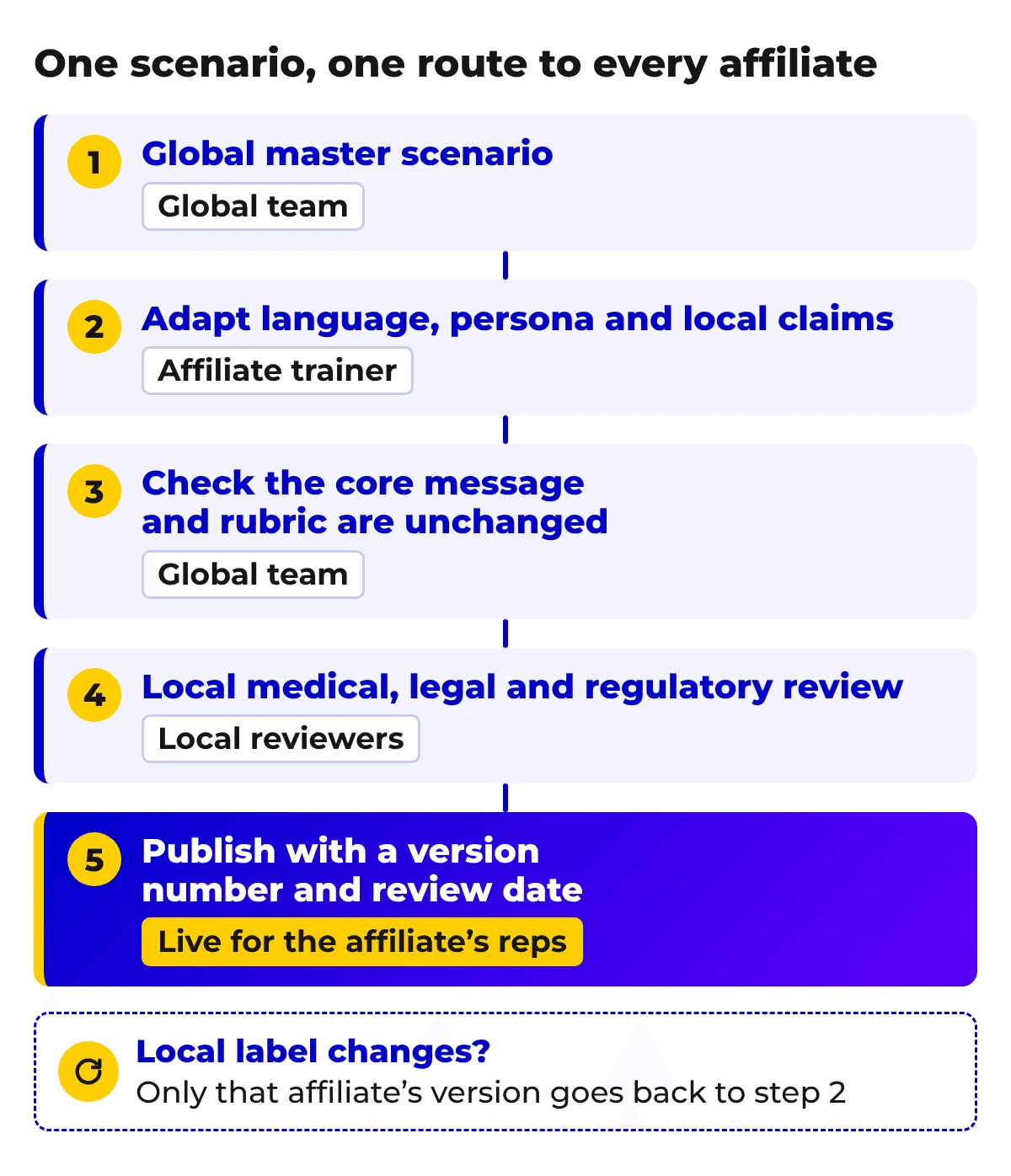
One route from the global master to every affiliate. Local reviewers see the final version, and each published version carries its review date.
Store each approved version with its review date, so an auditor in any market can see what reps practiced and who approved it. When a local label changes, only that affiliate's version goes back through review.
The card below is an illustrative sample of what an affiliate trainer fills in before the global check.

Illustrative adaptation card. The core message and rubric stay global, while register, care setting and local wording change.
The register field makes the trainer choose between du and Sie before anyone reviews the scenario.
How Do You Measure Readiness the Same Way in Every Market?
Agree on one definition for each metric before the first wave, and have every affiliate report it the same way. If the definitions differ, the comparison between markets is noise.
Metric | Definition to agree on | Review |
|---|---|---|
Participation | Share of assigned reps with at least one scored attempt in the period | Monthly during waves |
Score gain | Change between a rep's first attempt and most recent attempt on the same scenario | Monthly |
Time to certification | Days from assignment to a passed certification attempt | Each launch or POA cycle |
Coaching coverage | Share of reps who got manager feedback within the agreed window | Monthly |
Required statements | Share of certification attempts that include every required statement | Each cycle |
A score only compares across markets if it means the same thing in each. A 4 on objection handling in Madrid should equal a 4 in Chicago. Before scores feed any certification, ask managers from several regions to score the same recordings in a language they share, such as English. Compare their scores criterion by criterion, agree on example answers for each level, then rescore a sample to check that the scores have moved closer. Repeat the exercise in each other language with managers who speak it.

Calibrate before scores count toward certification. Repeat it when an affiliate joins or the rubric changes.
Check the AI's scores the same way. In each language, compare its scores on a sample of attempts with your managers' scores before the AI's score counts toward certification.
What Slows a Global Rollout, and How Do You Plan for It?
Plan for four things that can slow a rollout: manager time across time zones, connectivity in the field, local review queues and markets that are new to AI practice.

Four slowdowns, and a plan for each.
Manager Time Across Time Zones
Asynchronous review lets a regional manager in London score a rep in Singapore without a live call. Set a feedback window, such as 48 hours, and report it as part of coaching coverage.
Connectivity in the Field
Reps practice between appointments, often on a phone. Run a test session on a weak connection and check that it picks up where it dropped.
Local Review Queues
Every adapted scenario needs time with local reviewers. Ask each affiliate how long a review usually takes, and set the practice start date for each wave from that answer.
Markets New to AI Practice
Start with an affiliate champion, a manager or trainer who uses the platform first and shows peers their own results. Present practice as preparation for the next real HCP conversation.
Where Does SmartWinnr Fit?
SmartWinnr's pharma page describes its certification tracking, learning paths and audit-ready records as built for global teams across multiple brands and regions. Hold us to the same six tests. The table sets each one against what SmartWinnr's product pages describe, and what to confirm in your demo.
Test | What SmartWinnr's pages describe | Confirm in the demo |
|---|---|---|
Language depth | AI Roleplay supports multiple languages | Your markets' languages, with scoring and feedback in each |
Compliance at more than one level | Managers set required statements and pass gates, define weighted rubrics and control what the avatar can say | How company, brand and affiliate rules sit apart |
Affiliate authoring | Trainers upload talk tracks and clinical PDFs and choose personas | Whether affiliate trainers can adapt a scenario, and how changes are logged |
Version history | Reps get an explainable score, a transcript, missed-statement flags and an auditable trail | Which scenario version each attempt used |
Reporting by affiliate | Field Coaching shows coverage, frequency and skill trends by rep, team and region | A rollup by affiliate |
Data handling | SSO, role-based access, encryption and audit trails | Hosting region, and a written answer on model training |

One scenario in SmartWinnr, from approved content to coaching.
Targeted Learning adds personalized journeys by role, region and product, and managers can assign more practice from the coaching timeline. Integrating AI coaching and role-based learning paths shows how the two fit together. Ask how completions would reach your LMS, since that depends on your setup.
Plan Your Global Rollout
Download the rollout planner, a one-page checklist of the approvals, phase gates, adaptation steps and metric definitions for your first wave. When you're ready to test the six capabilities, request a demo.
Frequently Asked Questions
What decides how long a global AI Roleplay rollout takes?
Three things decide it: how many waves you need, how long each affiliate's local review takes, and the launch or POA dates you tie each wave to. Plan each wave from those three, with a go or no-go decision at its end.
How many languages should the platform support?
Every language your reps use with HCPs, including regional variants such as Canadian French. Test the persona, the scoring and the feedback in each one before you sign.
Do local reviewers need to approve AI Roleplay scenarios?
Plan on yes. Because the persona's lines are generated in the conversation, agree with each affiliate's reviewers on what they approve, such as the source content, the persona brief, the required statements and the feedback wording.
Can affiliates change the scoring rubric?
They can propose changes, and the global team decides, so that a score means the same thing in every market. Recalibrate with managers from several regions whenever the rubric changes.
Who should own a global rollout?
Global commercial training owns the program and the core scenarios, and each affiliate owns its local versions. IT security, legal and compliance and AI governance sign off before the pilot. Privacy and HR check each new country, local reviewers approve every adapted scenario, and procurement joins at the contract stage.
Disclaimer: This content reflects industry practices and does not constitute medical, legal, or regulatory advice.
Last Updated: