

Smart AI Blog Summary
Get a quick blog summary from any of the below LLM's
What You'll Learn
AI Roleplay for compliance training lets reps rehearse the conversations where one sentence carries regulatory risk, before they have them with customers. A persona brings the moment, such as a physician asking about an unapproved use or a surgeon mentioning a device that failed during a case, and a rubric your Compliance team approves scores what the rep says.
Scored practice adds evidence of what reps say when a customer pushes, alongside the policy modules and attestations they already complete. It can also show which required statements each rep delivered or missed.
This guide is for commercial training leaders in pharma and sales training leaders in medtech who build that practice with Compliance. Plan for review time before the first rep practices, since each scenario and its feedback go to your reviewers first.
Which Compliance Conversations Should Reps Rehearse?
Rehearse the moments your Compliance team corrects most often, plus any moment that starts a reporting clock. The five below come up in pharma and medtech alike, with different words and referral routes in each.
Moment | Pharma example | Medtech example | What the rep must do |
|---|---|---|---|
A question about an unapproved use | A physician asks whether the drug works in teenagers | A surgeon asks, mid-case, about using the device outside its cleared indication | Stay on label and offer to send the question to Medical Information (pharma) or Medical Affairs (medtech) |
A benefit claim | The rep presents an efficacy result | The rep compares outcomes with another device | Deliver the risk or safety statements your review board approved for that claim |
Safety information in passing | A physician mentions a patient's rash | A surgeon mentions a catheter that kinked during a case | Take the details and forward them under your adverse event or complaint procedure |
A request your interactions policy limits | An office asks for a meal the policy doesn't allow | A surgeon's team asks for a dinner the policy doesn't allow | Decline in plain words and offer what the policy allows |
Patient information | A physician reads details from a patient's chart | OR staff ask the rep to text a photo of a patient's imaging | Keep patient details out of notes and messages |
Three of these moments have FDA texts behind them. FDA's 2011 draft guidance on unsolicited requests for off-label information, which covers drugs and devices, recommends that off-label questions go to the firm's medical or scientific department. For prescription drug advertisements, 21 CFR 202.1 calls for a fair balance between side effect and effectiveness information; your review board decides which risk statements a rep delivers with each claim. Under 21 CFR 314.80, a drug company reviews adverse event information it receives from any source, including commercial marketing, and reports serious, unexpected events within 15 calendar days of first receipt. For devices, 21 CFR 803.3 treats a manufacturer as aware of an event that needs a 30-day report once any employee is.
The other two moments follow industry codes and your own policies. The PhRMA Code and the AdvaMed Code guide interactions with US health care professionals, and AdvaMed's revisions, effective November 1, 2025, add guidance on protecting patient privacy. Each scenario then tests the specifics in your company's policy.
How Do You Build a Compliance Scenario?
Build one scenario per moment, and write its gates before you write the persona. The gates say what Compliance needs to see. The persona's job is to make that moment arrive the way it does in the field.
A persona brief for a compliance scenario holds six things:
Who the customer is and where the call happens, from an office visit to case coverage in the OR.
What the customer wants from the call, so the conversation has a purpose of its own.
The trigger line that brings the moment, placed after the rep has started the message.
One push-back line for a rep who handles the first ask well.
What the persona must never say, for example clinical claims beyond your approved content.
The approved content it draws on: the prescribing information or IFU, plus the policy summary.
Write safety mentions the way they come up in a busy call, inside a question about something else. A rash mentioned on the way to a question about the copay card tests whether the rep notices it at all. Give every patient in a scenario invented details, so no practice recording holds real patient information.

An illustrative scenario card in demo data, for a side effect mentioned in passing during a pharma office call.
How Should You Score It?
Score each scenario with gates, which fail the attempt when any one is missed, and with weighted criteria like accuracy and tone for the rest of the call.
Write each gate as an action a reviewer can find in the transcript, such as "told the physician the rash will be reported under the adverse event procedure." A criterion that needs a judgment call about tone belongs in the weighted part.
Off-label scenarios need a gate for what the rep must avoid. FDA's draft guidance treats a request as solicited when a sales rep mentions an unapproved use and invites the physician to ask for more. A rep who hints at "some interesting data in younger patients" fails that gate, however clean the referral that follows.
Give each missed gate feedback in words the rep can use on the next attempt, and send those words through review with the rest of the scenario. Compliance decides what follows a miss, for example coaching and a retake, and your pass threshold decides when an attempt counts toward certification.

An illustrative scored transcript in demo data. The rep meets two gates and misses the third by suggesting a dose change.
To plan your own scenario, use the one-page worksheet at the end of this guide, or request a demo to see a scenario scored against gates.
Who Approves the Scenario Before Reps Practice?
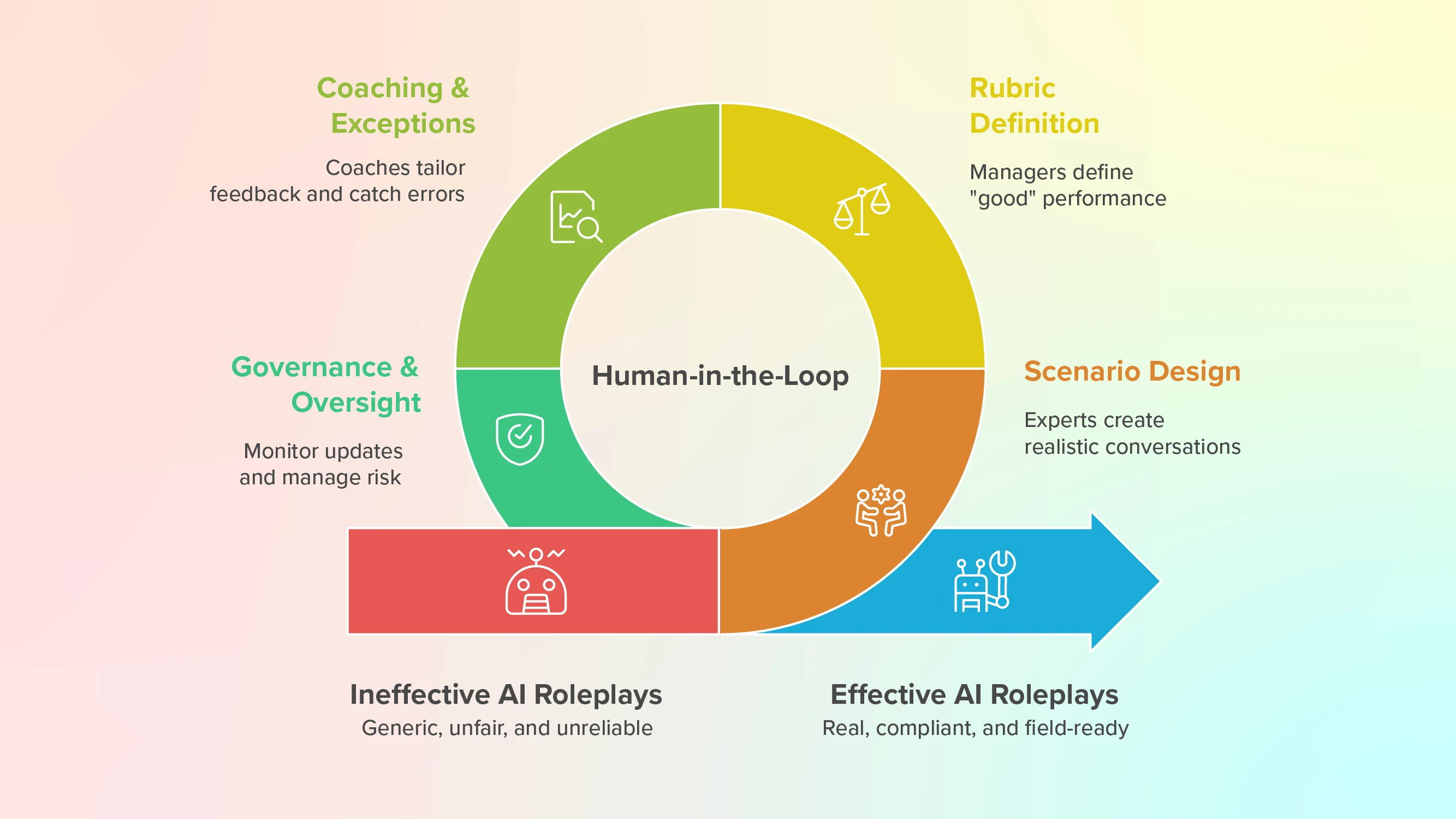
Compliance, the medical and safety teams who own referrals and reporting, your review board (called MLR or PRC depending on the company) and Privacy each approve part of a compliance scenario, in that order, before any rep practices it. In medtech, add Quality when certification records count as training records under your quality system.
Compliance sets the gates, the pass threshold and what happens after a miss. Medical Information or Medical Affairs approves the referral wording, and drug safety (pharma) or complaint handling (medtech) approves the reporting steps. The review board then approves the persona brief, required statements, model answers and feedback wording. Privacy approves how attempts are recorded and who can see them, and Quality follows in medtech. IT security and AI governance review the platform once, before the first scenario.
Plan for at least one round of changes. If your reviewers haven't seen AI Roleplay content before, walk them through one sample attempt first. A pilot with a few experienced reps comes last and catches persona lines that don't sound like the field.

The order of reviews for one compliance scenario, from Compliance's gates to a pilot with experienced reps.
What Should the Practice Record Show an Auditor?
Each attempt's record should show the rep, the scenario and its version, the date, the score, each gate met or missed, the transcript, and what followed, whether coaching or a retake.
The version matters most when something changes. After a label update or a policy change, a record that names the scenario version shows which standard each rep met.
Agree on retention and access with Compliance and Privacy before the first recording. Decide which parts you keep, from scores to full recordings, and for how long. Then decide who sees what, and tell reps how their recordings are used before they start.

An illustrative practice record in demo data for a medtech clinical specialist, from a missed gate to a passed retake.
How Do You Roll It Out and Use the Results?
Start with one moment and one team. Certify on the cadence your compliance calendar sets, and add or update a scenario whenever a label, an indication, a policy or an SOP changes.
Report pass rates for each gate by district or region, and read the pattern two ways. When one gate is low in every district, check the guidance first. A policy that says "refer the question" with no approved words for the referral leaves every rep improvising. When one district is low on every gate, look at coaching in that district.

An illustrative first-round readout in demo data. The referral gate is low in every district, and one district is low on every gate.
Take the gate pattern to Compliance each quarter. The fix may be a clearer policy line or an approved referral sentence.
What Do These Scenarios Look Like in Pharma and Medtech?
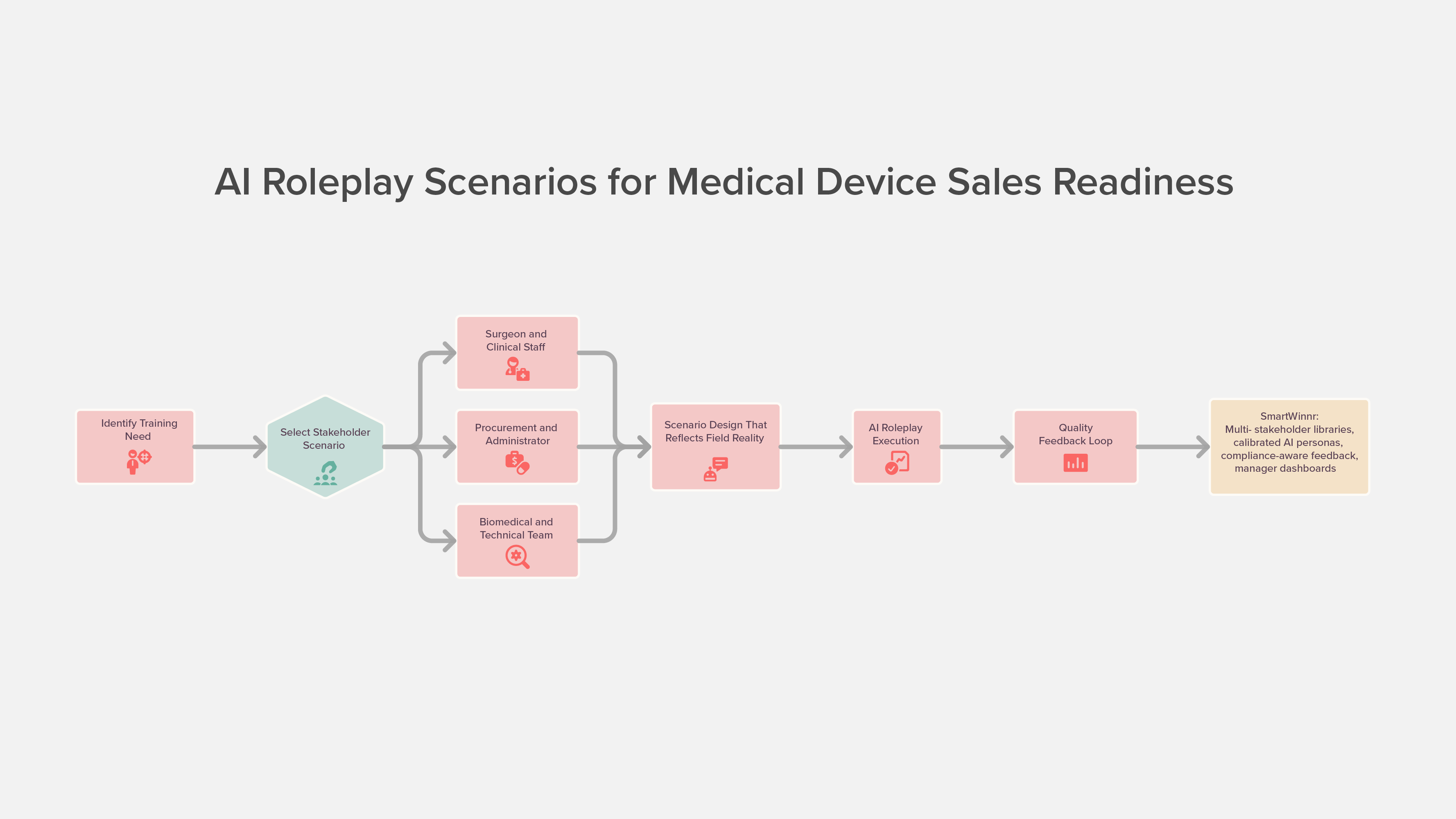
In pharma, the first example rehearses an off-label question in an office call; in medtech, the second rehearses a device problem raised mid-case. Both are hypothetical, and each shows the moment, its gates and what follows a miss.
Example: An Off-Label Question in a Pharma Office Call
Imagine a brand team whose drug is approved for adults only. The persona, an endocrinologist, asks whether anyone has tried the drug in teenagers, then pushes once: "You must have heard something from other offices." The gates require the rep to stay on label and offer to send the question to Medical Information, without inviting more.
In the first round, most misses land on the referral gate. The reps who miss it decline the question correctly and never offer the referral, because the policy summary gives them no words for it. Medical Information approves one referral sentence, and the review board adds it to the model answer. The second round shows whether the gap closed.
Example: A Device Problem Mentioned Mid-Case in Medtech
Imagine a medtech franchise whose clinical specialists cover cases in the OR. Mid-case, the surgeon persona says the catheter in the last case kinked during insertion, then asks about the next step of the procedure. The gates require the specialist to say the problem will be reported and to log a complaint, with the device and case details, under the company's procedure.
Complaint handling decides whether an event is reportable. Because 21 CFR 803.3 counts any employee's awareness as the company's for 30-day reports, the gate checks what the specialist does in the moment. Specialists who miss a gate get coaching and a retake inside the certification window.

An illustrative flow for the medtech example. The specialist's two gates sit in the OR, and complaint handling decides what gets reported.
For the clinical objections around these moments, see how pharma organizations scale HCP objection readiness and how medtech teams handle clinical objections in medical device sales.
Where Does SmartWinnr Fit?
SmartWinnr's AI Roleplay builds practice from your approved clinical and messaging content. The middle column below quotes SmartWinnr's product pages for each step, and the last column lists what to check.
Step | In SmartWinnr | Confirm in the demo |
|---|---|---|
Build the scenario | Trainers "choose personas, upload talk tracks and clinical PDFs, set pass thresholds, and decide how scoring works" | Whether a persona can hold its trigger line until mid-call |
Score with gates | "Managers set required statements and pass gates, define weighted rubrics, and control what the avatar can say" | Whether missing one pass gate fails the attempt |
Claims and safety statements | For pharma, AI Roleplay "built around approved safety statements"; for medical devices, "the session flags prohibited or unbalanced claims and stores audit-ready records" | Which statements and claim lists your team can load |
Record each attempt | Reps see "an explainable score, a transcript, missed-statement flags, and an auditable trail that compliance teams can review" | Whether each attempt keeps its scenario version, and the retention settings |
Report results | "Readiness analytics show time to first pass, skill-level scores, keyword coverage, and trends by team and region" | Pass rates by gate and district |
Set up that way, the side-effect scenario in this guide becomes a physician persona built from your prescribing information, pass gates for reporting the rash, taking the details and giving no treatment advice, and a weighted rubric for the rest of the call. On a joint visit, Field Coaching lets a manager score the rep on a shared form and assign an AI Roleplay, a SmartQuiz or a short lesson. If you're still comparing platforms, compliant sales coaching in pharma covers what to test.
Plan Your First Compliance Scenario
Download the compliance scenario worksheet (PDF). It fits one scenario's persona brief, gates, sign-offs and record fields on a single page. To see a compliance scenario scored against gates, request a demo.
Frequently Asked Questions
Should MSLs Practice the Same Scenarios?
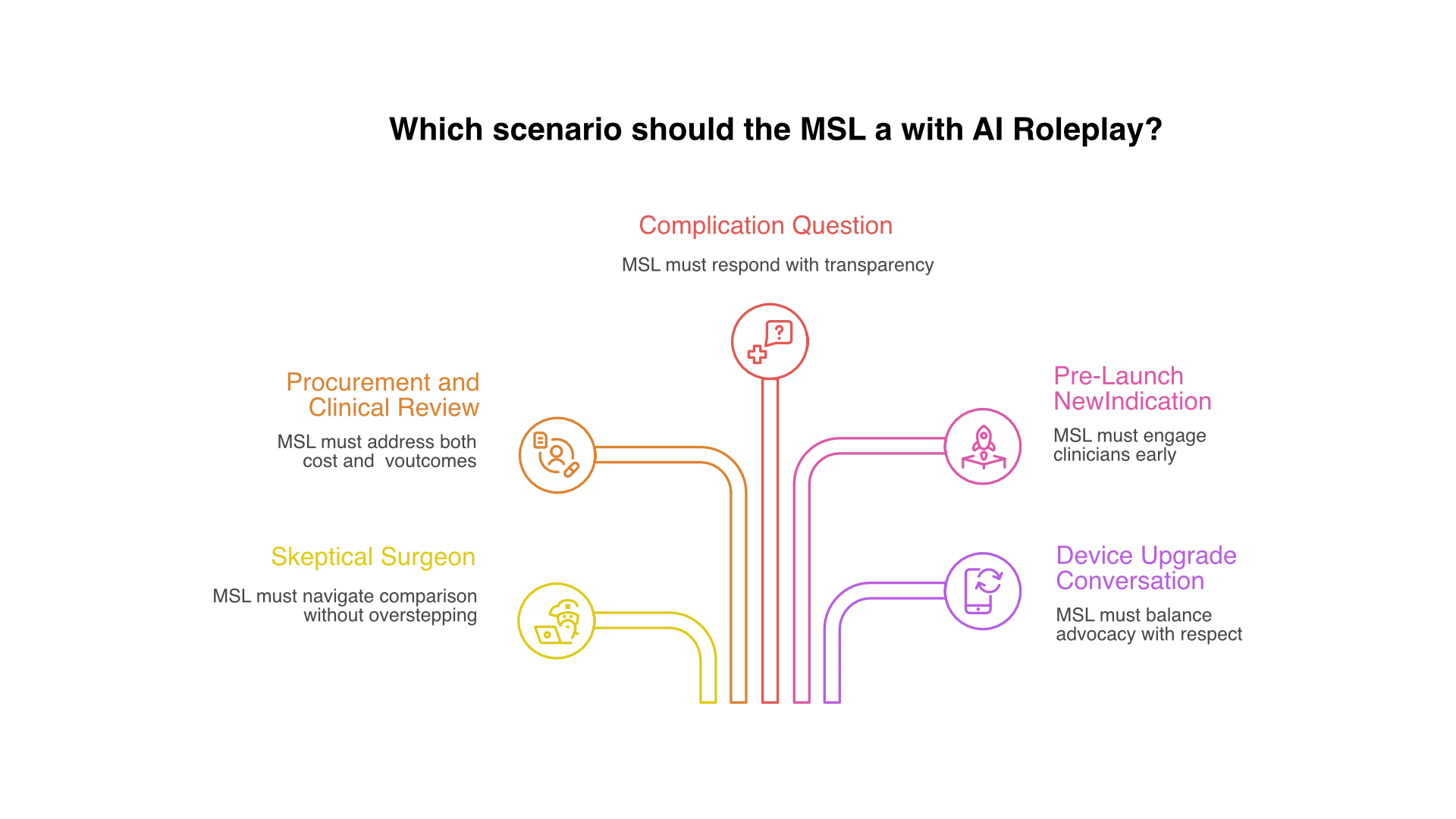
No. MSLs sit in Medical Affairs and are non-promotional, so their conversations about unapproved uses follow different rules. Build their scenarios separately, with Medical Affairs and its own review.
Who Should Write Compliance Scenarios?
A trainer drafts each one with a compliance partner on the gates and an experienced rep or field manager on the persona's lines. The reviewers above approve it, and the pilot group tests it before release.
Who Practices a Scenario Before Release?
A pilot group of a few experienced reps, after the reviews and before release. Their attempts test the persona and the gates, so they don't count toward certification. This content reflects industry practices and does not constitute medical, legal, or regulatory advice.
Disclaimer: This content reflects industry practices and does not constitute medical, legal, or regulatory advice.
Last Updated: